

2024 The Most Effective CKA with 68 Questions Answers
Try Free and Start Using Realistic Verified CKA Dumps Instantly.
The CKA certification is ideal for IT professionals who work with Kubernetes and want to demonstrate their proficiency in the field. CKA exam is vendor-neutral, meaning it is not tied to any particular cloud provider or Kubernetes distribution. As a result, the certification is widely recognized by employers and can help candidates stand out in a competitive job market. Additionally, the CKA certification can help organizations identify qualified Kubernetes administrators who can help them deploy and manage their containerized applications effectively.
NEW QUESTION # 32
Check the Image version of nginx-dev pod using jsonpath
Answer:
Explanation:
kubect1 get po nginx-dev -o
jsonpath='{.spec.containers[].image}{"\n"}'
NEW QUESTION # 33
Configure the kubelet systemd- managed service, on the node labelled with name=wk8s-node-1, to launch a pod containing a single container of Image httpd named webtool automatically. Any spec files required should be placed in the /etc/kubernetes/manifests directory on the node.
You can ssh to the appropriate node using:
[student@node-1] $ ssh wk8s-node-1
You can assume elevated privileges on the node with the following command:
[student@wk8s-node-1] $ | sudo -i
Answer:
Explanation:
See the solution below.
Explanation
solution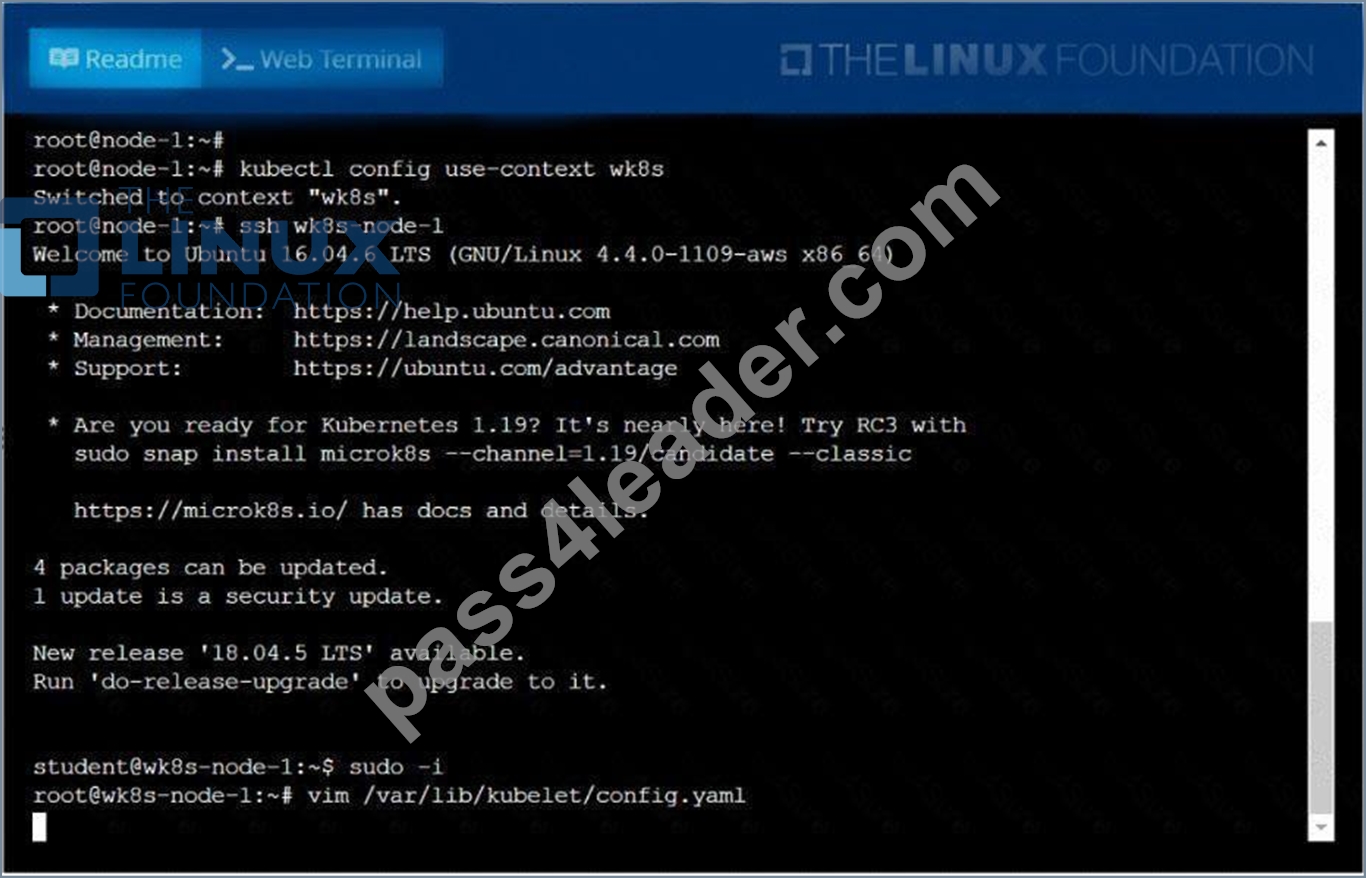


NEW QUESTION # 34
Score: 4%
Task
Schedule a pod as follows:
* Name: nginx-kusc00401
* Image: nginx
* Node selector: disk=ssd
Answer:
Explanation:
Solution:
#yaml
apiVersion: v1
kind: Pod
metadata:
name: nginx-kusc00401
spec:
containers:
- name: nginx
image: nginx
imagePullPolicy: IfNotPresent
nodeSelector:
disk: spinning
#
kubectl create -f node-select.yaml
NEW QUESTION # 35
Create a pod as follows:
* Name:non-persistent-redis
* container Image:redis
* Volume with name:cache-control
* Mount path:/data/redis
The pod should launch in thestagingnamespace and the volumemust notbe persistent.
Answer:
Explanation:
See the solution below.
Explanation
solution


NEW QUESTION # 36
Score: 7%
Task
Reconfigure the existing deployment front-end and add a port specification named http exposing port 80/tcp of the existing container nginx.
Create a new service named front-end-svc exposing the container port http.
Configure the new service to also expose the individual Pods via a NodePort on the nodes on which they are scheduled.
Answer:
Explanation:
See the solution below.
Explanation
Solution:
kubectl get deploy front-end
kubectl edit deploy front-end -o yaml
#port specification named http
#service.yaml
apiVersion: v1
kind: Service
metadata:
name: front-end-svc
labels:
app: nginx
spec:
ports:
- port: 80
protocol: tcp
name: http
selector:
app: nginx
type: NodePort
# kubectl create -f service.yaml
# kubectl get svc
# port specification named http
kubectl expose deployment front-end --name=front-end-svc --port=80 --tarport=80 --type=NodePort
NEW QUESTION # 37
Create a pod with environment variables as var1=value1.Check the environment variable in pod
- A. kubectl run nginx --image=nginx --restart=Never --env=var1=value1
# then
kubectl exec -it nginx -- env
# or
kubectl exec -it nginx -- sh -c 'echo $var1'
# or
kubectl describe po nginx | grep value1 - B. kubectl run nginx --image=nginx --restart=Never --env=var1=value1
# then
kubectl exec -it nginx -- env
# or
kubectl describe po nginx | grep value1
Answer: A
NEW QUESTION # 38
Create a hostPath PersistentVolume named task-pv-volume with storage 10Gi, access modes ReadWriteOnce, storageClassName manual, and volume at /mnt/data and verify
- A. vim task-pv-volume.yaml
apiVersion: v1
kind: PersistentVolume
metadata:
name: task-pv-volume
labels:
type: local
spec:
storageClassName: ""
capacity:
storage: 5Gi
accessModes:
- ReadWriteOnce
hostPath:
path: "/mnt/data"
kubectl apply -f task-pv-volume.yaml
//Verify
kubectl get pv
NAME CAPACITY ACCESS
MODES RECLAIM POLICY STATUS CLAIM
STORAGECLASS REASON AGE
task-pv-volume 5Gi RWO
Retain Available
3s - B. vim task-pv-volume.yaml
apiVersion: v1
kind: PersistentVolume
metadata:
name: task-pv-volume
labels:
type: local
spec:
storageClassName: ""
capacity:
storage: 5Gi
accessModes:
- ReadWriteOnce
hostPath:
path: "/mnt/data"
kubectl apply -f task-pv-volume.yaml
//Verify
kubectl get pv
NAME CAPACITY ACCESS
MODES RECLAIM POLICY STATUS CLAIM
STORAGECLASS REASON AGE
task-pv-volume 4Gi RWO
Retain Available
8s
Answer: A
NEW QUESTION # 39
Print pod name and start time to "/opt/pod-status" file
Answer:
Explanation:
kubect1 get pods -o=jsonpath='{range .items[*]}{.metadata.name}{"\t"}{.status.podIP}{"\n"}{end}'
NEW QUESTION # 40
Install a kubernetes cluster with one master and one worker using kubeadm
- A. This is a straightforward question, you need to install kubernetes cluster using kubeadm with one master and one worker.
Refer : https://kubernetes.io/docs/setup/production-environment/tools/kubeadm/ - B. This is a straightforward question, you need to install kubernetes cluster using kubeadm with one master and one worker.
Installation is considered success once both master and worker
nodes become available.
Refer : https://kubernetes.io/docs/setup/production-environment/tools/kubeadm/
Answer: B
NEW QUESTION # 41
Configure the kubelet systemd- managed service, on the node labelled with name=wk8s-node-1, to launch a pod containing a single container of Image httpd named webtool automatically. Any spec files required should be placed in the /etc/kubernetes/manifests directory on the node.
You can ssh to the appropriate node using:
[student@node-1] $ ssh wk8s-node-1
You can assume elevated privileges on the node with the following command:
[student@wk8s-node-1] $ | sudo -i
Answer:
Explanation:
solution


NEW QUESTION # 42
Create the nginx pod with version 1.17.4 and expose it on port 80
Answer:
Explanation:
kubectl run nginx --image=nginx:1.17.4 --restart=Never -- port=80
NEW QUESTION # 43
Check to see how many worker nodes are ready (not including nodes tainted NoSchedule) and write the number to /opt/KUCC00104/kucc00104.txt.
Answer:
Explanation:
See the solution below.
Explanation
solution
F:\Work\Data Entry Work\Data Entry\20200827\CKA\15 B.JPG
F:\Work\Data Entry Work\Data Entry\20200827\CKA\15 C.JPG
NEW QUESTION # 44
For this item, you will have to ssh and complete all tasks on these
nodes. Ensure that you return to the base node (hostname: ) when you have completed this item.
Context
As an administrator of a small development team, you have been asked to set up a Kubernetes cluster to test the viability of a new application.
Task
You must use kubeadm to perform this task. Any kubeadm invocations will require the use of the
--ignore-preflight-errors=all option.
Configure the node ik8s-master-O as a master node. .
Join the node ik8s-node-o to the cluster.
Answer:
Explanation:
See the solution below.
Explanation
solution
You must use the kubeadm configuration file located at /etc/kubeadm.conf when initializingyour cluster.
You may use any CNI plugin to complete this task, but if you don't have your favourite CNI plugin's manifest URL at hand, Calico is one popular option:
https://docs.projectcalico.org/v3.14/manifests/calico.yaml
Docker is already installed on both nodes and apt has been configured so that you can install the required tools.
NEW QUESTION # 45
Create a pod named kucc8 with a single app container for each of the following images running inside (there may be between 1 and 4 images specified):
nginx + redis + memcached.
Answer:
Explanation:
solution


NEW QUESTION # 46
Modify "hello-job" and make it run 10 times one after one and 5 times parallelism: 5
- A. kubectl create job hello-job --image=busybox --dry-run -o yaml
-- echo "Hello I am from job" > hello-job.yaml
// edit the yaml file to add completions: 10 and
kubectl create -f hello-job.yaml
YAML File:
apiVersion: batch/v1
kind: Job
metadata:
name: hello-job
spec:
completions: 10
parallelism: 5
template:
metadata:
spec:
containers:
- command:
- echo
- Hello I am from job
image: busybox
name: hello-job
restartPolicy: Never - B. kubectl create job hello-job --image=busybox --dry-run -o yaml
-- echo "Hello I am from job" > hello-job.yaml
// edit the yaml file to add completions: 16 and
kubectl create -f hello-job.yaml
YAML File:
apiVersion: batch/v1
kind: Job
metadata:
name: hello-job
spec:
completions: 16
parallelism: 5
template:
metadata:
spec:
containers:
- command:
- echo
- Hello I am from job
image: busybox
name: hello-job
restartPolicy: Never
Answer: A
NEW QUESTION # 47
Get list of all the pods showing name and namespace with a jsonpath expression.
Answer:
Explanation:
See the solution below.
Explanation
kubectl get pods -o=jsonpath="{.items[*]['metadata.name'
, 'metadata.namespace']}"
NEW QUESTION # 48
Create a Cronjob with busybox image that prints date and hello from kubernetes cluster message for every minute
- A. CronJob Syntax:
* --> Minute
* --> Hours
* --> Day of The Month
* --> Month
* --> Day of the Week
*/1 * * * * --> Execute a command every one minutes.
vim date-job.yaml
apiVersion: batch/v1beta1
kind: CronJob
metadata:
name: date-job
spec:
schedule: "*/1 * * * *"
jobTemplate:
spec:
template:
spec:
containers:
- name: hello
image: busybox
args:
- /bin/sh
- -c
- date; echo Hello from the Kubernetes cluster
restartPolicy: OnFailure
kubectl apply -f date-job.yaml
//Verify
kubectl get cj date-job -o yaml - B. CronJob Syntax:
* --> Minute
* --> Hours
* --> Day of The Month
* --> Month
* --> Day of the Week
*/1 * * * * --> Execute a command every one minutes.
vim date-job.yaml
apiVersion: batch/v1beta1
kind: CronJob
metadata:
name: date-job
spec:
schedule: "*/1 * * * *"
jobTemplate:
spec:
template:
- /bin/sh
- -c
- date; echo Hello from the Kubernetes cluster
restartPolicy: OnFailure
kubectl apply -f date-job.yaml
//Verify
kubectl get cj date-job -o yaml
Answer: A
NEW QUESTION # 49
Create a file called "config.txt" with two values key1=value1
and key2=value2. Then create a configmap named "keyvalcfgmap" andread data from the file "config.txt" and verify that configmap is created correctly
- A. cat >> config.txt << EOF
key1=value1
key2=value2
EOF
kubectl create cm keyvalcfgmap --from-file=config.txt
//Verify
kubectl get cm keyvalcfgmap -o yaml - B. cat >> config.txt << EOF
key1=value1
key2=value2
EOF
cat config.txt
// Create configmap from "config.txt" file
kubectl create cm keyvalcfgmap --from-file=config.txt
//Verify
kubectl get cm keyvalcfgmap -o yaml
Answer: B
NEW QUESTION # 50
Create a deployment spec file that will:
Launch 7 replicas of the nginx Image with the label app_runtime_stage=dev deployment name: kual00201 Save a copy of this spec file to /opt/KUAL00201/spec_deployment.yaml (or /opt/KUAL00201/spec_deployment.json).
When you are done, clean up (delete) any new Kubernetes API object that you produced during this task.
Answer:
Explanation:
solution

NEW QUESTION # 51
Resume the rollout of the deployment
Answer:
Explanation:
kubectl rollout resume deploy webapp
NEW QUESTION # 52
......
Download Free Latest Exam CKA Certified Sample Questions: https://www.pass4leader.com/Linux-Foundation/CKA-exam.html
CKA Actual Questions - Instant Download 68 Questions: https://drive.google.com/open?id=1L9nmeT9aaNze9i_r-GYXsVkkOh4jgN2H