

2023 Current CKA dumps Preparation through Our Practice Test
100% Reliable Microsoft CKA Exam Dumps Test Pdf Exam Material
CNCF CKA Certification Exam Prep Materials
You can find the test materials that are available to help you prepare for the CNCF CKA Certification Exam. Pass4Leader has the CNCF CKA Certification Exam questions and answers. There is a basic question and answer format to the materials. The competition has made this exam harder to pass, which means that students will need to be well prepared for it. A guarantee will be available to help you pass the CNCF CKA Certification Exam. CNCF CKA exam dumps have been prepared by experts to help students prepare for the CNCF CKA Certification Exam. Online certification exams will be required and must be completed before you can register for the exam. The materials that are available will only be found on the website. Support will be available if you have questions while you are studying for the CNCF CKA Certification Exam. The materials that are available will help you pass your exams without a problem. Study guides will help students study for the CNCF CKA Certification Exam. Updated information will be available to help students understand the concepts that they are learning about.
Self-paced study will be ideal for people who have busy schedules and can not spend a lot of time studying. Success in the exam will be guaranteed. Money back guarantee will be provided to help you make a decision on what to choose. Path will be available for the CNCF CKA Certification Exam. One of the ways students can make decisions is through having access to real time statistics. The CNCF CKA Certification Exam will determine whether you are successful or not. Security and confidentiality will be provided to help you succeed. The CNCF CKA Certification Exam can either be done online or in person. Ensure that the information you are studying for is right in order to get the right results. Pod will be available for the CNCF CKA Certification Exam. Networking will be available for the CNCF CKA Certification Exam. Service is important for the CNCF CKA Certification Exam.
The CKA Program Certification Exam consists of a set of performance-based tasks that candidates must complete within a given time frame. The exam covers a broad range of topics, including cluster architecture, installation and configuration, networking, storage, troubleshooting, and security. Candidates are expected to demonstrate their ability to perform tasks such as deploying applications, scaling and upgrading clusters, configuring network policies, troubleshooting node and cluster problems, and securing Kubernetes clusters.
NEW QUESTION # 26
Check to see how many worker nodes are ready (not including nodes tainted NoSchedule) and write the number to /opt/KUCC00104/kucc00104.txt.
Answer:
Explanation:
See the solution below.
Explanation
solution

NEW QUESTION # 27
A Kubernetes worker node, named wk8s-node-0 is in state NotReady. Investigate why this is the case, and perform any appropriate steps to bring the node to a Ready state, ensuring that any changes are made permanent.
You can ssh to the failed node using:
[student@node-1] $ | ssh Wk8s-node-0
You can assume elevated privileges on the node with the following command:
[student@w8ks-node-0] $ | sudo -i
Answer:
Explanation:
See the solution below.
Explanation
solution


NEW QUESTION # 28
Given a partially-functioning Kubernetes cluster, identify symptoms of failure on the cluster.
Determine the node, the failing service, and take actions to bring up the failed service and restore the health of the cluster. Ensure that any changes are made permanently.
You can ssh to the relevant I nodes (
[student@node-1] $ ssh <nodename
You can assume elevated privileges on any node in the cluster with the following command:
[student@nodename] $ | sudo -i
Answer:
Explanation:
See the solution below.
Explanation
solution
F:\Work\Data Entry Work\Data Entry\20200827\CKA\23 C.JPG
F:\Work\Data Entry Work\Data Entry\20200827\CKA\23 D.JPG
F:\Work\Data Entry Work\Data Entry\20200827\CKA\23 E.JPG
NEW QUESTION # 29
Create a deployment as follows:
* Name: nginx-random
* Exposed via a service nginx-random
* Ensure that the service & pod are accessible via their respective DNS records
* The container(s) within any pod(s) running as a part of this deployment should use the nginx Image Next, use the utility nslookup to look up the DNS records of the service & pod and write the output to
/opt/KUNW00601/service.dns and /opt/KUNW00601/pod.dns respectively.
Answer:
Explanation:
See the solution below.
Explanation
Solution:


NEW QUESTION # 30
Create a Kubernetes secret as follows:
Name: super-secret
password: bob
Create a pod named pod-secrets-via-file, using the redis Image, which mounts a secret named super-secret at
/secrets.
Create a second pod named pod-secrets-via-env, using the redis Image, which exports password as CONFIDENTIAL
Answer:
Explanation:
See the solution below.
Explanation
solution
F:\Work\Data Entry Work\Data Entry\20200827\CKA\12 B.JPG
F:\Work\Data Entry Work\Data Entry\20200827\CKA\12 C.JPG
F:\Work\Data Entry Work\Data Entry\20200827\CKA\12 D.JPG
NEW QUESTION # 31
Create a pod as follows:
Name: mongo
Using Image: mongo
In a new Kubernetes namespace named: my-website
Answer:
Explanation:
solution
NEW QUESTION # 32
Ensure a single instance of pod nginx is running on each node of the Kubernetes cluster where nginx also represents the Image name which has to be used. Do not override any taints currently in place.
Use DaemonSet to complete this task and use ds-kusc00201 as DaemonSet name.
Answer:
Explanation:
See the solution below.
Explanation
solution
F:\Work\Data Entry Work\Data Entry\20200827\CKA\3 B.JPG
F:\Work\Data Entry Work\Data Entry\20200827\CKA\3 C.JPG
F:\Work\Data Entry Work\Data Entry\20200827\CKA\3 D.JPG
F:\Work\Data Entry Work\Data Entry\20200827\CKA\3 E.JPG
NEW QUESTION # 33
Undo the deployment with the previous version and verify
everything is Ok
Answer:
Explanation:
kubectl rollout undo deploy webapp kubectl rollout status deploy webapp kubectl get pods
NEW QUESTION # 34
Create a Pod with main container busybox and which executes this
"while true; do echo 'Hi I am from Main container' >>
/var/log/index.html; sleep 5; done" and with sidecar container
with nginx image which exposes on port 80. Use emptyDir Volume
and mount this volume on path /var/log for busybox and on path
/usr/share/nginx/html for nginx container. Verify both containers
are running.
- A. // create an initial yaml file with this
kubectl run multi-cont-pod --image=busbox --restart=Never --
dry-run -o yaml > multi-container.yaml
// edit the yml as below and create it
kubectl create -f multi-container.yaml
vim multi-container.yaml
apiVersion: v1
kind: Pod
metadata:
labels:
run: multi-cont-pod
name: multi-cont-pod
spec:
volumes:
- name: var-logs
emptyDir: {}
containers:
- image: busybox
command: ["/bin/sh"]
args: ["-c", "while true; do echo 'Hi I am from Main
container' >> /var/log/index.html; sleep 5;done"]
name: main-container
volumeMounts:
- name: var-logs
mountPath: /var/log
- image: nginx
name: sidecar-container
ports:
- containerPort: 80
volumeMounts:
- name: var-logs
mountPath: /usr/share/nginx/html
restartPolicy: Never
// Create Pod
kubectl apply -f multi-container.yaml
//Verify
kubectl get pods - B. // create an initial yaml file with this
kubectl run multi-cont-pod --image=busbox --restart=Never --
dry-run -o yaml > multi-container.yaml
// edit the yml as below and create it
kubectl create -f multi-container.yaml
vim multi-container.yaml
apiVersion: v1
kind: Pod
metadata:
labels:
run: multi-cont-pod
name: multi-cont-pod
spec:
volumes:
- image: busybox
command: ["/bin/sh"]
args: ["-c", "while true; do echo 'Hi I am from Main
container' >> /var/log/index.html; sleep 5;done"]
name: main-container
volumeMounts:
- name: var-logs
mountPath: /var/log
- image: nginx
name: sidecar-container
ports:
mountPath: /usr/share/nginx/html
restartPolicy: Never
// Create Pod
kubectl apply -f multi-container.yaml
//Verify
kubectl get pods
Answer: A
NEW QUESTION # 35
Score:7%
Task
Create a new PersistentVolumeClaim
* Name: pv-volume
* Class: csi-hostpath-sc
* Capacity: 10Mi
Create a new Pod which mounts the PersistentVolumeClaim as a volume:
* Name: web-server
* Image: nginx
* Mount path: /usr/share/nginx/html
Configure the new Pod to have ReadWriteOnce access on the volume.
Finally, using kubectl edit or kubectl patch expand the PersistentVolumeClaim to a capacity of 70Mi and record that change.
Answer:
Explanation:
Solution:
vi pvc.yaml
storageclass pvc
apiVersion: v1
kind: PersistentVolumeClaim
metadata:
name: pv-volume
spec:
accessModes:
- ReadWriteOnce
volumeMode: Filesystem
resources:
requests:
storage: 10Mi
storageClassName: csi-hostpath-sc
# vi pod-pvc.yaml
apiVersion: v1
kind: Pod
metadata:
name: web-server
spec:
containers:
- name: web-server
image: nginx
volumeMounts:
- mountPath: "/usr/share/nginx/html"
name: my-volume
volumes:
- name: my-volume
persistentVolumeClaim:
claimName: pv-volume
# craete
kubectl create -f pod-pvc.yaml
#edit
kubectl edit pvc pv-volume --record
NEW QUESTION # 36
A bootstrap USB flash drive has been prepared using a Windows workstation to load the initial configuration of a Palo Alto Networks firewall that was previously being used in a lab. The USB flash drive was formatted using file system FAT32 and the initial configuration is stored in a file named init-cfg.txt. The firewall is currently running PAN-OS 10.0 and using a lab config. The contents of init-cgf.txt in the USB flash drive are as follows:
type=dhcp-client
Ip-address=
default-gateway=
netmask=
Ipv6-address=
Ipv6-default-gateway=
hostname=Ca-FW-DC1
panorama-server=10.5.107.20
panorama-server-2=10.5.107.21
tplname=FINANCE_TG4
dgname=finance_dg
dns-primary=10.5.6.6
dns-secondary=10.5.6.7
op-command-modes-multi-vsys.jumbo-frame
dhcp-send-hostname=yes
dhcp-send-client-id=yes
dhcp-accept-server-hostname=yes
dhcp-accept-server-domain=yes
The USB flash drive has been inserted in the firewalls' USB port, and the firewall has been restarted using command> request restart system Upon restart, the firewall fails to begin the bootstrapping process. The failure is caused because:
- A. Firewall must be in factory default state or have all private data deleted for bootstrapping
- B. The hostname is a required parameter, but it is missing in init-cfg.txt
- C. The USB must be formatted using the exi3 file system, FAT32 is
- D. The bootstrap xml file is a required file, but it is missing
- E. PAN-OS version must be 9.1 x at a minimum, but the firewall is running 10.0x
Answer: C
NEW QUESTION # 37
Score: 4%
Task
Set the node named ek8s-node-1 as unavailable and reschedule all the pods running on it.
Answer:
Explanation:
SOLUTION:
[student@node-1] > ssh ek8s
kubectl cordon ek8s-node-1
kubectl drain ek8s-node-1 --delete-local-data --ignore-daemonsets --force
NEW QUESTION # 38
List pod logs named "frontend" and search for the pattern "started" and write it to a file "/opt/error-logs"
Answer:
Explanation:
See the solution below.
Explanation
Kubectl logs frontend | grep -i "started" > /opt/error-logs
NEW QUESTION # 39
Get the pods with label env=dev and output the labels
Answer:
Explanation:
kubectl get pods -l env=dev --show-labels
NEW QUESTION # 40
Score: 7%
Task
Given an existing Kubernetes cluster running version 1.20.0, upgrade all of the Kubernetes control plane and node components on the master node only to version 1.20.1.
Be sure to drain the master node before upgrading it and uncordon it after the upgrade.
You are also expected to upgrade kubelet and kubectl on the master node.
Answer:
Explanation:
See the solution below.
Explanation
SOLUTION:
[student@node-1] > ssh ek8s
kubectl cordon k8s-master
kubectl drain k8s-master --delete-local-data --ignore-daemonsets --force apt-get install kubeadm=1.20.1-00 kubelet=1.20.1-00 kubectl=1.20.1-00 --disableexcludes=kubernetes kubeadm upgrade apply 1.20.1 --etcd-upgrade=false systemctl daemon-reload systemctl restart kubelet kubectl uncordon k8s-master
NEW QUESTION # 41
Get list of all the pods showing name and namespace with a jsonpath expression.
Answer:
Explanation:
kubectl get pods -o=jsonpath="{.items[*]['metadata.name'
, 'metadata.namespace']}"
NEW QUESTION # 42
List all the pods sorted by name
Answer:
Explanation:
kubect1 get pods --sort-by=.metadata.name
NEW QUESTION # 43
Create a Kubernetes secret asfollows:
* Name: super-secret
* password: bob
Create a pod namedpod-secrets-via-file Image, which mounts a secret namedsuper-secretat
/secrets.
Create a second pod namedpod-secrets-via-env Image, which exportspasswordas CONFIDENTIAL
Answer:
Explanation:
See the solution below.
Explanation
solution


NEW QUESTION # 44
Undo the deployment to the previous version 1.17.1 and verify Image has the previous version
Answer:
Explanation:
kubectl rollout undo deploy webapp kubectl describe deploy webapp | grep Image
NEW QUESTION # 45
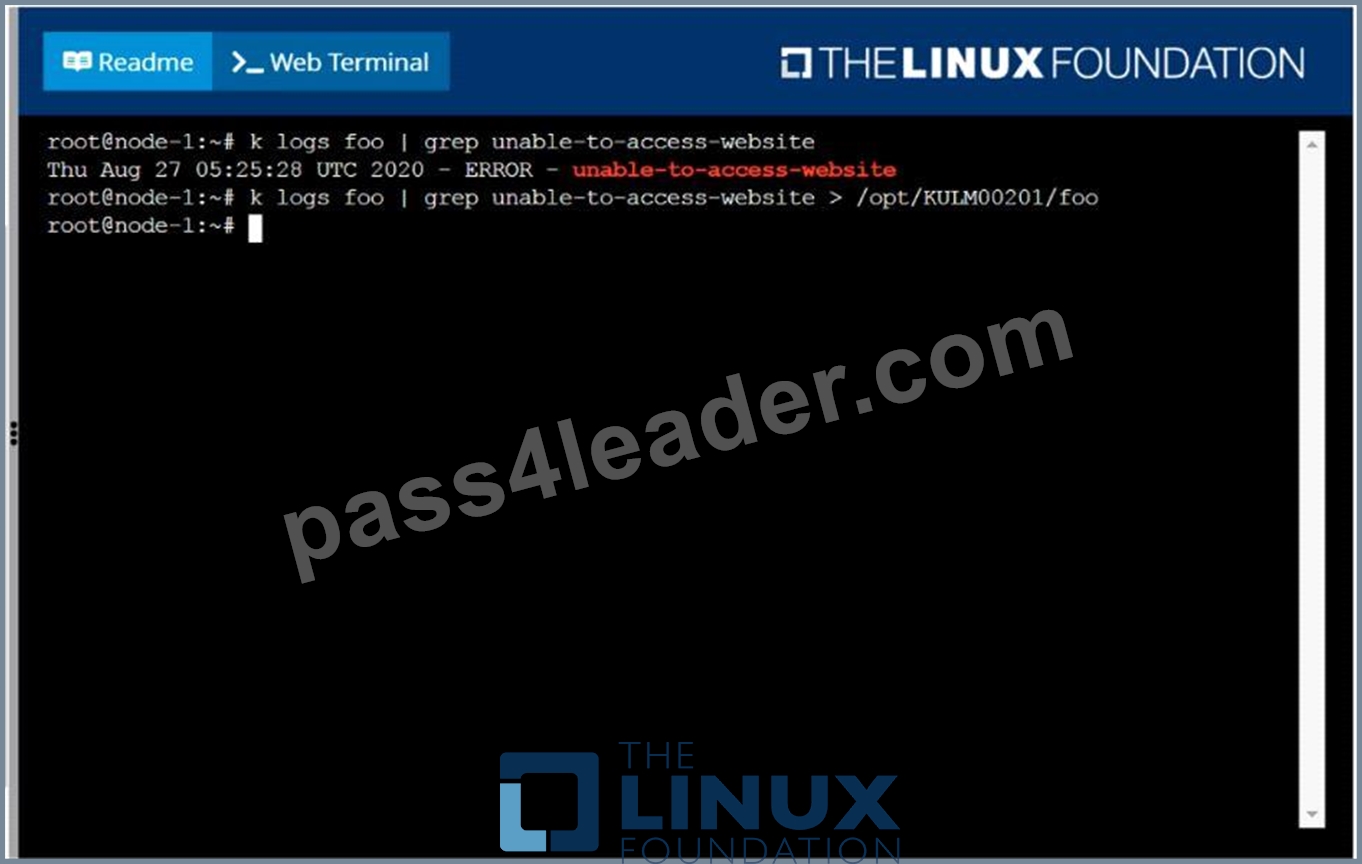
Monitor the logs of pod foo and:
Extract log lines corresponding to error
unable-to-access-website
Write them to /opt/KULM00201/foo
Answer:
Explanation:
solution
NEW QUESTION # 46
......
Free CKA Dumps are Available for Instant Access: https://www.pass4leader.com/Linux-Foundation/CKA-exam.html
Based on Official Syllabus Topics of Actual Linux Foundation CKA Exam: https://drive.google.com/open?id=1I8_oT-YeTgxxQOsMH5HMjaPAAQwZ9Tyd