

[May-2025] Exam Sure Pass The Open Group Certification with OGBA-101 exam questions
Real The Open Group OGBA-101 Exam Questions Study Guide
The Open Group OGBA-101 Exam Syllabus Topics:
| Topic | Details |
|---|---|
| Topic 1 |
|
| Topic 2 |
|
| Topic 3 |
|
| Topic 4 |
|
NEW QUESTION # 31
In business capability mapping, when you have documented all of the business capabilities, what should you do next?
- A. Organize the business capabilities in a logical manner.
- B. Draw up a business value assessment for each of the business capabilities.
- C. Identify the human and computer actors associated with each business capability.
- D. Map the business capabilities to stakeholder concerns.
Answer: A
Explanation:
In business capability mapping, once all business capabilities have been documented, the next step is to organize these capabilities logically. This organization helps in understanding how different capabilities interact and align with the business strategy. Here's a detailed explanation based on TOGAF principles:
Business Capability Mapping:
Business capability mapping involves identifying and documenting the capabilities required to execute the business strategy. Capabilities are the building blocks of the business, representing what the business does.
Logical Organization:
Grouping and Categorization: Capabilities should be grouped and categorized logically to reflect their relationships and dependencies. This can be done by aligning capabilities with business functions, processes, or strategic objectives.
Hierarchical Structure: Organizing capabilities into a hierarchical structure helps in visualizing how high-level capabilities decompose into more specific, detailed capabilities. This hierarchical view aids in understanding the complexity and scope of capabilities.
Alignment with Strategy: Logical organization ensures that capabilities are aligned with the business strategy and objectives. It helps in identifying which capabilities are critical for achieving strategic goals and which ones need development or improvement.
TOGAF ADM References:
Phase B: Business Architecture: This phase involves developing the business architecture, including capability mapping. Organizing capabilities logically is a key step in this process, as it helps in creating a coherent and comprehensive business architecture.
Capability Models: TOGAF recommends using capability models to represent the organization's capabilities.
These models should be logically organized to facilitate analysis and planning.
Practical Steps:
Analyze Relationships: Examine the relationships between capabilities to identify dependencies and interactions. This analysis helps in grouping related capabilities together.
Create a Capability Map: Develop a visual representation of the capabilities, organized logically. This map serves as a reference for understanding the business architecture and planning initiatives.
In summary, after documenting all business capabilities, organizing them in a logical manner is essential for creating a coherent and effective business architecture. This logical organization facilitates better analysis, planning, and alignment with business strategy.
NEW QUESTION # 32
Consider the diagram.
What are the items labelled A, B and C?
- A. A-Enterprise Architecture, B-Architecture Building Blocks, C-Solutions Building Blocks
- B. A-Enterprise Strategic Architecture, B-Segment Architecture, C-Solutions Architecture
- C. A-Architecture Vision, B-Business Architecture. C-lnformation Systems Architecture
- D. A-Enterprise Continuum, B-Architecture Continuum. C-Solutions Continuum
Answer: D
Explanation:
The diagram shows the Enterprise Continuum, which is a view of the Architecture Repository that provides methods for classifying architecture and solution artifacts as they evolve from generic Foundation Architectures to Organization-Specific Architectures4. The Enterprise Continuum comprises two complementary concepts: the Architecture Continuum and the Solutions Continuum. The Architecture Continuum shows the relationships among foundational frameworks, common system architectures, industry architectures, and enterprise architectures4. The Solutions Continuum shows the relationships among foundational solutions, common system solutions, industry solutions, and enterprise solutions4.
NEW QUESTION # 33
Which of the following best describes a TOGAF business scenario?
- A. A business case.
- B. A use-case providing detailed descriptions.
- C. A method to develop a business model.
- D. A technique to elaborate an architecture effort.
Answer: D
Explanation:
A TOGAF business scenario is a technique that can be used to fully understand the requirements of information technology and align it with business needs1. It is not a business case, which is a document that provides justification for a proposed project or initiative6. It is not a method to develop a business model, which is a description of how an organization creates, delivers, and captures value for its stakeholders7. It is not a use-case, which is a description of how a system interacts with external actors to achieve a specific goal.
A TOGAF business scenario is a technique that helps to derive architecture requirements by describing a business process, application, or set of activities. It includes detailing the actors, roles, goals, business policies, business processes, and the environment in which the scenario takes place. Business scenarios are used within TOGAF to ensure that the architecture has a clear link to the business requirements.
NEW QUESTION # 34
Consider the diagram of an architecture development cycle.
Which description matches the phase of the ADM labeled as item 2?
- A. Provides architectural oversight for the implementation
- B. Conducts Implementation planning for the architecture defined in previous phases
- C. Operates the process of managing architecture requirements
- D. Establishes procedures for managing change to the new architecture
Answer: A
Explanation:
The Architecture Development Method (ADM) is the core process of TOGAF which outlines a method for developing and managing the lifecycle of enterprise architecture. Considering the phases of the ADM, the item labeled as '2' in the provided architecture development cycle diagram likely corresponds to the
'Architecture Change Management' phase, which is responsible for providing ongoing architectural oversight and guidance to ensure that the implementation remains aligned with the architecture defined in the previous phases. This includes managing changes to the architecture in a controlled manner as the implementation progresses and ensuring that the architecture continues to meet the business needs.
NEW QUESTION # 35
Which statement best describes iteration and the ADM?
- A. The level of detail is defined once and applies to all iterations.
- B. The ADM is iterative between phases B to D, and between Phases E and F.
- C. The ADM is sequential. Iteration is applied within phases.
- D. The ADM is iterative, over the whole process, between phases, and within phases.
Answer: D
Explanation:
The statement that best describes iteration and the ADM is that the ADM is iterative, over the whole process, between phases, and within phases4. Iteration is a key concept in managing the complexity of developing an Enterprise Architecture and managing its lifecycle4. The ADM supports several forms of iteration as follows:
Iteration over the whole process: Projects will iterate through the entire ADM cycle, commencing with Phase A (Architecture Vision) and ending with Phase H (Architecture Change Management)4. Each cycle of the ADM will be bound by a Request for Architecture Work that defines the scope and objectives of the project4. The architecture output will populate or update the Architecture Landscape that describes the current and target states of the enterprise4.
Iteration between phases: Projects may cycle between ADM phases in planned cycles covering multiple phases4. Typically, this is used to converge on a detailed Target Architecture when higher-level architecture does not exist to provide context and constraint4. For example, a project may iterate between Phase B (Business Architecture), Phase C (Information Systems Architectures), and Phase D (Technology Architecture) until a satisfactory solution is achieved4.
Iteration within phases: Projects may return to previous activities within an ADM phase in order to circle back and update work products with new information4. Typically, this is used to manage the inter-relationship between different aspects of an architecture domain or viewpoint4. For example, a project may revisit Business Architecture models after developing Information Systems Architecture models to ensure alignment and consistency4.
NEW QUESTION # 36
Which step during development of a business scenario ensures that each iteration is managed as a mini-project?
- A. Reviewing Step
- B. Gathering Step
- C. Documenting Step
- D. Planning Step
Answer: D
Explanation:
The step during development of a business scenario that ensures that each iteration is managed as a mini-project is the Planning Step3. The Planning Step is a preparatory step that defines how to approach each iteration of developing a business scenario3. The Planning Step involves setting up a project team with clear roles and responsibilities, defining a project plan with milestones and deliverables, identifying stakeholders and their concerns, establishing communication channels and feedback mechanisms, and securing resources and budget3. The Planning Step can help to ensure that each iteration is managed as a mini-project with clear objectives, scope, schedule, quality criteria, risks, and issues.
NEW QUESTION # 37
What process is used to decompose a set of business capabilities to communicate more detail?
- A. Layering
- B. Leveling
- C. Mapping
- D. Sorting
Answer: B
Explanation:
The process used to decompose a set of business capabilities to communicate more detail is leveling6. Leveling is a technique that can be used to break down a business capability into sub-capabilities at lower levels of granularity6. Leveling can help to provide more clarity and specificity about what a business capability entails and how it supports the business goals and objectives6. Leveling can also help to identify dependencies, gaps, overlaps, or redundancies among business capabilities6.
NEW QUESTION # 38
Consider the following business capability map. where cells of a model are given different colors to represent desired maturity levels (Green (G) = level achieved, yellow (Y) = one level away, red (R) =two or more levels away, purple (P) = missing capability):
Which of the following best describes what this shows?
- A. The Strategic capabilities need more attention in two areas. Policy Management, and Government Relations Management. Agent Management is missing as a Core capability Information Management needs attention as a Supporting Capability.
- B. Agent Management needs immediate attention. Market Planning. Government Relations Management, and HR Management have Issues but are of lower priority Partner Management. Customer Management, and Training Management are new business capabilities that do not exist.
- C. Policy Management. Government Relations Management, and HR Management need immediate attention. Partner Management. Account Management, and Training Management have issues but are of lower priority Agent Management Is a new business capability that does not exist
- D. Agent Management needs immediate attention. Market Planning. HR Management and Government Relations Management need attention. Customer Management. Training Management and Partner Management need attention but are of lower priority.
Answer: C
Explanation:
The business capability map provided uses color coding to represent the maturity levels of various business capabilities in strategic, core, and supporting functions. The colors indicate the current state or priority for development, with red indicating capabilities that are significantly below desired maturity levels and thus require immediate attention. In this case, Policy Management, Government Relations Management, and HR Management are marked as red, signaling the need for urgent improvement. Yellow indicates capabilities that are closer to the desired state but still need attention, while green shows capabilities that have achieved the desired maturity level. Purple indicates a missing capability that does not currently exist in the enterprise, which is the case for Agent Management.
NEW QUESTION # 39
Which of the following is a purpose of mapping capabilities to value stream stages?
- A. To provide a self-contained business description that is independent of the organizational structure.
- B. To identify and eliminate business capabilities that do not contribute to the business.
- C. To classify, group, and align capabilities into categories for a deeper understanding.
- D. To describe the business in terms of services provided and consumed.
Answer: B
Explanation:
The purpose of this activity is to identify which business capabilities (out of the total set of capabilities) are critical to delivering stakeholder value, and therefore which ones need to be performed to a sufficient standard of quality to meet stakeholder expectations. It also helps to identify those business capabilities that do not contribute toward any of the core value streams, and which may be eliminated from the business.
The primary purpose of mapping capabilities to value stream stages within the TOGAF framework is to analyze how each capability contributes to delivering value to the customer. This process helps to identify:
* Capabilities essential for value creation:These are the capabilities that directly contribute to the activities within the value stream and are critical for delivering customer value.
* Capabilities with indirect or unclear contributions:These may require further investigation to determine their role in the value stream.
* Non-contributing capabilities:These capabilities do not play a role in the value stream and may be candidates for elimination or optimization to improve efficiency and reduce costs.
NEW QUESTION # 40
What is the relationship labeled Y?
- A. Enables
- B. Creates
- C. Consists of
- D. Receives
Answer: A
Explanation:
In TOGAF, the relationship labeled "Y" as "Enables" typically refers to how one element of the architecture facilitates or supports the functioning of another element. Here's a detailed explanation:
* Relationship Definition:
* Enables: This relationship indicates that one component (e.g., a business capability, process, or technology) enables or supports another component to function or achieve its objectives. It shows a dependency where the presence or effectiveness of one element is necessary for the other to perform effectively.
* Examples in TOGAF:
* Business Capabilities and Processes: A business capability may enable specific business processes. For instance, the capability of "Customer Relationship Management" enables processes like "Customer Support" and "Sales".
* Technology and Applications: A particular technology infrastructure may enable the operation of various business applications, ensuring they can deliver the required functionalities.
* TOGAF ADM Phases:
* Phase B: Business Architecture: Identifying how different business capabilities enable business processes helps in understanding the interdependencies and ensuring that all necessary capabilities are developed and supported.
* Phase C: Information Systems Architectures: In this phase, identifying how technology enables business applications and data flows is crucial for designing a coherent and efficient architecture.
* Importance:
* Understanding enabling relationships helps in ensuring that all necessary components are in place and functioning correctly to support the overall architecture. It also helps in identifying critical dependencies that need to be managed during implementation.
In summary, the relationship labeled "Enables" describes how one component facilitates or supports the functioning of another, ensuring that the architecture is coherent and all dependencies are managed effectively.
NEW QUESTION # 41
Complete the sentence. The TOGAF standard covers the development of four architecture domains. Business. Dat a. Technology and___________.
- A. Transition
- B. Capability
- C. Application
- D. Segment
Answer: C
Explanation:
The TOGAF standard covers the development of four architecture domains: Business, Data, Technology, and Application. The Application Architecture domain defines the applications required to process the data and support the business functions.
NEW QUESTION # 42
Consider the following example using the Business Model Canvas:
What are the segments labeled A, D and I?
- A. Customer Relationships, Value Propositions, Market Segments.
- B. Key Partners, Customer Relationships, Revenue Streams.
- C. Customer Segments, Value Add Services, Profit Channels.
- D. Key Resources. Revenue Streams. Cost Structure
Answer: B
Explanation:
The segments labeled A, D and I in the Business Model Canvas are Key Partners, Customer Relationships, and Revenue Streams respectively1. The Business Model Canvas is a tool that can be used to describe how an organization creates, delivers, and captures value for its stakeholders1. The Business Model Canvas consists of nine segments that cover four main areas: customers (segments B,C,D), offer (segment E), infrastructure (segments A,F,G), and financial viability (segments H,I)1. The segments are defined as follows:
Key Partners (segment A): The network of suppliers and partners that make the business model work1. Key partners can provide resources, activities, or support that enable the organization to offer its value proposition1.
Customer Relationships (segment D): The type of relationship that the organization establishes with its customer segments1. Customer relationships can be driven by customer acquisition, retention, or loyalty objectives1. Customer relationships can also influence the customer experience and satisfaction1.
Revenue Streams (segment I): The sources of income that the organization generates from each customer segment1. Revenue streams can be derived from different pricing mechanisms, such as asset sale, subscription, fee, commission, or advertising1. Revenue streams can also reflect the value that customers are willing to pay for the organization's offer1.
NEW QUESTION # 43
Complete the following sentence:
Presenting different ____ and ____ to stakeholders helps architects to extract hidden agendas, principles, and requirements that could impact the final Target Architecture.
- A. Business Scenarios, Business Models
- B. Architecture Views, Architecture Viewpoints
- C. Alternatives, Trade-offs
- D. Solutions, Applications
Answer: B
Explanation:
Presenting differentalternatives and trade-offsto stakeholders is a crucial technique in TOGAF for eliciting valuable feedback and refining the Target Architecture. This approach encourages stakeholders to actively participate in the architecture development process and express their preferences and concerns.
Here's why this approach is effective:
* Reveals hidden agendas:By presenting different options with varying implications, stakeholders may reveal priorities or concerns that were not explicitly stated before. This helps architects uncover hidden agendas that could influence the architecture's success.
* Uncovers underlying principles:Stakeholder reactions to different alternatives can reveal their underlying principles and values, providing insights into what they consider important in the architecture.
* Identifies unspoken requirements:Through discussions and comparisons of alternatives, stakeholders may express needs or requirements that were not captured during initial requirements gathering.
NEW QUESTION # 44
Consider the following output from Phase A:
What is this an example of?
- A. Capability Map
- B. Value Stream Map
- C. Organization Map
- D. Process Map
Answer: A
Explanation:
The diagram provided illustrates aCapability Map. Here's why:
* Focus on "what" the organization does:The diagram depicts various functions and activities that the organization performs, such as "Program/Human Resource Matching," "EmployeeSupply and Demand Mgmt," "Benefits Management," etc. These represent the capabilities of the organization, or what it is able to do.
* Hierarchical structure:The capabilities are organized hierarchically, with broader functions like "HR Mgmt." encompassing more specific capabilities like "Position Advertising" and "Skills Assessment." This shows how different capabilities relate to each other and contribute to higher-level functions.
* No specific process flow:Unlike a process map or value stream map, this diagram doesn't show a sequence of steps or flow of activities. It focuses on the capabilities themselves, not how they are executed
NEW QUESTION # 45
Consider the following example using the Business Model Canvas:
What are the segments labeled A, D and I?
- A. Customer Relationships, Value Propositions, Market Segments.
- B. Key Partners, Customer Relationships, Revenue Streams.
- C. Customer Segments, Value Add Services, Profit Channels.
- D. Key Resources. Revenue Streams. Cost Structure
Answer: B
Explanation:
The segments labeled A, D and I in the Business Model Canvas are Key Partners, Customer Relationships, and Revenue Streams respectively1. The Business ModelCanvas is a tool that can be used to describe how an organization creates, delivers, and captures value for its stakeholders1. The Business Model Canvas consists of nine segments that cover four main areas: customers (segments B,C,D), offer (segment E), infrastructure (segments A,F,G), and financial viability (segments H,I)1. The segments are defined as follows:
* Key Partners (segment A): The network of suppliers and partners that make the business model work1. Key partners can provide resources, activities, or support that enable the organization to offer its value proposition1.
* Customer Relationships (segment D): The type of relationship that the organization establishes with its customer segments1. Customer relationships can be driven by customer acquisition, retention, or loyalty objectives1. Customer relationships can also influence the customer experience and satisfaction1.
* Revenue Streams (segment I): The sources of income that the organization generates from each customer segment1. Revenue streams can be derived from different pricing mechanisms, such as asset sale, subscription, fee, commission, or advertising1. Revenue streams can also reflect the value that customers are willing to pay for the organization's offer1.
NEW QUESTION # 46
Which of the following best describes information mapping?
- A. A technique to create a maturity model for information management.
- B. A technique to construct a baseline description of the structure and interaction of information assets that support key business functions.
- C. A technique to represent business information assets in use, or planned by the enterprise.
- D. A technique to construct a high level description of the informational requirements of a business.
Answer: C
Explanation:
Information mapping in TOGAF is a technique used to represent business information assets that are either currently in use or planned for future use by the enterprise. Here's a detailed explanation:
Purpose of Information Mapping:
Information mapping provides a clear visualization of how information flows within the enterprise, highlighting the information assets and their interactions. This is crucial for understanding the current state and planning the future state of information management.
TOGAF Framework:
Phase C: Information Systems Architectures: Within this phase, information mapping is used to develop the Data Architecture, which outlines the structure of an organization's logical and physical data assets and data management resources.
Supporting Analysis: Information mapping supports various analyses, including gap analysis, impact analysis, and the identification of information dependencies and redundancies.
Benefits:
Clear Representation: It provides a clear and structured representation of business information assets, aiding in the understanding and management of information flows.
Alignment with Business Processes: Helps ensure that information assets are aligned with business processes and objectives, enhancing the efficiency and effectiveness of information usage.
Components:
Current Information Assets: Information mapping identifies and catalogs the information assets currently in use within the enterprise.
Planned Information Assets: It also includes planned information assets that will be needed to support future business processes and strategies.
In summary, information mapping is a technique to represent business information assets in use or planned by the enterprise, providing a structured view of information flows and supporting effective information management.
NEW QUESTION # 47
Consider the following:
You need to analyze a new value stream within the scope of a project.
Which of the following would you use?
- A. Combining information mapping with a business process model.
- B. An organization chart showing the business units that work with the enterprise and their value.
- C. Heat mapping by value stream stages.
- D. Converting the value stream stages to entities and then building a logical data model
Answer: A
Explanation:
To analyze a new value stream within the scope of a project, it is effective to combine information mapping with a business process model. This approach allows for a comprehensive understanding of the value stream, including the information required and produced at each stage, and how this information supports the business processes involved in delivering value.
NEW QUESTION # 48
Which of the following is a derived relationship in an organization map?
- A. Capability
- B. Location
- C. Value flow
- D. Scope of enterprise
Answer: C
Explanation:
According to the TOGAF Series Guide: Organization Mapping, one of the derived relationships in an organization map is value flow1. A value flow is a relationship that shows how value is exchanged between business units or other entities in an organization map1. A value flow can be expressed as a verb phrase that indicates what type of value is transferred or shared between entities1. For example, in an organization map for an online retailer, a possible value flow could be "Delivers products" between the Warehouse business unit and the Customer entity.
NEW QUESTION # 49
Complete the sentence. The architecture domains that are considered by the TOGAF standard as subsets of an overall enterprise architecture are Business, Technology,
- A. Logical and Physical
- B. Capability and Segment
- C. Application and Data
- D. Information and Data
Answer: C
Explanation:
In the TOGAF framework, the architecture domains considered as subsets of an overall enterprise architecture are Business, Technology, Application, and Data. Here's a detailed explanation:
* TOGAF Architecture Domains:
* Business Architecture: Describes the business strategy, governance, organization, and key business processes.
* Data Architecture: Defines the structure of an organization's logical and physical data assets and data management resources.
* Application Architecture: Provides a blueprint for the individual applications to be deployed, their interactions, and their relationships to the core business processes of the organization.
* Technology Architecture: Describes the logical software and hardware capabilities that are required to support the deployment of business, data, and application services.
* Importance of Each Domain:
* Business Architecture: Aligns the architecture with the business strategy and goals.
* Data Architecture: Ensures that data is structured and managed to support business processes and decisions.
* Application Architecture: Ensures that applications are designed and integrated to support business processes.
* Technology Architecture: Provides the technology infrastructure needed to support applications and data management.
* TOGAF References:
* Phase B: Business Architecture: Focuses on developing the Business Architecture.
* Phase C: Information Systems Architectures: This phase includes both Data Architecture and Application Architecture.
* Phase D: Technology Architecture: Focuses on developing the Technology Architecture.
In summary, the TOGAF standard considers Business, Technology, Application, and Data as the architecture domains that are subsets of an overall enterprise architecture.
NEW QUESTION # 50
Refer to the table below:
Which ADM Phase(s) does this describe?
- A. Preliminary Phase
- B. Phase E
- C. Phase B
- D. Phase B. C and D
Answer: D
Explanation:
The table describes the steps involved in Phase B (Business Architecture), Phase C (Information Systems Architectures), and Phase D (Technology Architecture) of the TOGAF ADM5. These phases are responsible for developing the target architectures for each domain and identifying the gaps between the baseline and target architectures. The table shows the outputs and outcomes of each phase, as well as the essential knowledge required for each phase.
NEW QUESTION # 51
What component of the Architecture Repository is an architectural representation of SBBs supporting the Architecture Landscape?
- A. Solutions Continuum
- B. Solutions Repository
- C. Solutions Library
- D. Solutions Landscape
Answer: D
Explanation:
The component of the Architecture Repository that is an architectural representation of SBBs supporting the Architecture Landscape is the Solutions Landscape3. The Solutions Landscape presents an architectural representation of the Solution Building Blocks (SBBs) that support the Architecture Landscape and have been planned or deployed by the enterprise3. The Solutions Landscape shows how SBBs are mapped to Architecture Building Blocks (ABBs) in different architecture domains and levels3. The Solutions Landscape can help to ensure consistency and alignment between the Architecture Landscape and the solutions that implement it.
NEW QUESTION # 52
When developing a Business Architecture, which of the following best describes the approach to take If no Architecture Descriptions exist?
- A. Identify the business goals, business objectives, and drivers for the enterprise
- B. Information should be gathered, and Business Architecture models developed.
- C. Validate the business principles and update the Statement of Architecture Work.
- D. Review the contents of the Architecture Repository.
Answer: B
Explanation:
In the absence of existing Architecture Descriptions, the development of a Business Architecture would begin with the gathering of relevant information about the business. This information can come from strategic documents, business plans, process documents, and stakeholder interviews, among other sources. Once gathered, this information would be used to create Business Architecture models that articulate the business vision, strategy, governance, organization, and key business processes. These models provide a blueprint that captures the essence of the business and guides subsequent architecture work.
NEW QUESTION # 53
Consider the following graphic illustrating a method supporting the TOGAF ADM.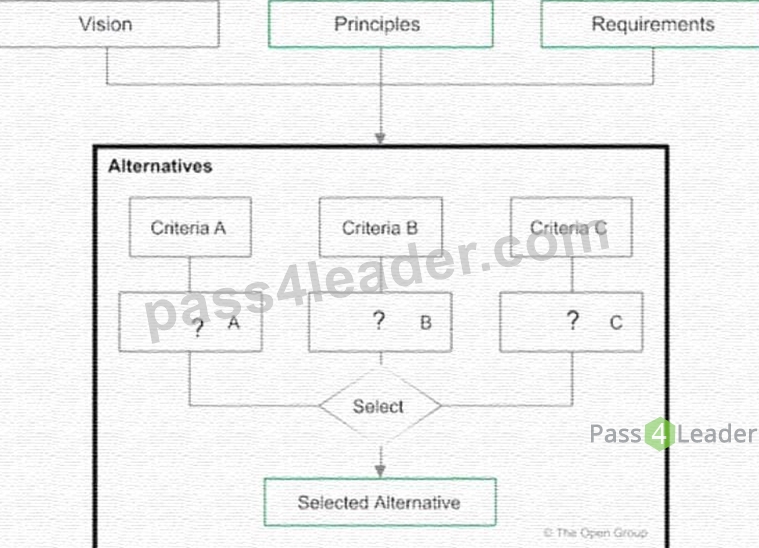
What does the method help identify?
- A. Business Scenarios
- B. Alternative Target Architectures
- C. Solution Building Blocks
- D. Architecture Solutions
Answer: B
Explanation:
The graphic illustrates a method for developing alternative target architectures in Phase E of the TOGAF ADM1. The method involves identifying and evaluating candidate architectures based on criteria such as business value, cost, risk, and feasibility1. The method helps to identify the most suitable architecture solution for the enterprise.
The graphic illustrates a method that supports the TOGAF ADM by identifying and evaluating alternative target architectures. The process begins with a vision, influenced by principles and requirements, leading to the consideration of alternatives. Each alternative is assessed based on different criteria, leading to the selection of the most suitable target architecture. This is consistent with the TOGAF approach of developing a set of potential architectures and then selecting the one that best meets the enterprise's needs.
NEW QUESTION # 54
......
Updated and Accurate OGBA-101 Questions for passing the exam Quickly: https://www.pass4leader.com/TheOpenGroup/OGBA-101-exam.html
Download Real OGBA-101 Exam Dumps for candidates. 100% Free Dump Files: https://drive.google.com/open?id=120iVUjW3y4KHSGA_ocMT1m--Uzw1jnqs