

[Oct-2021] Pass Microsoft DP-203 Exam in First Attempt Guaranteed!
Full DP-203 Practice Test and 149 unique questions with explanations waiting just for you, get it now!
NEW QUESTION 64
You have an Azure Data Lake Storage Gen2 container that contains 100 TB of data.
You need to ensure that the data in the container is available for read workloads in a secondary region if an outage occurs in the primary region. The solution must minimize costs.
Which type of data redundancy should you use?
- A. read-access geo-redundant storage (RA-GRS)
- B. geo-redundant storage (GRS)
- C. locally-redundant storage (LRS)
- D. zone-redundant storage (ZRS)
Answer: A
Explanation:
Geo-redundant storage (with GRS or GZRS) replicates your data to another physical location in the secondary region to protect against regional outages. However, that data is available to be read only if the customer or Microsoft initiates a failover from the primary to secondary region. When you enable read access to the secondary region, your data is available to be read at all times, including in a situation where the primary region becomes unavailable.
Reference:
https://docs.microsoft.com/en-us/azure/storage/common/storage-redundancy
NEW QUESTION 65
You need to create an Azure Data Factory pipeline to process data for the following three departments at your company: Ecommerce, retail, and wholesale. The solution must ensure that data can also be processed for the entire company.
How should you complete the Data Factory data flow script? To answer, drag the appropriate values to the correct targets. Each value may be used once, more than once, or not at all. You may need to drag the split bar between panes or scroll to view content.
NOTE: Each correct selection is worth one point.
Answer:
Explanation:
Reference:
https://docs.microsoft.com/en-us/azure/data-factory/data-flow-conditional-split
NEW QUESTION 66
You plan to create an Azure Synapse Analytics dedicated SQL pool.
You need to minimize the time it takes to identify queries that return confidential information as defined by the company's data privacy regulations and the users who executed the queues.
Which two components should you include in the solution? Each correct answer presents part of the solution.
NOTE: Each correct selection is worth one point.
- A. sensitivity-classification labels applied to columns that contain confidential information
- B. dynamic data masking for columns that contain confidential information
- C. resource tags for databases that contain confidential information
- D. audit logs sent to a Log Analytics workspace
Answer: A,D
Explanation:
A: You can classify columns manually, as an alternative or in addition to the recommendation-based classification:
1. Select Add classification in the top menu of the pane.
2. In the context window that opens, select the schema, table, and column that you want to classify, and the information type and sensitivity label.
3. Select Add classification at the bottom of the context window.
C: An important aspect of the information-protection paradigm is the ability to monitor access to sensitive data.
Azure SQL Auditing has been enhanced to include a new field in the audit log called data_sensitivity_information. This field logs the sensitivity classifications (labels) of the data that was returned by a query. Here's an example:
Reference:
https://docs.microsoft.com/en-us/azure/azure-sql/database/data-discovery-and-classification-overview
NEW QUESTION 67
You have two Azure Data Factory instances named ADFdev and ADFprod. ADFdev connects to an Azure DevOps Git repository.
You publish changes from the main branch of the Git repository to ADFdev.
You need to deploy the artifacts from ADFdev to ADFprod.
What should you do first?
- A. From ADFdev, create a linked service.
- B. From Azure DevOps, update the main branch.
- C. From Azure DevOps, create a release pipeline.
- D. From ADFdev, modify the Git configuration.
Answer: C
Explanation:
In Azure Data Factory, continuous integration and delivery (CI/CD) means moving Data Factory pipelines from one environment (development, test, production) to another.
Note:
The following is a guide for setting up an Azure Pipelines release that automates the deployment of a data factory to multiple environments.
In Azure DevOps, open the project that's configured with your data factory.
On the left side of the page, select Pipelines, and then select Releases.
Select New pipeline, or, if you have existing pipelines, select New and then New release pipeline.
In the Stage name box, enter the name of your environment.
Select Add artifact, and then select the git repository configured with your development data factory. Select the publish branch of the repository for the Default branch. By default, this publish branch is adf_publish.
Select the Empty job template.
Reference:
https://docs.microsoft.com/en-us/azure/data-factory/continuous-integration-deployment
NEW QUESTION 68
You have a C# application that process data from an Azure IoT hub and performs complex transformations.
You need to replace the application with a real-time solution. The solution must reuse as much code as possible from the existing application.
- A. Azure Databricks
- B. Azure Data Factory
- C. Azure Stream Analytics
- D. Azure Event Grid
Answer: C
Explanation:
Explanation
Azure Stream Analytics on IoT Edge empowers developers to deploy near-real-time analytical intelligence closer to IoT devices so that they can unlock the full value of device-generated data. UDF are available in C# for IoT Edge jobs Azure Stream Analytics on IoT Edge runs within the Azure IoT Edge framework. Once the job is created in Stream Analytics, you can deploy and manage it using IoT Hub.
References:
https://docs.microsoft.com/en-us/azure/stream-analytics/stream-analytics-edge
NEW QUESTION 69
You have an enterprise-wide Azure Data Lake Storage Gen2 account. The data lake is accessible only through an Azure virtual network named VNET1.
You are building a SQL pool in Azure Synapse that will use data from the data lake.
Your company has a sales team. All the members of the sales team are in an Azure Active Directory group named Sales. POSIX controls are used to assign the Sales group access to the files in the data lake.
You plan to load data to the SQL pool every hour.
You need to ensure that the SQL pool can load the sales data from the data lake.
Which three actions should you perform? Each correct answer presents part of the solution.
NOTE: Each area selection is worth one point.
- A. Create a shared access signature (SAS).
- B. Add your Azure Active Directory (Azure AD) account to the Sales group.
- C. Use the snared access signature (SAS) as the credentials for the data load process.
- D. Create a managed identity.
- E. Add the managed identity to the Sales group.
- F. Use the managed identity as the credentials for the data load process.
Answer: B,D,E
Explanation:
The managed identity grants permissions to the dedicated SQL pools in the workspace.
Note: Managed identity for Azure resources is a feature of Azure Active Directory. The feature provides Azure services with an automatically managed identity in Azure AD Reference:
https://docs.microsoft.com/en-us/azure/synapse-analytics/security/synapse-workspace-managed-identity
NEW QUESTION 70
You have an Azure Synapse Analytics dedicated SQL pool that contains the users shown in the following table.
User1 executes a query on the database, and the query returns the results shown in the following exhibit.
User1 is the only user who has access to the unmasked data.
Use the drop-down menus to select the answer choice that completes each statement based on the information presented in the graphic.
Answer:
Explanation:
NEW QUESTION 71
You have a SQL pool in Azure Synapse.
A user reports that queries against the pool take longer than expected to complete.
You need to add monitoring to the underlying storage to help diagnose the issue.
Which two metrics should you monitor? Each correct answer presents part of the solution.
NOTE: Each correct selection is worth one point.
- A. Active queries
- B. DWU Limit
- C. Cache used percentage
- D. Cache hit percentage
- E. Snapshot Storage Size
Answer: C,D
Explanation:
A: Cache used is the sum of all bytes in the local SSD cache across all nodes and cache capacity is the sum of the storage capacity of the local SSD cache across all nodes.
E: Cache hits is the sum of all columnstore segments hits in the local SSD cache and cache miss is the columnstore segments misses in the local SSD cache summed across all nodes Reference:
https://docs.microsoft.com/en-us/azure/synapse-analytics/sql-data-warehouse/sql-data-warehouse-concept-resource-utilization-query-activity
NEW QUESTION 72
You have an Azure Data Lake Storage account that has a virtual network service endpoint configured.
You plan to use Azure Data Factory to extract data from the Data Lake Storage account. The data will then be loaded to a data warehouse in Azure Synapse Analytics by using PolyBase.
Which authentication method should you use to access Data Lake Storage?
- A. service principal authentication
- B. account key authentication
- C. managed identity authentication
- D. shared access key authentication
Answer: C
Explanation:
Reference:
https://docs.microsoft.com/en-us/azure/data-factory/connector-azure-sql-data-warehouse#use-polybase-to-load-data-into-azure-sql-data-warehouse
NEW QUESTION 73
You have an Azure subscription that contains a logical Microsoft SQL server named Server1. Server1 hosts an Azure Synapse Analytics SQL dedicated pool named Pool1.
You need to recommend a Transparent Data Encryption (TDE) solution for Server1. The solution must meet the following requirements:
Track the usage of encryption keys.
Maintain the access of client apps to Pool1 in the event of an Azure datacenter outage that affects the availability of the encryption keys.
What should you include in the recommendation? To answer, select the appropriate options in the answer are a.
NOTE: Each correct selection is worth one point.
Answer:
Explanation:
Reference:
https://docs.microsoft.com/en-us/azure/synapse-analytics/security/workspaces-encryption
https://docs.microsoft.com/en-us/azure/key-vault/general/logging
NEW QUESTION 74
Note: This question is part of a series of questions that present the same scenario. Each question in the series contains a unique solution that might meet the stated goals. Some question sets might have more than one correct solution, while others might not have a correct solution.
After you answer a question in this section, you will NOT be able to return to it. As a result, these questions will not appear in the review screen.
You are designing an Azure Stream Analytics solution that will analyze Twitter dat a.
You need to count the tweets in each 10-second window. The solution must ensure that each tweet is counted only once.
Solution: You use a hopping window that uses a hop size of 10 seconds and a window size of 10 seconds.
Does this meet the goal?
- A. No
- B. Yes
Answer: A
Explanation:
Instead use a tumbling window. Tumbling windows are a series of fixed-sized, non-overlapping and contiguous time intervals.
Reference:
https://docs.microsoft.com/en-us/stream-analytics-query/tumbling-window-azure-stream-analytics
NEW QUESTION 75
You have an Azure event hub named retailhub that has 16 partitions. Transactions are posted to retailhub. Each transaction includes the transaction ID, the individual line items, and the payment details. The transaction ID is used as the partition key.
You are designing an Azure Stream Analytics job to identify potentially fraudulent transactions at a retail store. The job will use retailhub as the input. The job will output the transaction ID, the individual line items, the payment details, a fraud score, and a fraud indicator.
You plan to send the output to an Azure event hub named fraudhub.
You need to ensure that the fraud detection solution is highly scalable and processes transactions as quickly as possible.
How should you structure the output of the Stream Analytics job? To answer, select the appropriate options in the answer area.
NOTE: Each correct selection is worth one point.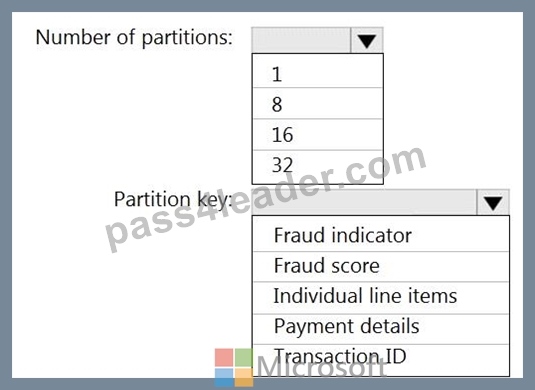
Answer:
Explanation:
Reference:
https://docs.microsoft.com/en-us/azure/event-hubs/event-hubs-features#partitions
NEW QUESTION 76
Note: This question is part of a series of questions that present the same scenario. Each question in the series contains a unique solution that might meet the stated goals. Some question sets might have more than one correct solution, while others might not have a correct solution.
After you answer a question in this scenario, you will NOT be able to return to it. As a result, these questions will not appear in the review screen.
You have an Azure Storage account that contains 100 GB of files. The files contain text and numerical values. 75% of the rows contain description data that has an average length of 1.1 MB.
You plan to copy the data from the storage account to an enterprise data warehouse in Azure Synapse Analytics.
You need to prepare the files to ensure that the data copies quickly.
Solution: You convert the files to compressed delimited text files.
Does this meet the goal?
- A. No
- B. Yes
Answer: B
Explanation:
All file formats have different performance characteristics. For the fastest load, use compressed delimited text files.
Reference:
https://docs.microsoft.com/en-us/azure/sql-data-warehouse/guidance-for-loading-data
NEW QUESTION 77
You are designing the folder structure for an Azure Data Lake Storage Gen2 container.
Users will query data by using a variety of services including Azure Databricks and Azure Synapse Analytics serverless SQL pools. The data will be secured by subject are a. Most queries will include data from the current year or current month.
Which folder structure should you recommend to support fast queries and simplified folder security?
- A. /{YYYY}/{MM}/{DD}/{SubjectArea}/{DataSource}/{FileData}_{YYYY}_{MM}_{DD}.csv
- B. /{SubjectArea}/{DataSource}/{YYYY}/{MM}/{DD}/{FileData}_{YYYY}_{MM}_{DD}.csv
- C. /{SubjectArea}/{DataSource}/{DD}/{MM}/{YYYY}/{FileData}_{YYYY}_{MM}_{DD}.csv
- D. /{DD}/{MM}/{YYYY}/{SubjectArea}/{DataSource}/{FileData}_{YYYY}_{MM}_{DD}.csv
Answer: B
Explanation:
There's an important reason to put the date at the end of the directory structure. If you want to lock down certain regions or subject matters to users/groups, then you can easily do so with the POSIX permissions. Otherwise, if there was a need to restrict a certain security group to viewing just the UK data or certain planes, with the date structure in front a separate permission would be required for numerous directories under every hour directory. Additionally, having the date structure in front would exponentially increase the number of directories as time went on.
Note: In IoT workloads, there can be a great deal of data being landed in the data store that spans across numerous products, devices, organizations, and customers. It's important to pre-plan the directory layout for organization, security, and efficient processing of the data for down-stream consumers. A general template to consider might be the following layout:
{Region}/{SubjectMatter(s)}/{yyyy}/{mm}/{dd}/{hh}/
NEW QUESTION 78
You implement an enterprise data warehouse in Azure Synapse Analytics.
You have a large fact table that is 10 terabytes (TB) in size.
Incoming queries use the primary key SaleKey column to retrieve data as displayed in the following table:
You need to distribute the large fact table across multiple nodes to optimize performance of the table.
Which technology should you use?
- A. round robin distributed table with clustered Columnstore index
- B. heap table with distribution replicate
- C. hash distributed table with clustered index
- D. round robin distributed table with clustered index
- E. hash distributed table with clustered Columnstore index
Answer: E
Explanation:
Hash-distributed tables improve query performance on large fact tables.
Columnstore indexes can achieve up to 100x better performance on analytics and data warehousing workloads and up to 10x better data compression than traditional rowstore indexes.
Incorrect Answers:
C, D: Round-robin tables are useful for improving loading speed.
Reference:
https://docs.microsoft.com/en-us/azure/sql-data-warehouse/sql-data-warehouse-tables-distribute
https://docs.microsoft.com/en-us/sql/relational-databases/indexes/columnstore-indexes-query-performance
NEW QUESTION 79
......
Prepare for your Microsoft certification with the updated Pass4Leader DP-203 exam questions: https://drive.google.com/open?id=1GrOpukVkQ03Mjl-4mYKI-5Sp6XlA6y8z
Get Latest DP-203 Dumps Exam Questions in here: https://www.pass4leader.com/Microsoft/DP-203-exam.html