

DP-203 Dumps with Practice Exam Questions Answers
DP-203 by Microsoft Certified: Azure Data Engineer Associate Actual Free Exam Practice Test
The Microsoft DP-203 exam is suitable for those who have experience with Microsoft Azure and want to specialize in data engineering. The exam covers a wide range of topics such as data processing, data storage, data transformation, and data integration. It tests the candidate's ability to design, implement, and monitor data processing solutions on Azure.
NEW QUESTION # 78
You have an Azure Data Lake Storage Gen2 account that contains a JSON file for customers. The file contains two attributes named FirstName and LastName.
You need to copy the data from the JSON file to an Azure Synapse Analytics table by using Azure Databricks.
A new column must be created that concatenates the FirstName and LastName values.
You create the following components:
* A destination table in Azure Synapse
* An Azure Blob storage container
* A service principal
In which order should you perform the actions? To answer, move the appropriate actions from the list of actions to the answer area and arrange them in the correct order.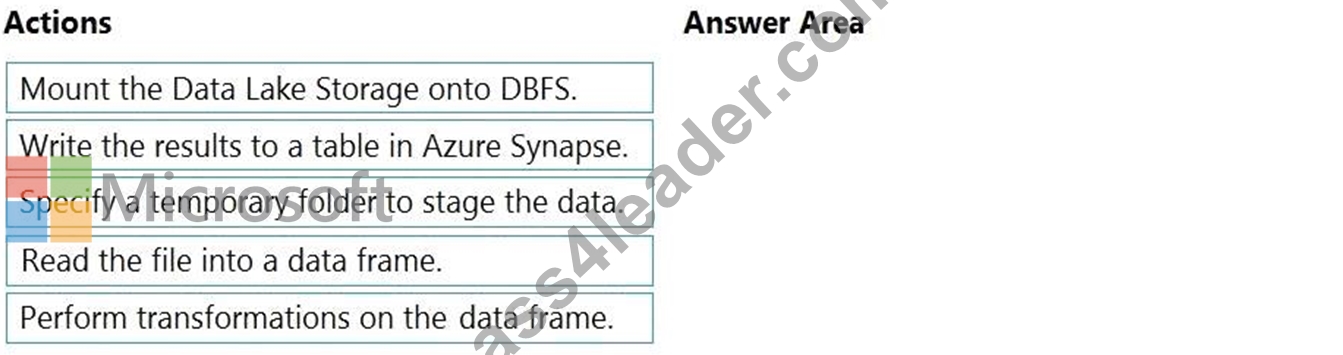
Answer:
Explanation: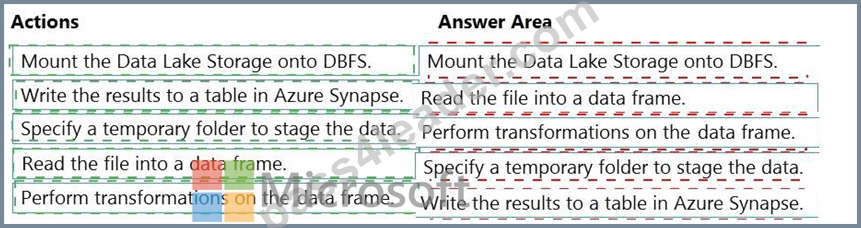
Explanation
Table Description automatically generated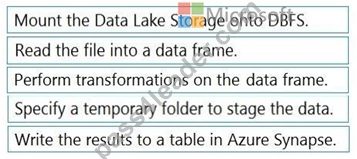
Step 1: Mount the Data Lake Storage onto DBFS
Begin with creating a file system in the Azure Data Lake Storage Gen2 account.
Step 2: Read the file into a data frame.
You can load the json files as a data frame in Azure Databricks.
Step 3: Perform transformations on the data frame.
Step 4: Specify a temporary folder to stage the data
Specify a temporary folder to use while moving data between Azure Databricks and Azure Synapse.
Step 5: Write the results to a table in Azure Synapse.
You upload the transformed data frame into Azure Synapse. You use the Azure Synapse connector for Azure Databricks to directly upload a dataframe as a table in a Azure Synapse.
Reference:
https://docs.microsoft.com/en-us/azure/azure-databricks/databricks-extract-load-sql-data-warehouse
NEW QUESTION # 79
You have an Azure subscription that contains the following resources:
An Azure Active Directory (Azure AD) tenant that contains a security group named Group1 An Azure Synapse Analytics SQL pool named Pool1 You need to control the access of Group1 to specific columns and rows in a table in Pool1.
Which Transact-SQL commands should you use? To answer, select the appropriate options in the answer area.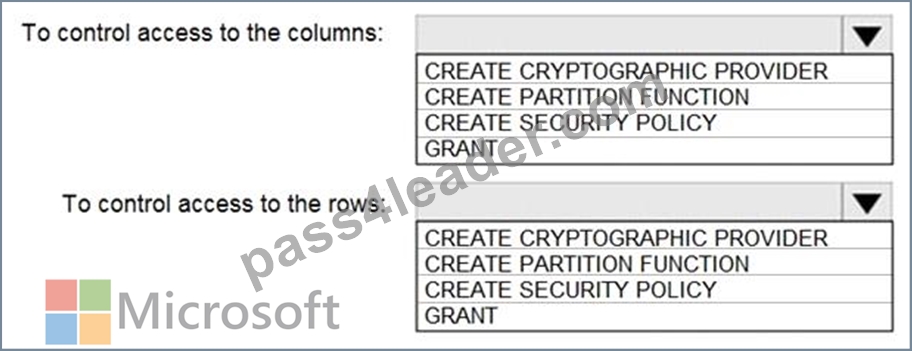
Answer:
Explanation: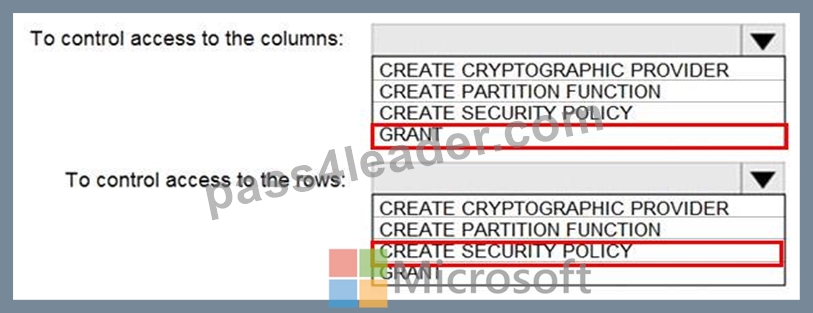
Reference:
https://docs.microsoft.com/en-us/azure/synapse-analytics/sql-data-warehouse/column-level-security
NEW QUESTION # 80
You have an Azure Active Directory (Azure AD) tenant that contains a security group named Group1. You have an Azure Synapse Analytics dedicated SQL pool named dw1 that contains a schema named schema1.
You need to grant Group1 read-only permissions to all the tables and views in schema1. The solution must use the principle of least privilege.
Which three actions should you perform in sequence? To answer, move the appropriate actions from the list of actions to the answer area and arrange them in the correct order.
NOTE: More than one order of answer choices is correct. You will receive credit for any of the correct orders you select.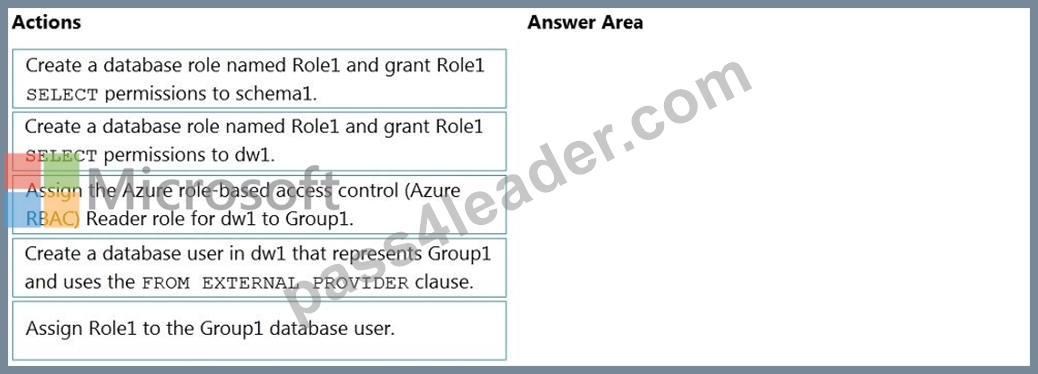
Answer:
Explanation: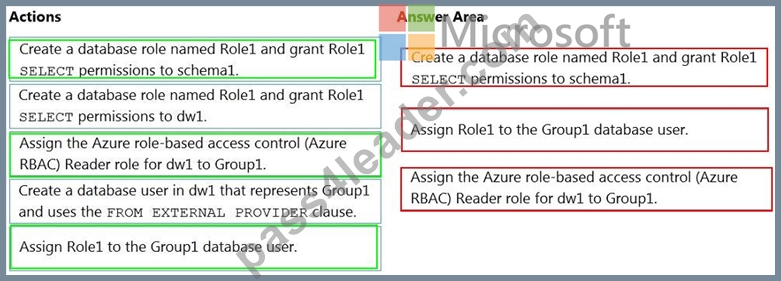
Reference:
https://docs.microsoft.com/en-us/azure/data-share/how-to-share-from-sql
NEW QUESTION # 81
You have an Azure Storage account that generates 200,000 new files daily. The file names have a format of {YYYY}/{MM}/{DD}/{HH}/{CustomerID}.csv.
You need to design an Azure Data Factory solution that will load new data from the storage account to an Azure Data Lake once hourly. The solution must minimize load times and costs.
How should you configure the solution? To answer, select the appropriate options in the answer are a.
NOTE: Each correct selection is worth one point.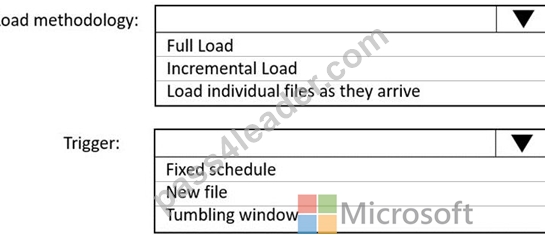
Answer:
Explanation: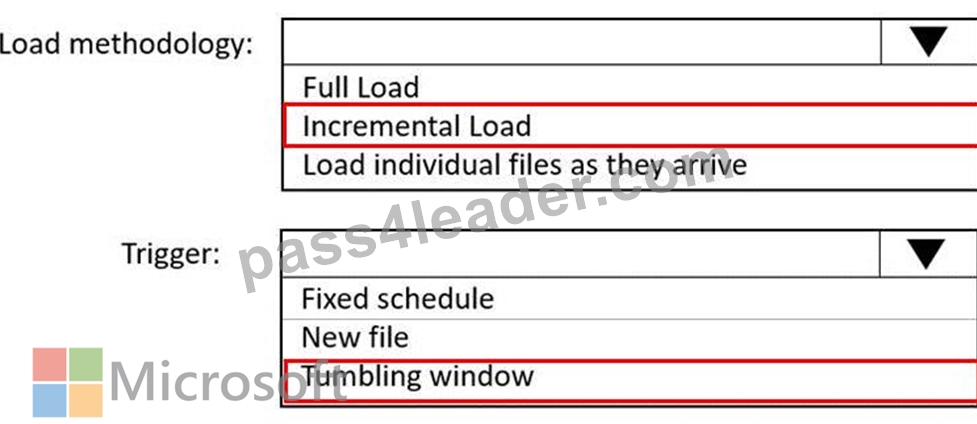
Reference:
https://docs.microsoft.com/en-us/stream-analytics-query/tumbling-window-azure-stream-analytics
NEW QUESTION # 82
You are designing a statistical analysis solution that will use custom proprietary1 Python functions on near real-time data from Azure Event Hubs.
You need to recommend which Azure service to use to perform the statistical analysis. The solution must minimize latency.
What should you recommend?
- A. Azure Databricks
- B. Azure Synapse Analytics
- C. Azure Stream Analytics
- D. Azure SQL Database
Answer: C
Explanation:
Reference:
https://docs.microsoft.com/en-us/azure/event-hubs/process-data-azure-stream-analytics
NEW QUESTION # 83
You haw an Azure data factory named ADF1.
You currently publish all pipeline authoring changes directly to ADF1.
You need to implement version control for the changes made to pipeline artifacts. The solution must ensure that you can apply version control to the resources currently defined m the UX Authoring canvas for ADF1.
Which two actions should you perform? Each correct answer presents part of the solution NOTE: Each correct selection is worth one point.
- A. Create a GitHub action
- B. From the UX Authoring canvas, select Set up code repository
- C. From the UX Authoring canvas, run Publish All.
- D. Create an Azure Data Factory trigger
- E. From the UX Authoring canvas, select Publish
- F. Create a Git repository
Answer: C,F
Explanation:
Reference:
https://docs.microsoft.com/en-us/azure/data-factory/source-control
NEW QUESTION # 84
You have an Azure Synapse Analytics dedicated SQL pool named Pool1 and an Azure Data Lake Storage Gen2 account named Account1.
You plan to access the files in Account1 by using an external table.
You need to create a data source in Pool1 that you can reference when you create the external table.
How should you complete the Transact-SQL statement? To answer, select the appropriate options in the answer area.
NOTE: Each correct selection is worth one point.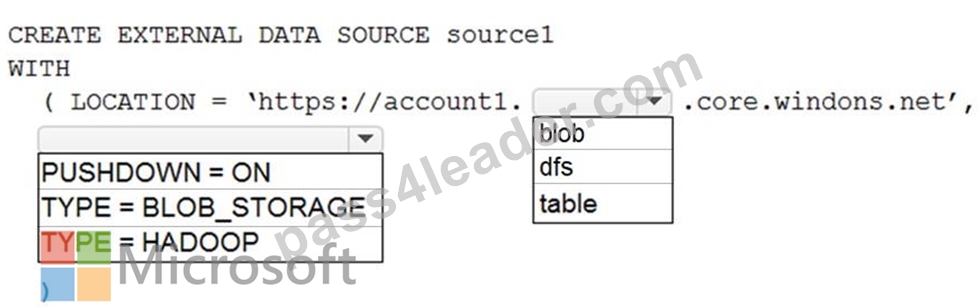
Answer:
Explanation: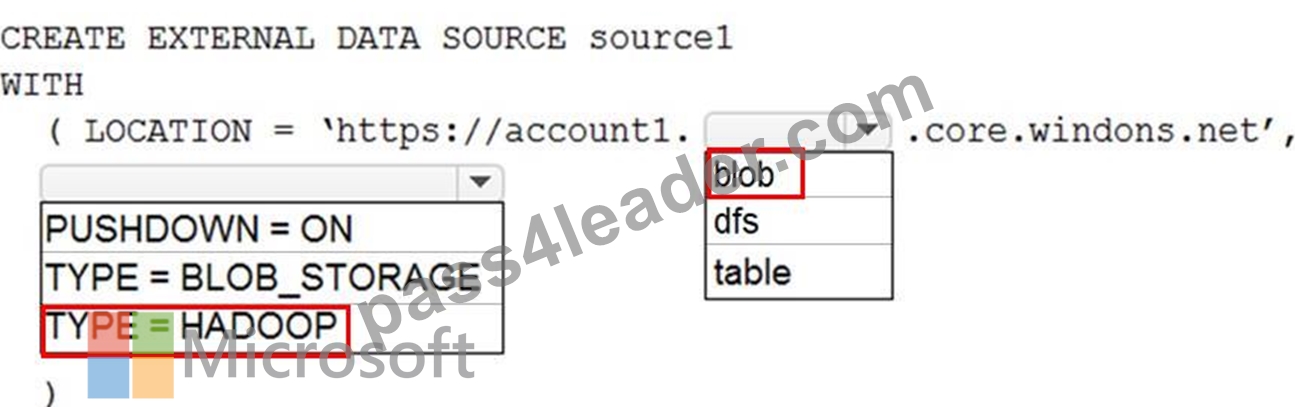
Reference:
https://docs.microsoft.com/en-us/azure/synapse-analytics/sql/develop-tables-external-tables
NEW QUESTION # 85
You are designing the folder structure for an Azure Data Lake Storage Gen2 container.
Users will query data by using a variety of services including Azure Databricks and Azure Synapse Analytics serverless SQL pools. The data will be secured by subject are a. Most queries will include data from the current year or current month.
Which folder structure should you recommend to support fast queries and simplified folder security?
- A. /{YYYY}/{MM}/{DD}/{SubjectArea}/{DataSource}/{FileData}_{YYYY}_{MM}_{DD}.csv
- B. /{SubjectArea}/{DataSource}/{YYYY}/{MM}/{DD}/{FileData}_{YYYY}_{MM}_{DD}.csv
- C. /{DD}/{MM}/{YYYY}/{SubjectArea}/{DataSource}/{FileData}_{YYYY}_{MM}_{DD}.csv
- D. /{SubjectArea}/{DataSource}/{DD}/{MM}/{YYYY}/{FileData}_{YYYY}_{MM}_{DD}.csv
Answer: B
Explanation:
There's an important reason to put the date at the end of the directory structure. If you want to lock down certain regions or subject matters to users/groups, then you can easily do so with the POSIX permissions. Otherwise, if there was a need to restrict a certain security group to viewing just the UK data or certain planes, with the date structure in front a separate permission would be required for numerous directories under every hour directory. Additionally, having the date structure in front would exponentially increase the number of directories as time went on.
Note: In IoT workloads, there can be a great deal of data being landed in the data store that spans across numerous products, devices, organizations, and customers. It's important to pre-plan the directory layout for organization, security, and efficient processing of the data for down-stream consumers. A general template to consider might be the following layout:
{Region}/{SubjectMatter(s)}/{yyyy}/{mm}/{dd}/{hh}/
NEW QUESTION # 86
You are designing a financial transactions table in an Azure Synapse Analytics dedicated SQL pool. The table will have a clustered columnstore index and will include the following columns:
TransactionType: 40 million rows per transaction type
CustomerSegment: 4 million per customer segment
TransactionMonth: 65 million rows per month
AccountType: 500 million per account type
You have the following query requirements:
Analysts will most commonly analyze transactions for a given month.
Transactions analysis will typically summarize transactions by transaction type, customer segment, and/or account type You need to recommend a partition strategy for the table to minimize query times.
On which column should you recommend partitioning the table?
- A. CustomerSegment
- B. AccountType
- C. TransactionMonth
- D. TransactionType
Answer: D
Explanation:
For optimal compression and performance of clustered columnstore tables, a minimum of 1 million rows per distribution and partition is needed. Before partitions are created, dedicated SQL pool already divides each table into 60 distributed databases.
Example: Any partitioning added to a table is in addition to the distributions created behind the scenes. Using this example, if the sales fact table contained 36 monthly partitions, and given that a dedicated SQL pool has 60 distributions, then the sales fact table should contain 60 million rows per month, or 2.1 billion rows when all months are populated. If a table contains fewer than the recommended minimum number of rows per partition, consider using fewer partitions in order to increase the number of rows per partition.
NEW QUESTION # 87
You have an Azure data factory.
You need to ensure that pipeline-run data is retained for 120 days. The solution must ensure that you can query the data by using the Kusto query language.
Which four actions should you perform in sequence? To answer, move the appropriate actions from the list of actions to the answer area and arrange them in the correct order.
NOTE: More than one order of answer choices is correct. You will receive credit for any of the correct orders you select.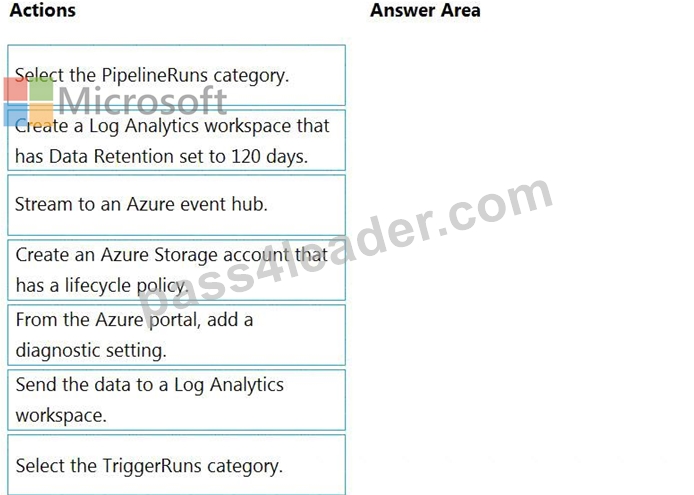
Answer:
Explanation: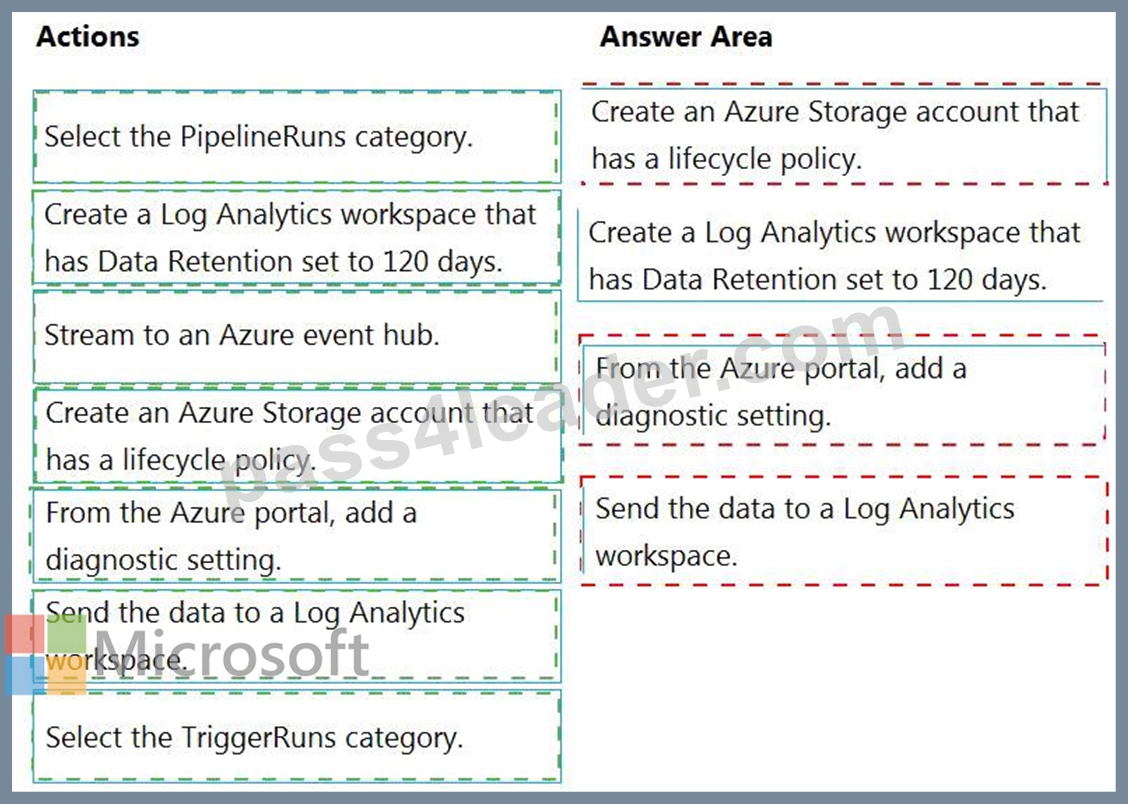
Explanation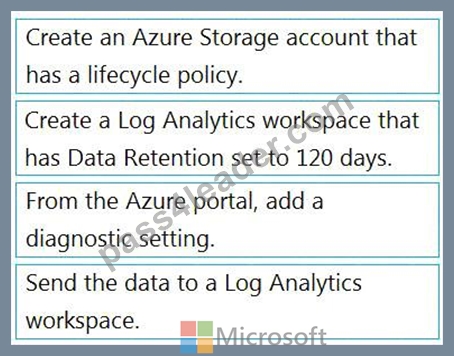
Step 1: Create an Azure Storage account that has a lifecycle policy
To automate common data management tasks, Microsoft created a solution based on Azure Data Factory. The service, Data Lifecycle Management, makes frequently accessed data available and archives or purges other data according to retention policies. Teams across the company use the service to reduce storage costs, improve app performance, and comply with data retention policies.
Step 2: Create a Log Analytics workspace that has Data Retention set to 120 days.
Data Factory stores pipeline-run data for only 45 days. Use Azure Monitor if you want to keep that data for a longer time. With Monitor, you can route diagnostic logs for analysis to multiple different targets, such as a Storage Account: Save your diagnostic logs to a storage account for auditing or manual inspection. You can use the diagnostic settings to specify the retention time in days.
Step 3: From Azure Portal, add a diagnostic setting.
Step 4: Send the data to a log Analytics workspace,
Event Hub: A pipeline that transfers events from services to Azure Data Explorer.
Keeping Azure Data Factory metrics and pipeline-run data.
Configure diagnostic settings and workspace.
Create or add diagnostic settings for your data factory.
* In the portal, go to Monitor. Select Settings > Diagnostic settings.
* Select the data factory for which you want to set a diagnostic setting.
* If no settings exist on the selected data factory, you're prompted to create a setting. Select Turn on diagnostics.
* Give your setting a name, select Send to Log Analytics, and then select a workspace from Log Analytics Workspace.
* Select Save.
Reference:
https://docs.microsoft.com/en-us/azure/data-factory/monitor-using-azure-monitor
NEW QUESTION # 88
You have an Azure Synapse Analytics dedicated SQL pool.
You need to Create a fact table named Table1 that will store sales data from the last three years. The solution must be optimized for the following query operations:
Show order counts by week.
* Calculate sales totals by region.
* Calculate sales totals by product.
* Find all the orders from a given month.
Which data should you use to partition Table1?
- A. week
- B. month
- C. product
- D. region
Answer: B
Explanation:
Table partitions enable you to divide your data into smaller groups of data. In most cases, table partitions are created on a date column.
Benefits to queries
Partitioning can also be used to improve query performance. A query that applies a filter to partitioned data can limit the scan to only the qualifying partitions. This method of filtering can avoid a full table scan and only scan a smaller subset of data. With the introduction of clustered columnstore indexes, the predicate elimination performance benefits are less beneficial, but in some cases there can be a benefit to queries.
For example, if the sales fact table is partitioned into 36 months using the sales date field, then queries that filter on the sale date can skip searching in partitions that don't match the filter.
Note: Benefits to loads
The primary benefit of partitioning in dedicated SQL pool is to improve the efficiency and performance of loading data by use of partition deletion, switching and merging. In most cases data is partitioned on a date column that is closely tied to the order in which the data is loaded into the SQL pool. One of the greatest benefits of using partitions to maintain data is the avoidance of transaction logging. While simply inserting, updating, or deleting data can be the most straightforward approach, with a little thought and effort, using partitioning during your load process can substantially improve performance.
NEW QUESTION # 89
You are developing a solution using a Lambda architecture on Microsoft Azure.
The data at test layer must meet the following requirements:
Data storage:
* Serve as a repository (or high volumes of large files in various formats.
* Implement optimized storage for big data analytics workloads.
* Ensure that data can be organized using a hierarchical structure.
Batch processing:
* Use a managed solution for in-memory computation processing.
* Natively support Scala, Python, and R programming languages.
* Provide the ability to resize and terminate the cluster automatically.
Analytical data store:
* Support parallel processing.
* Use columnar storage.
* Support SQL-based languages.
You need to identify the correct technologies to build the Lambda architecture.
Which technologies should you use? To answer, select the appropriate options in the answer area NOTE: Each correct selection is worth one point.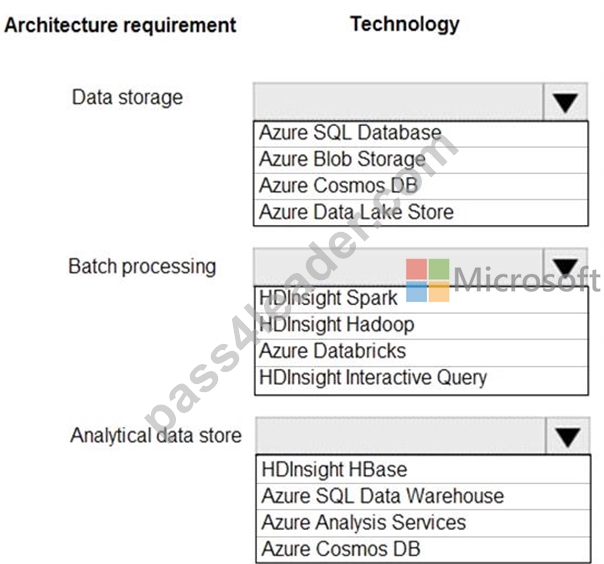
Answer:
Explanation: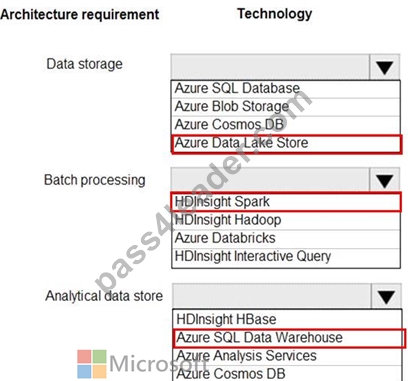
References:
https://docs.microsoft.com/en-us/azure/storage/blobs/data-lake-storage-namespace
https://docs.microsoft.com/en-us/azure/architecture/data-guide/technology-choices/batch-processing
https://docs.microsoft.com/en-us/azure/sql-data-warehouse/sql-data-warehouse-overview-what-is
NEW QUESTION # 90
You have an enterprise data warehouse in Azure Synapse Analytics that contains a table named FactOnlineSales. The table contains data from the start of 2009 to the end of 2012.
You need to improve the performance of queries against FactOnlineSales by using table partitions. The solution must meet the following requirements:
* Create four partitions based on the order date.
* Ensure that each partition contains all the orders places during a given calendar year.
How should you complete the T-SQL command? To answer, select the appropriate options in the answer area.
NOTE: Each correct selection is worth one point.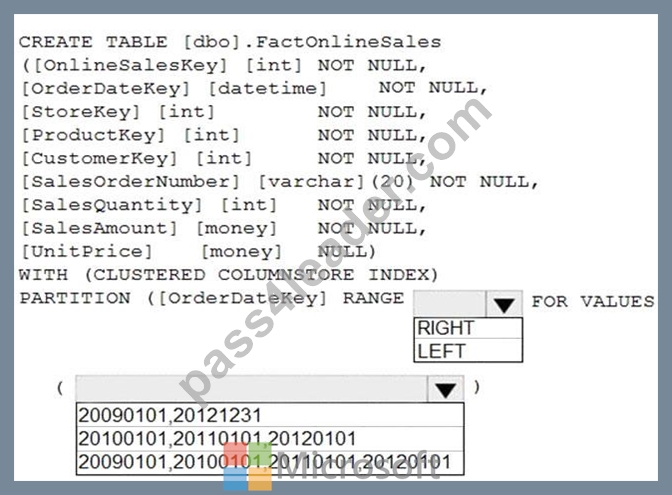
Answer:
Explanation: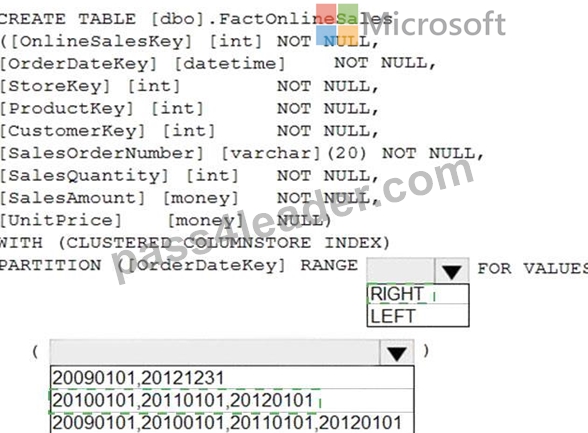
Explanation
Text Description automatically generated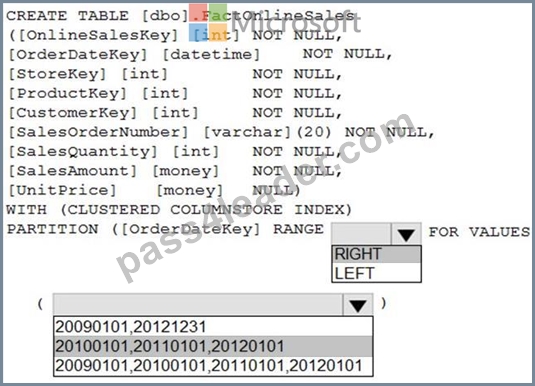
Range Left or Right, both are creating similar partition but there is difference in comparison For example: in this scenario, when you use LEFT and 20100101,20110101,20120101 Partition will be, datecol<=20100101, datecol>20100101 and datecol<=20110101, datecol>20110101 and datecol<=20120101, datecol>20120101 But if you use range RIGHT and 20100101,20110101,20120101 Partition will be, datecol<20100101, datecol>=20100101 and datecol<20110101, datecol>=20110101 and datecol<20120101, datecol>=20120101 In this example, Range RIGHT will be suitable for calendar comparison Jan 1st to Dec 31st Reference:
https://docs.microsoft.com/en-us/sql/t-sql/statements/create-partition-function-transact-sql?view=sql-server-ver1
NEW QUESTION # 91
You are developing a solution using a Lambda architecture on Microsoft Azure.
The data at test layer must meet the following requirements:
Data storage:
* Serve as a repository (or high volumes of large files in various formats.
* Implement optimized storage for big data analytics workloads.
* Ensure that data can be organized using a hierarchical structure.
Batch processing:
* Use a managed solution for in-memory computation processing.
* Natively support Scala, Python, and R programming languages.
* Provide the ability to resize and terminate the cluster automatically.
Analytical data store:
* Support parallel processing.
* Use columnar storage.
* Support SQL-based languages.
You need to identify the correct technologies to build the Lambda architecture.
Which technologies should you use? To answer, select the appropriate options in the answer area NOTE: Each correct selection is worth one point.
Answer:
Explanation: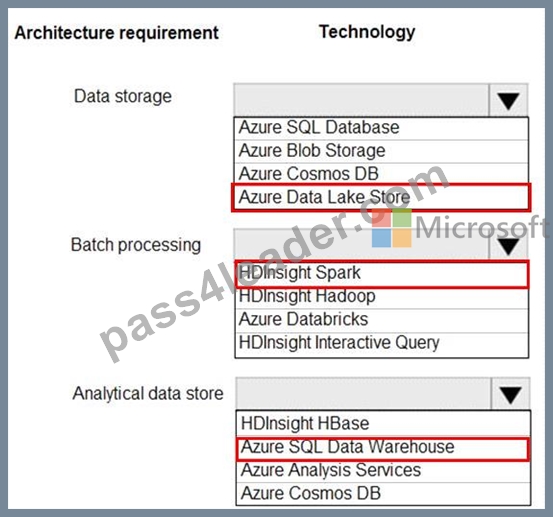
Reference:
https://docs.microsoft.com/en-us/azure/storage/blobs/data-lake-storage-namespace
https://docs.microsoft.com/en-us/azure/architecture/data-guide/technology-choices/batch-processing
https://docs.microsoft.com/en-us/azure/sql-data-warehouse/sql-data-warehouse-overview-what-is
NEW QUESTION # 92
You need to collect application metrics, streaming query events, and application log messages for an Azure Databrick cluster.
Which type of library and workspace should you implement? To answer, select the appropriate options in the answer area.
NOTE: Each correct selection is worth one point.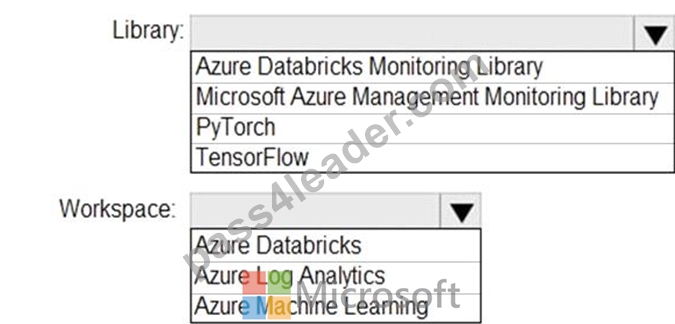
Answer:
Explanation: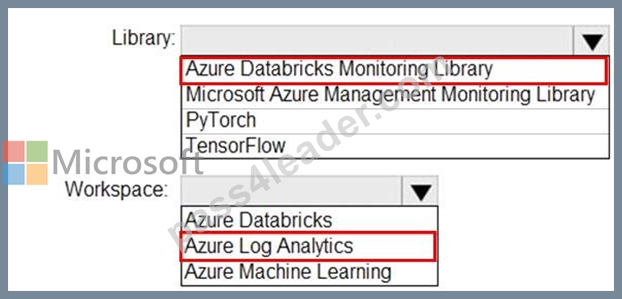
Reference:
https://docs.microsoft.com/en-us/azure/architecture/databricks-monitoring/application-logs
NEW QUESTION # 93
You have a SQL pool in Azure Synapse.
You plan to load data from Azure Blob storage to a staging table. Approximately 1 million rows of data will be loaded daily. The table will be truncated before each daily load.
You need to create the staging table. The solution must minimize how long it takes to load the data to the staging table.
How should you configure the table? To answer, select the appropriate options in the answer area.
NOTE: Each correct selection is worth one point.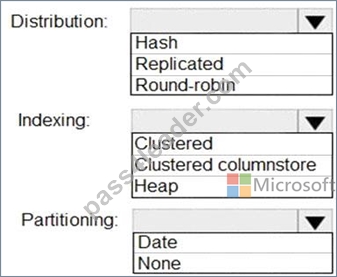
Answer:
Explanation: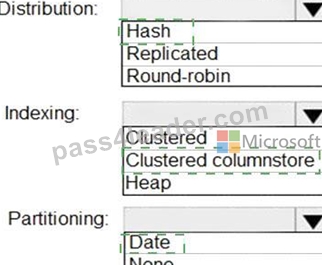
Explanation
Graphical user interface, application, table Description automatically generated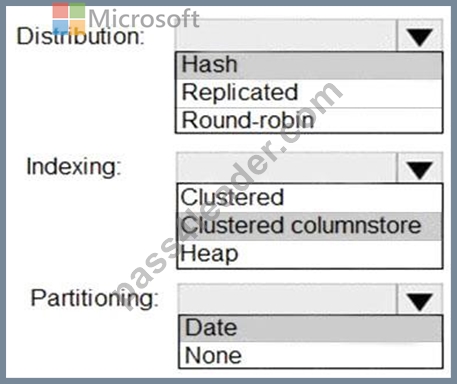
Box 1: Hash
Hash-distributed tables improve query performance on large fact tables. They can have very large numbers of rows and still achieve high performance.
Box 2: Clustered columnstore
When creating partitions on clustered columnstore tables, it is important to consider how many rows belong to each partition. For optimal compression and performance of clustered columnstore tables, a minimum of 1 million rows per distribution and partition is needed.
Box 3: Date
Table partitions enable you to divide your data into smaller groups of data. In most cases, table partitions are created on a date column.
Partition switching can be used to quickly remove or replace a section of a table.
Reference:
https://docs.microsoft.com/en-us/azure/synapse-analytics/sql-data-warehouse/sql-data-warehouse-tables-partition
https://docs.microsoft.com/en-us/azure/synapse-analytics/sql-data-warehouse/sql-data-warehouse-tables-distribu
NEW QUESTION # 94
You need to design the partitions for the product sales transactions. The solution must meet the sales transaction dataset requirements.
What should you include in the solution? To answer, select the appropriate options in the answer area.
NOTE: Each correct selection is worth one point.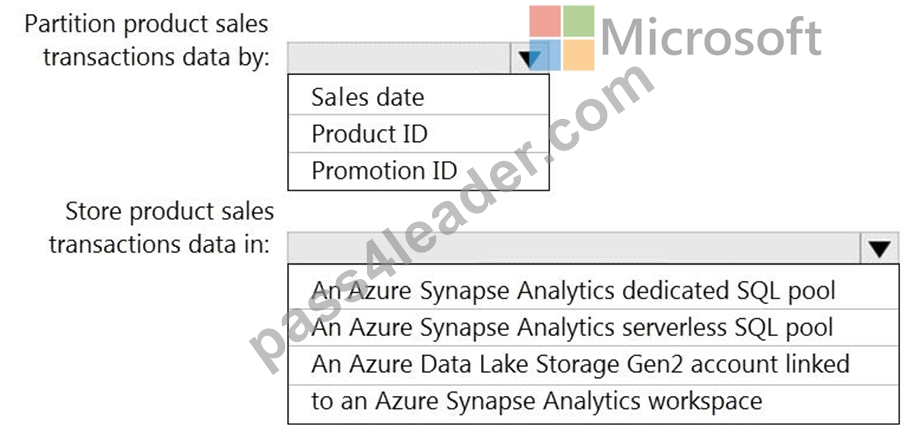
Answer:
Explanation: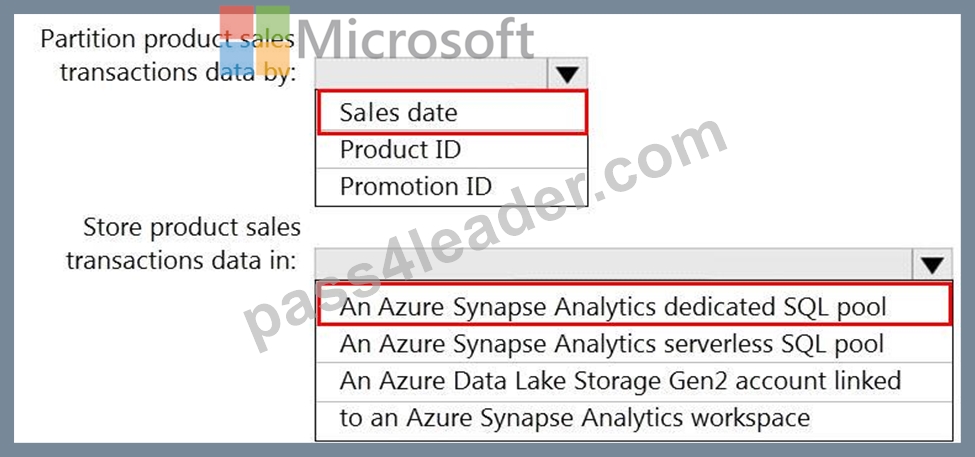
Reference:
https://docs.microsoft.com/en-us/azure/synapse-analytics/sql-data-warehouse/sql-data-warehouse-overview-what-is
NEW QUESTION # 95
You have an Azure Data Lake Storage Gen2 account named account1 that stores logs as shown in the following table.
You do not expect that the logs will be accessed during the retention periods.
You need to recommend a solution for account1 that meets the following requirements:
Automatically deletes the logs at the end of each retention period
Minimizes storage costs
What should you include in the recommendation? To answer, select the appropriate options in the answer are a.
NOTE: Each correct selection is worth one point.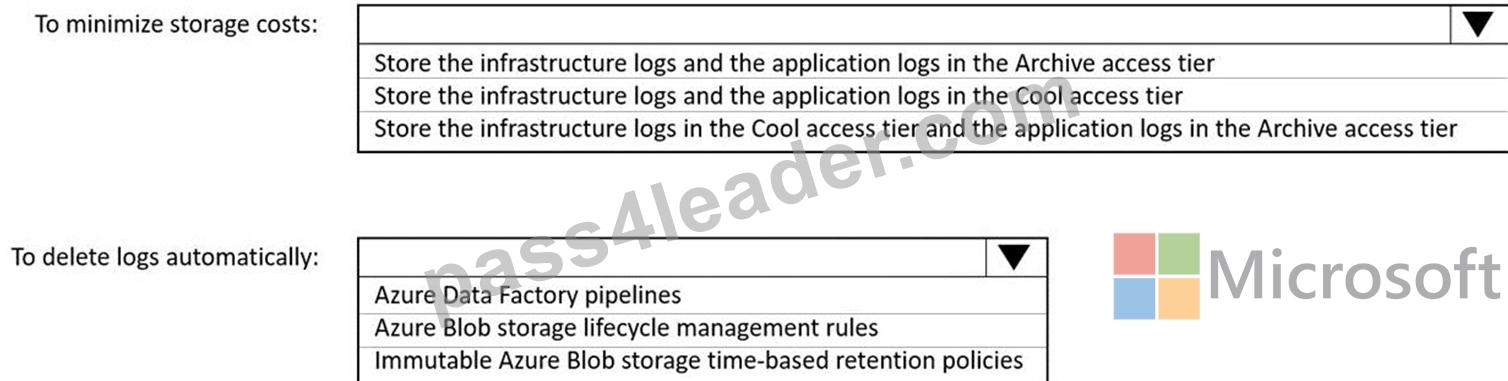
Answer:
Explanation: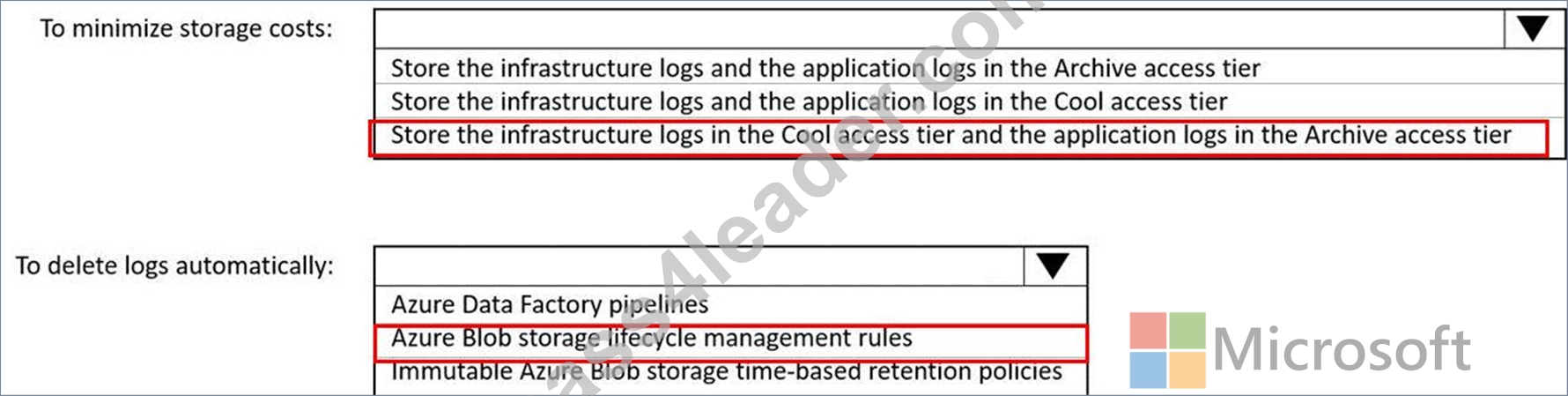
Reference:
https://docs.microsoft.com/en-us/azure/storage/blobs/access-tiers-overview
NEW QUESTION # 96
You are processing streaming data from vehicles that pass through a toll booth.
You need to use Azure Stream Analytics to return the license plate, vehicle make, and hour the last vehicle passed during each 10-minute window.
How should you complete the query? To answer, select the appropriate options in the answer area.
NOTE: Each correct selection is worth one point.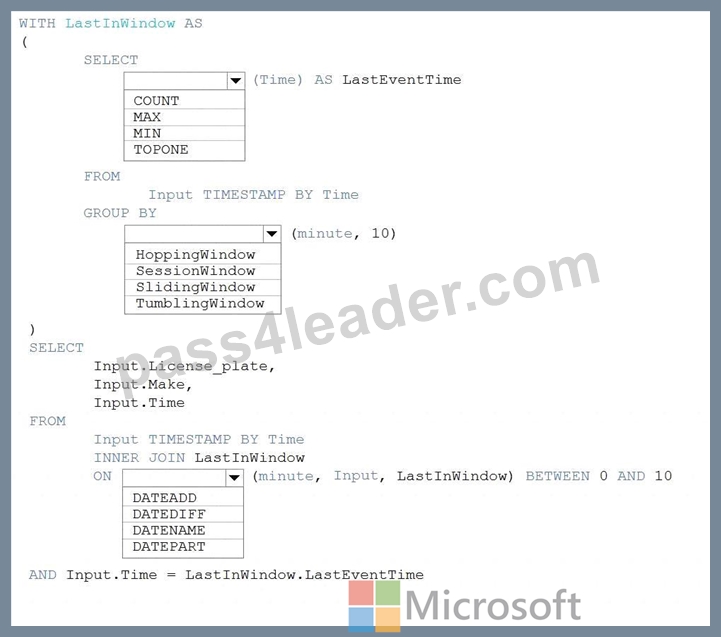
Answer:
Explanation: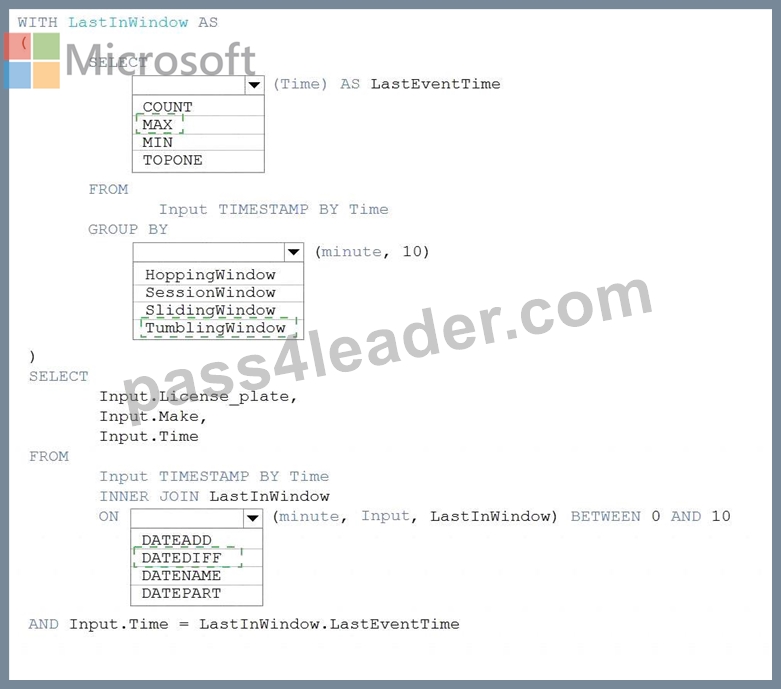
Explanation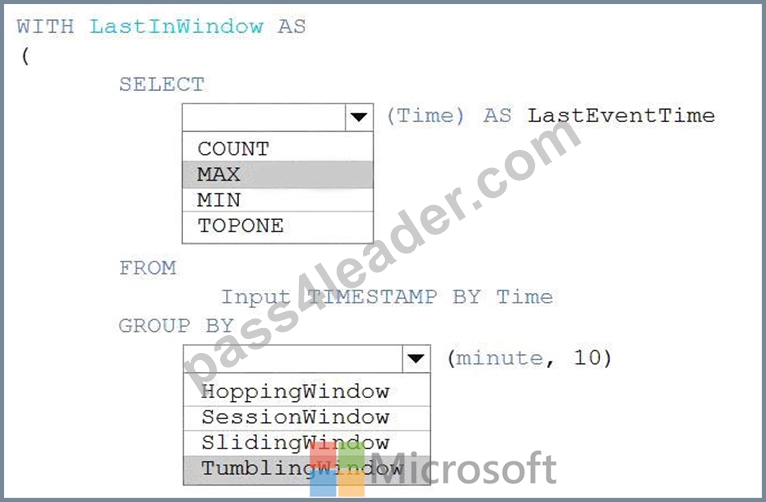
Graphical user interface, text, application Description automatically generated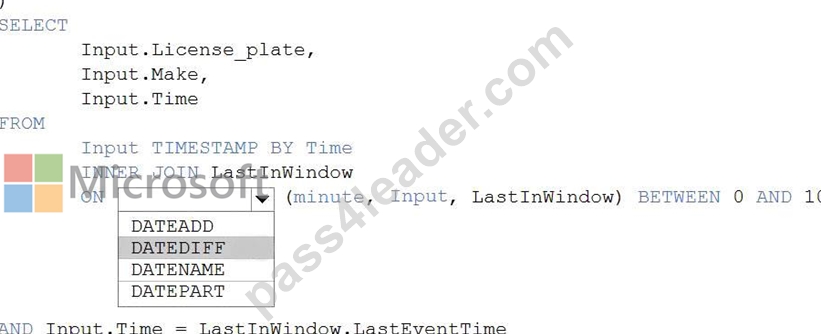
Box 1: MAX
The first step on the query finds the maximum time stamp in 10-minute windows, that is the time stamp of the last event for that window. The second step joins the results of the first query with the original stream to find the event that match the last time stamps in each window.
Query:
WITH LastInWindow AS
(
SELECT
MAX(Time) AS LastEventTime
FROM
Input TIMESTAMP BY Time
GROUP BY
TumblingWindow(minute, 10)
)
SELECT
Input.License_plate,
Input.Make,
Input.Time
FROM
Input TIMESTAMP BY Time
INNER JOIN LastInWindow
ON DATEDIFF(minute, Input, LastInWindow) BETWEEN 0 AND 10
AND Input.Time = LastInWindow.LastEventTime
Box 2: TumblingWindow
Tumbling windows are a series of fixed-sized, non-overlapping and contiguous time intervals.
Box 3: DATEDIFF
DATEDIFF is a date-specific function that compares and returns the time difference between two DateTime fields, for more information, refer to date functions.
Reference:
https://docs.microsoft.com/en-us/stream-analytics-query/tumbling-window-azure-stream-analytics
NEW QUESTION # 97
The storage account container view is shown in the Refdata exhibit. (Click the Refdata tab.) You need to configure the Stream Analytics job to pick up the new reference dat a. What should you configure? To answer, select the appropriate options in the answer area NOTE: Each correct selection is worth one point.
Answer:
Explanation: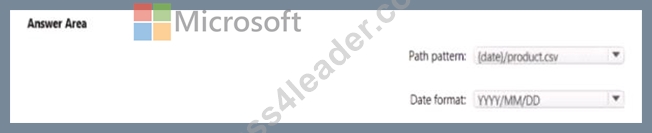
NEW QUESTION # 98
......
Free Microsoft Certified: Azure Data Engineer Associate DP-203 Exam Question: https://www.pass4leader.com/Microsoft/DP-203-exam.html
DP-203 dumps & Microsoft Certified: Azure Data Engineer Associate sure practice dumps: https://drive.google.com/open?id=1xREiwh-24UMgu0T2yMh0jIbXiXvJW7Dj