

Get instant access to Virginia-Real-Estate-Salesperson Practice Tests 2026 Free Updated Today!
Welcome to download the newest PassLeader Virginia-Real-Estate-Salesperson PDF dumps ( 125 Q&As)
NEW QUESTION # 69
What is a building permit?
- A. legal document from a local authority that authorizes a construction or remodeling project
- B. document that permits changing the zoning of one small area within the existing zoning
- C. written permission from the government to seize private property for public use
- D. document that permits landowners to use land in a way that is typically not permitted by land use restrictions of zoning law
Answer: A
Explanation:
A building permit is written authorization from a local government (building department) allowing construction, remodeling, or major repair work.
Ensures compliance with zoning, building codes, and safety standards.
Other options:
(A) Refers to eminent domain, not a permit.
(B) Refers to a variance (zoning exception).
(D) Refers to spot zoning (rezoning of a small parcel).
Reference (Virginia Real Estate):
Virginia Uniform Statewide Building Code
Code of Virginia Title 36 (Housing)
A490-02REGS.pdf - Land use & building regulations
NEW QUESTION # 70
Bobby took out a commercial mortgage to pay for his new podcast studio. It is an interest-only loan of $800,000 with an interest rate of 4.5%. How much will Bobby pay in interest over the year?
- A. $36.000
- B. $10,500
- C. $45,000
- D. $3,500
Answer: A
Explanation:
Reference (Virginia Real Estate Finance):
Real Estate Math section in Virginia Pre-License Education requirements (interest-only loan calculations) A490-02REGS.pdf sections on finance and math competency for licensure
NEW QUESTION # 71
Harry, an agent, transfers some money from an escrow account into his personal savings accounts. What is he doing and is it legal or illegal?
- A. This is commingling, and it is legal.
- B. This is conversion, and it is illegal.
- C. This is commingling, and it is illegal.
- D. This is conversion, and it is legal.
Answer: B
Explanation:
Commingling occurs when a licensee mixes clients' escrow funds with their own funds in the same account. This is prohibited but usually involves "mixing," not directly taking the money.
Conversion occurs when a licensee uses or transfers client funds for personal use, such as Harry moving money from an escrow account to his personal account.
Conversion is considered a serious violation of Virginia license law and is illegal.
Reference:
Virginia Code §54.1-2108.1 (Maintenance and management of escrow accounts)
NEW QUESTION # 72
In Virginia, the grantor tax rate is currently $0.50 per $500 of the sales price. How much would the taxes be on a $756,000 home purchase?
- A. $756
- B. $1,512
- C. $15,120
- D. $7,560
Answer: A
Explanation: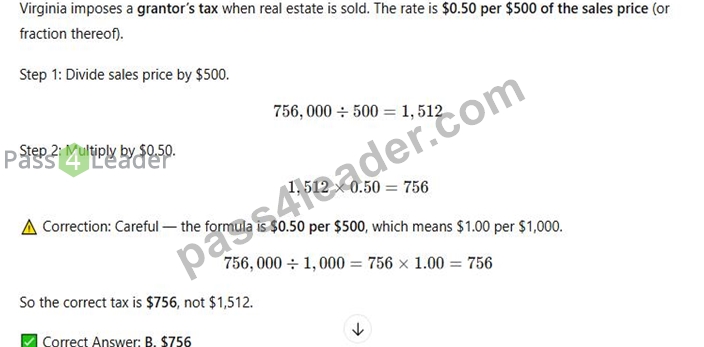
Reference (Virginia Real Estate):
Virginia Code § 58.1-802 (Grantor's tax)
Virginia Real Estate Principles - Transfer taxes section
NEW QUESTION # 73
The subject property has a pool valued at $30,000 and two bathrooms valued at $10,000 each. Comp 1 does not have a pool and has one less bathroom than the subject property.
What adjustments should be made to Comp 1's value?
- A. add $40,000 to Comp 1's value
- B. subtract $40,000 from Comp 1's value
- C. add $20,000 to Comp 1's value
- D. subtract $20,000 from Comp 1's value
Answer: A
Explanation: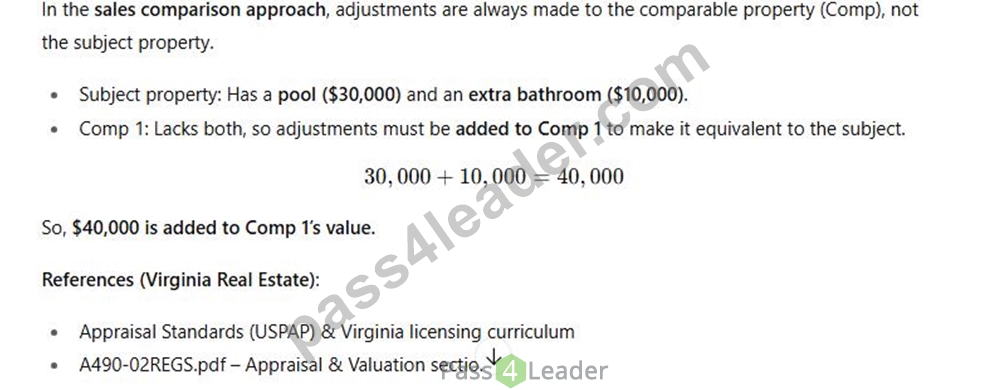
NEW QUESTION # 74
Disclosure is an important part of a brokerage's duties and responsibilities. Which of the following is NOT an important disclosure all brokerages should make?
- A. disclosure of an area's demographics of race and ethnicity
- B. disclosure of all offers
- C. disclosure of financial condition
- D. disclosure of agency
Answer: A
Explanation:
Brokerages have legal and ethical disclosure obligations, including:
Disclosure of agency (who the licensee represents).
Disclosure of financial condition (as it pertains to ability to complete transaction).
Disclosure of all offers (must present promptly).
However, disclosing demographics of race and ethnicity violates the Fair Housing Act because it could encourage steering or discrimination. This type of disclosure is explicitly prohibited.
Reference (Virginia Real Estate):
Federal Fair Housing Act (42 U.S.C. §§ 3601-3619)
Virginia Fair Housing Law, Code of Virginia Title 36, Ch. 5.1
Real Estate Board Regulations (18 VAC 135-20-300) - Standards of conduct
NEW QUESTION # 75
Marty, who is not a real estate agent, owns a duplex. He lives in one unit and rents out the other. He turns down a\family with small children as tenants because he doesn't want to deal with noise. Evaluate the situation.
- A. Marty has violated the Fair Housing Act on grounds of marital status protections.
- B. Marty has violated the Fair Housing Act on grounds of parental status protections.
- C. Marty has violated the Fair Housing Act on grounds of familial status protections.
- D. Marty has done nothing wrong. This housing situation is exempt from the Fair Housing Act.
Answer: C
Explanation:
The Fair Housing Act protects against housing discrimination based on:
Race, color, religion, sex, national origin, familial status, and disability.
Familial status = protection for households with children under 18, pregnant women, or legal guardians of children.
Marty's refusal to rent to a family with small children violates familial status protections.
Exemption note (owner-occupied duplex rule): While the Fair Housing Act has a limited exemption for small owner-occupied dwellings ("Mrs. Murphy exemption"), Virginia Fair Housing Law does not allow discrimination based on familial status even in this situation.
Thus, the correct answer is familial status discrimination.
Reference:
Federal Fair Housing Act, 42 U.S.C. §3601 et seq.
Virginia Fair Housing Law, Code of Virginia Title 36, Chapter 5.1
NEW QUESTION # 76
Which listing agreement allows multiple real estate brokers (and the owners themselves) the right to sell the property, with a commission being paid to whoever is the procuring cause of the sale?
- A. net listing
- B. open listing
- C. exclusive agency listing
- D. exclusive right-to-sell listing
Answer: B
Explanation:
An open listing is a nonexclusive agreement allowing:
Multiple brokers to market the property.
The seller to sell the property themselves.
A commission only being paid to the broker (or seller) who is the procuring cause of the sale.
Other agreements:
(B) Exclusive right-to-sell = listing broker gets commission no matter who sells.
(C) Exclusive agency = one broker represents seller, but seller can sell on their own without paying commission.
(D) Net listing = illegal in many states (broker keeps anything above seller's required price).
Reference (Virginia Real Estate):
Code of Virginia § 54.1-2137 (Agency agreements)
Virginia Real Estate Principles - Listing agreements
A490-02REGS.pdf - Brokerage & Listing curriculum
NEW QUESTION # 77
Alana is renting a three-bedroom home for one year. Alana is the:
- A. holdover tenant
- B. optionor
- C. tenant or lessee
- D. tenant or lessor
Answer: C
Explanation:
Tenant/lessee = person renting property under a lease.
Alana rents the home for one year → she is the tenant/lessee.
Other options:
(B) Holdover tenant - stays after lease expires.
(C) Optionor - person giving an option contract, not a renter.
(D) Lessor - landlord/owner, not tenant.
Reference:
Virginia Residential Landlord and Tenant Act (VRLTA), Code of Virginia §55.1-1200 Real Estate Principles - Leasehold Estates
NEW QUESTION # 78
Which of these is a federal law that aims to protect people and the environment from the harmful effects of air pollution?
- A. Safe Drinking Water Act
- B. CERCLA
- C. Clean Air Act
- D. Superfund Amendments and Reauthorization Act
Answer: C
Explanation:
The Clean Air Act (CAA) is the federal law designed to protect human health and the environment from the harmful effects of air pollution.
It authorizes the EPA to set air quality standards, regulate emissions from industries and vehicles, and enforce compliance.
Other options:
(B) Safe Drinking Water Act → protects water quality.
(C) Superfund Amendments and Reauthorization Act (SARA) → expands CERCLA's hazardous waste cleanup responsibilities.
(D) CERCLA (Comprehensive Environmental Response, Compensation, and Liability Act) → governs cleanup of hazardous waste sites ("Superfund").
Reference (Virginia Real Estate):
Clean Air Act, 42 U.S.C. § 7401 et seq.
Virginia Real Estate Principles - Environmental issues section
NEW QUESTION # 79
Vicarious liability is the common law concept that:
- A. a person is liable for the actions of those acting with authority on that individual's behalf
- B. brokers are free from taking responsibility for their agents' actions
- C. license holders may ONLY be held liable if violations are brought to court
- D. agents cannot be held liable for violating fiduciary duties, while brokers can
Answer: A
Explanation:
Vicarious liability is a common law concept where a person in authority is responsible for the actions of another acting on their behalf:
In real estate, brokers are vicariously liable for the actions of their salespersons/agents when those actions are within the scope of their authority.
This does not absolve agents of their own liability, but it means the broker shares responsibility for ensuring compliance with real estate law and ethical standards.
Other options:
(A) Wrong - liability doesn't depend on whether violations are taken to court.
(C) Wrong - brokers are not free from responsibility.
(D) Wrong - both brokers and agents can be held liable.
Reference (Virginia Real Estate):
Virginia Code § 54.1-2101 et seq. (Broker supervisory responsibilities) Real Estate Board Regulations 18 VAC 135-20-160 A490-02REGS.pdf - Agency law & fiduciary duties
NEW QUESTION # 80
The creation of express agency is best handled via a(n):
- A. oral agreement or buyer representation agreement
- B. listing agreement or buyer representation agreement
- C. listing agreement or ratified actions
- D. oral agreement or ratified actions
Answer: B
Explanation:
Express agency is created through a clear written or oral agreement.
In real estate, the best practice (and Virginia requirement for enforceability) is through:
Listing agreement (seller representation)
Buyer representation agreement (buyer representation)
Other options:
(A) Oral agreements possible but not best practice in Virginia.
(B) Ratified actions = implied agency, not express.
(C) Listing agreement alone covers only seller side.
Reference:
Code of Virginia §54.1-2137 & §54.1-2138 (Agency agreements in writing) Virginia Real Estate Board Regulations - Agency Disclosure
NEW QUESTION # 81
Clarence owns three rental homes he doesn't have time to oversee himself. He decides to hire George to take care of his rental units in the hopes of maximizing the return on his investment. What role is George filling?
- A. property manager
- B. sponsoring broker
- C. appraisal manager
- D. broker's agent
Answer: A
Explanation:
A property manager is hired by an owner to manage rental property, maintain operations, and maximize return on investment.
Other options:
(A) Sponsoring broker - oversees real estate salespersons, not rentals.
(B) Appraisal manager - not a real estate role.
(C) Broker's agent - represents broker in brokerage activities, not property management.
Reference:
Code of Virginia §54.1-2100 (definition includes property management as brokerage services) Virginia Real Estate Principles & Practices - Property Management
NEW QUESTION # 82
When must a lender provide borrowers with a Closing Disclosure?
- A. at the end of the closing ceremony
- B. on the day of closing
- C. at least three business days before the consummation of the loan
- D. at least five business days after consummation of the loan
Answer: C
Explanation:
The TILA-RESPA Integrated Disclosure Rule (TRID) requires that the lender provide the Closing Disclosure (CD) at least three business days prior to loan consummation. This ensures that borrowers have adequate time to review the final loan terms, costs, and obligations.
If significant changes occur (such as APR change beyond tolerance, loan product change, or addition of a prepayment penalty), a new three-day waiting period is triggered.
This rule is enforced by the Consumer Financial Protection Bureau (CFPB) but is an important part of Virginia real estate education since agents must be aware of closing timelines.
Reference (Virginia Real Estate & Federal):
TRID Rule under Regulation Z (12 CFR 1026.19(f))
NEW QUESTION # 83
Larry's new tenant, who uses a wheelchair, asks Larry to install grab bars in the bathtub, as well as lowered light switches. The tenant is asking for:
- A. injunctions, and the Americans with Disabilities Act (ADA) will cover the cost
- B. accommodations, and Larry must pay for them, no matter the expense
- C. modifications, and Larry can require that the tenant pay for their installation
- D. bias, and Larry is not obligated to complete the request
Answer: C
Explanation:
Under the Fair Housing Act (FHA), landlords must permit reasonable modifications to rental units to allow persons with disabilities full use and enjoyment of the premises.
Examples: installing grab bars, lowering light switches, widening doorways.
Cost responsibility: The tenant typically pays for these modifications unless the housing is federally funded. The landlord may require the tenant to restore the unit to its original condition at the end of tenancy (reasonable wear and tear excluded).
This differs from reasonable accommodations, which are changes to policies/rules (e.g., allowing a service animal) and must be paid for by the housing provider.
Reference (Virginia Real Estate):
Federal Fair Housing Act, 42 U.S.C. §§ 3601-3619
Virginia Fair Housing Law (Code of Virginia Title 36, Ch. 5.1)
A490-02REGS.pdf - Fair Housing curriculum
NEW QUESTION # 84
Trystan and Nia enter into a contract for the sale of a tiny house. Trystan is 17. Closing is supposed to occur in two weeks. This contract is:
- A. executed and voidable
- B. executed and void
- C. executory and void
- D. executory and voidable
Answer: D
Explanation:
A contract is executory when its terms have not yet been fully performed (here, closing has not yet occurred).
Because Trystan is 17 years old, he is a minor under Virginia law (legal capacity begins at 18). A minor's contract is generally voidable at the option of the minor, but enforceable against the adult party.
Therefore, this contract is executory (not yet performed) and voidable (due to Trystan's age).
Reference:
Code of Virginia §1-204 (Age of majority = 18)
Virginia Real Estate Board Exam Outline - Contracts (capacity, validity, executory vs executed)
NEW QUESTION # 85
What is unique about an exclusive right-to-sell listing agreement?
- A. The broker gets compensation regardless of who sells the property.
- B. The broker represents both the seller and the buyer.
- C. The broker acts as a general agent for the client in all business dealings.
- D. There are multiple brokers working to sell the same property.
Answer: A
Explanation:
An Exclusive Right-to-Sell Listing Agreement is the strongest listing contract for brokers.
The broker earns a commission regardless of who procures the buyer-whether it's another broker, the seller themselves, or the listing agent.
This contrasts with an Exclusive Agency Agreement, where the seller may avoid paying commission if they find the buyer themselves.
Virginia law requires such agreements to be in writing, signed by all parties, and have a definite termination date (§ 54.1-2137).
Reference (Virginia Real Estate):
Code of Virginia § 54.1-2137 (Agency agreements)
Real Estate Regulations (18 VAC 135-20-280) regarding written agreements
NEW QUESTION # 86
......
May-2026 Latest Pass4Leader Virginia-Real-Estate-Salesperson Exam Dumps with PDF and Exam Engine: https://www.pass4leader.com/Real-Estate-Licensing/Virginia-Real-Estate-Salesperson-exam.html
Premium Quality Real Estate Licensing Virginia-Real-Estate-Salesperson Online dumps: https://drive.google.com/open?id=1YkTnBBi28UR50sDqyKiu-8dr-W7SQNcP