

Get up-to-date Real Exam Questions for MCD-Level-1 UPDATED [2023]
Pass MuleSoft MCD-Level-1 Exam in First Attempt Guaranteed
Objectives for This Validation
There are varied topics targeting the MuleSoft Certified Developer - Level 1 (Mule 4) certificate. They are as follows:
- Structuring Mule Applications
This sector concerns data and it goes ahead to cover tasks such as parameterizing applications, describing and reutilizing global configurations, elements of Flow Reference, private flows, and subflows in breaking an application. Additionally, you will have to identify which data is used between flows and before & after a call. Finally, candidates will have to be proficient in Mule events and resources used for external purposes.
- Transforming Data with DataWeave
This topic goes into the matters of custom data varieties, DataWeave functions and scripts, Mule Flows, and DataWeave syntax. Additionally, candidates will get equipped with such skills as operating with JSON, XML, and Java data chunks as well as their content, and custom data pieces.
- Handling Errors
This section embraces controlling default errors as well as custom global default inaccuracies, stating error handlers, structures for data, and an app mapping of errors. Also, you will have to differentiate between the On Error Continue & On Error Propagate parts and define the Mule Error object.
- Creation and Consumption of APIs
In this domain, candidates will tackle issues with the APIs lifecycle, query parameters, RAML, parameters for URI, and those data types that can be reused. What's more, examinees will be highlighted on samples for format independence, RESTful requests, headers, and nested sources.
- App Network Fundamentals
This area includes such concepts as IT delivery gap, C4E (Center for Enablement), modern API, as well as the HTTP protocol. It is also about capabilities and elements accessible in Anypoint, which also target the API full lifecycle. Apart from these, candidates will get exposed to API connectivity, interface, execution, and invocation alongside application networking facets, requests, and responses.
- Debugging and Troubleshooting Mule Application
It takes care of inspecting Mules, installation of lacking Maven dependencies, and going through and interpreting error alerts from messages for logs related to Mule.
NEW QUESTION # 54
Refer to the exhibits.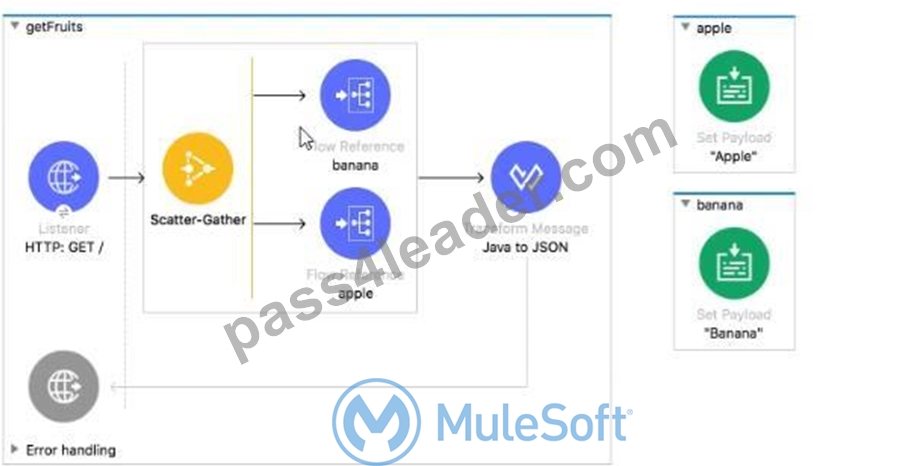
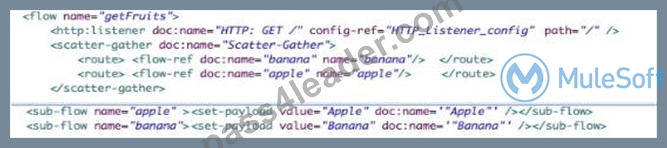
A
web client submits a request to http://localhQst:8081. What is the structure of the payload at the end of the flow?
A)
B)
C)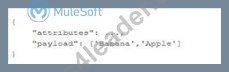
D)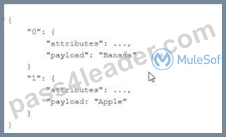
- A. Option A
- B. Option C
- C. Option D
- D. Option B
Answer: C
NEW QUESTION # 55
A shopping API contains a method to look up store details by department.
To get the information for a particular store, web clients will submit requests with a query parameter named department and uri parameter named storeId What is valid RAML snippet that supports requests from a web client to get a data for a specific storeId and department name?
- A. 1. /department:
2. get:
3. uriParameter:
4. storeId: - B. 1. /{storeId}:
2. get:
3. queryParameter:
4. department: - C. 1. get:
2. uriParameter:
3. {storeId}:
4. queryParameter:
5. department: - D. 1. get:
2. queryParameter:
3. department:
4. uriParameter:
5. {storeId}:
Answer: B
NEW QUESTION # 56
A Mule application contains a global error handler configured to catch any errors.
Where must the global error handler be specified so that the global error handler catches all errors from flows without their own error handlers?
- A. Nowhere, the global error handler is automatically used
- B. A configuration properties file
- C. A global element
- D. The pom.xml file
Answer: C
Explanation:
Correct answer is A global element
Global error handlers are to be created in global element .
Quick note to remember here is Global error handlers come in to picture only when there are no error handlers specified as flow level.
Steps to create Global error handler
1) Click Global Elements to open Global Configuration Elements. Global Elements is located below the Studio canvas
2) In Global Configuration Elements, click Create to open the Choose Global Type dialog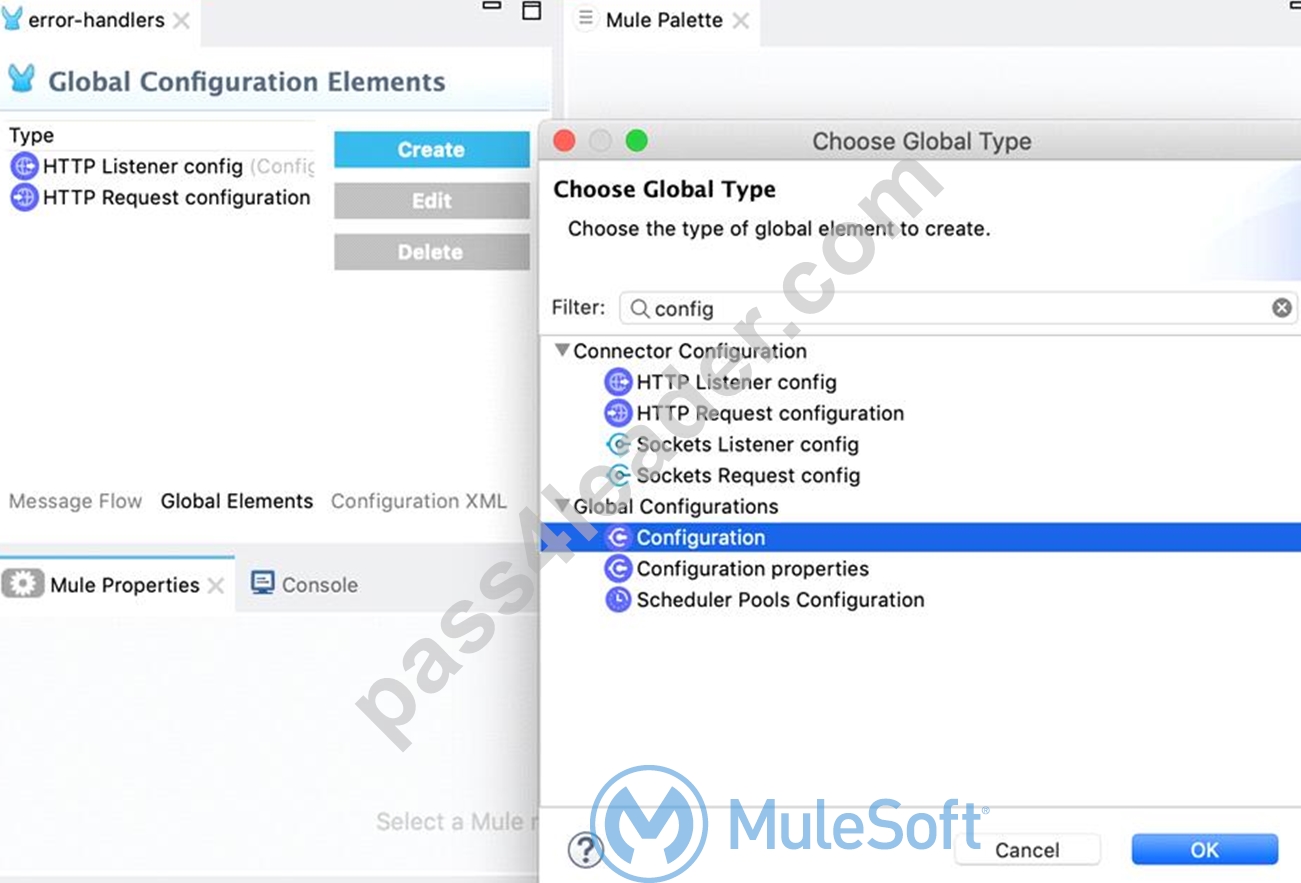
3) From the dialog, select Global Configuration -> Configuration, and then click OK to open the Configuration dialog.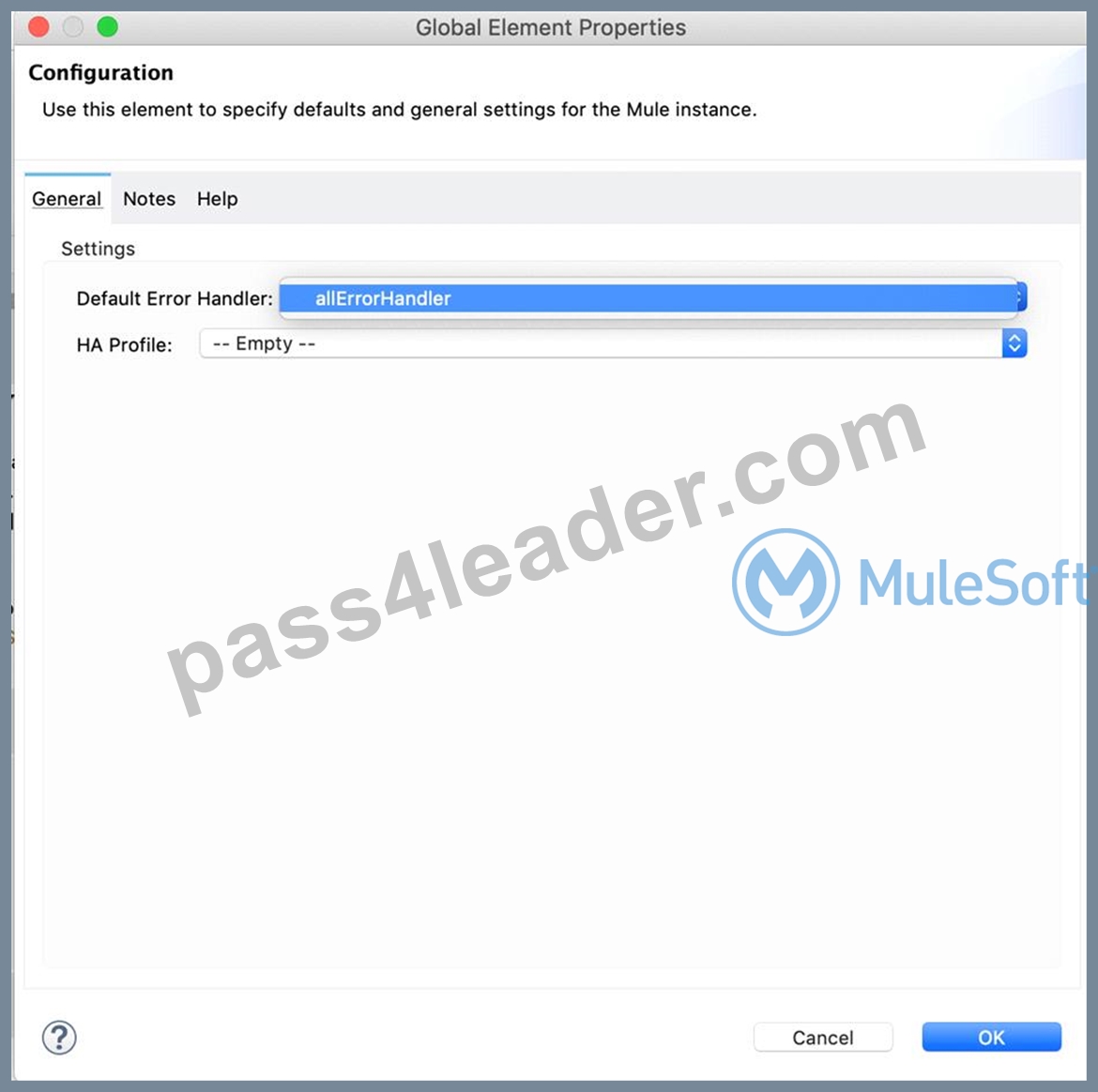
4) From the select Configuration dialog, select allErrorHandler for the Default Error Handler field, and click OK.
NEW QUESTION # 57
Refer to the exhibit.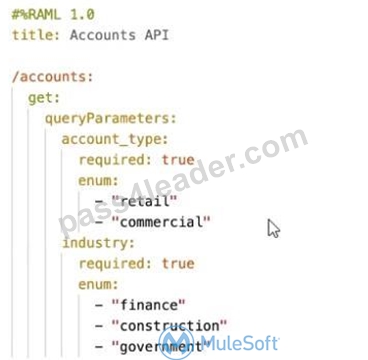
This RAML specification includes a resource and method to retrieve accounts by account_type and industry.
What is the correct URI to get all retail finance accounts?
- A. /accounts/account_type=retall/industty=finance
- B. /accounts?account_type:retail&itxJustry:finance
- C. /accounts/retail/finance
- D. /accounts?account_type=retail&industry=finance
Answer: B
NEW QUESTION # 58
Refer to the exhibits.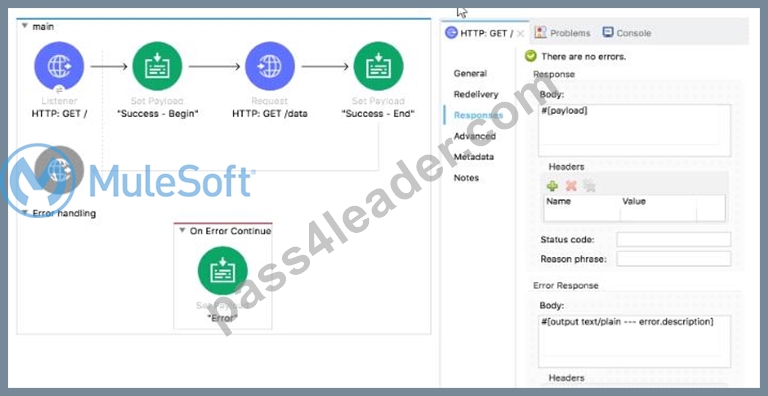
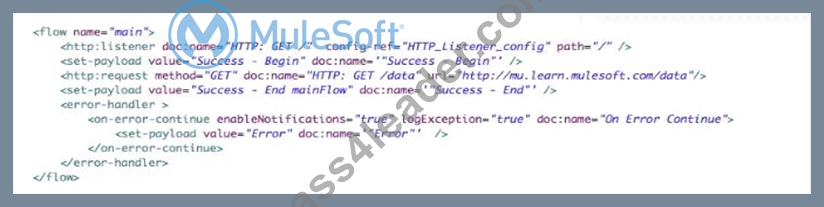
A web client submits a request to the HTTP Listener and the HTTP Request throws an error.
What payload and status code are returned to the web client?
Refer to the exhibits. A web client submits a request to the HTTP Listener and the HTTP Request throws an error.
What payload and status code are returned to the web client?
- A. Response body: "Success - End" Default response status code: 200
- B. Response body: "Success - Begin* Default response status code: 200
- C. Error response body: error, description Default error response status code: 500
- D. Response body: "Error" Default response status code: 200
Answer: D
Explanation:
Response body: "Error" Default response status code: 200.
-------------------------------------------------------------------------------------------------------------------------------------------------
1) Payload is successfully set to "Success - Started Flow"
2) When HTTP Request throws an error, execution halts
#[error.description] = "ABC"
#[error.errorType] = "XYZ"
3) The On Error Continue scope handles the error. When On Error Continue scope is invoked, all the processors in error block are executed and success response is sent back to the client with payload which is set in error flow. In this case payload is set to "Error" value in error block.
4) "Error" is returned to the requestor in the body of the HTTP request with HTTP Status Code: 200 as On error continue always sends success error code.
Reference Diagram: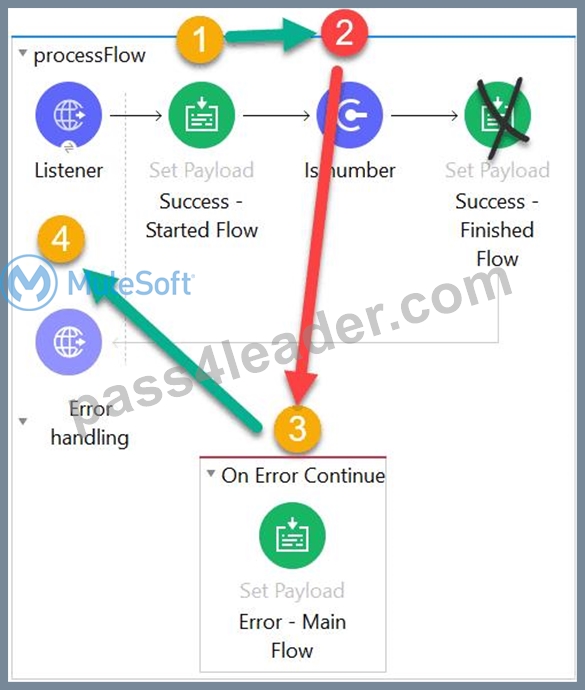
NEW QUESTION # 59
A
web client submits a request to http://localhost:8081?accountType=personal. The query parameter is captured using a Set Variable transformer to a variable named accountType.
What is the correct DataWeave expression to log accountType?
- A. Account Type: # [attributes.accountType]
- B. Account Type: #[message.inboundProperties.accountType]
- C. Account Type: #[vars.accountType]
- D. Account Type: #[flowVars.accountType]
Answer: C
NEW QUESTION # 60
Refer to the exhibits.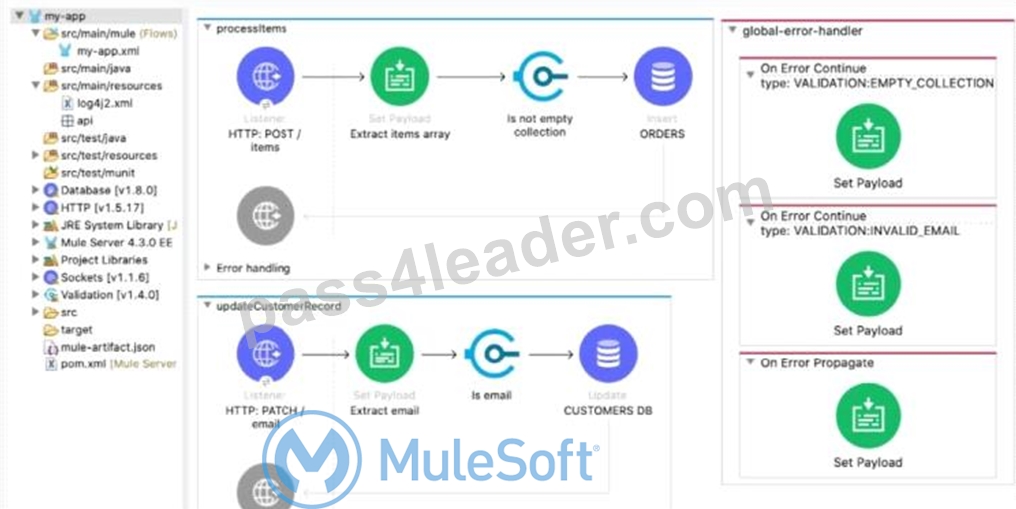
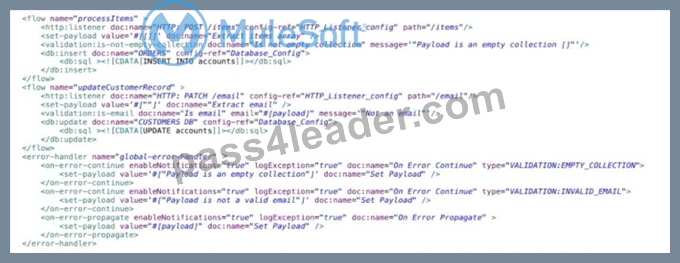
The my-app xml file contains an Error Handier scope named "global-error-handler" The Error Handler scope needs to be set to be the default error handler for every flow in the Mule application Where and how should the value "global-error-handler" be added in the Mule project so that the Error Handler scope is the default error handler of the Mule application?
- A. In the my-app.xml file, as an attribute of a configuration element
- B. In the mule-artifact json file, as the value of a key-value pair
- C. In the Validation folder as the value of a global element in the error-handling yaml file
- D. In the pom.xml file, as the value of a global element
Answer: A
NEW QUESTION # 61
A Mule project contains a DataWeave module called MyModule.dwl that defines a function named formatString. The module is located in the project's src/main/resources/modules folder.
What is the correct way in DataWeave code to import MyModule using a wildcard and then call the module's formatString function?
A)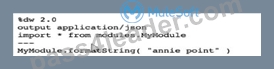
B)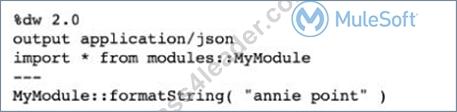
C)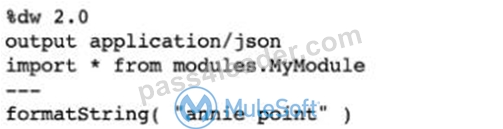
D)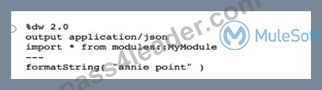
- A. Option A
- B. Option C
- C. Option D
- D. Option B
Answer: C
NEW QUESTION # 62
By default, what happens to a file after it is read using an FTP connector Read operation?
- A. The file is moved to a different folder
- B. The file is renamed in the same folder
- C. The file stays in the same folder unchanged
- D. The file is deleted from the folder
Answer: C
Explanation:
File is not updated when FTP read operations is performed.
MuleSoft Doc Ref : https://docs.mulesoft.com/file-connector/1.3/file-read
NEW QUESTION # 63
Refer to the exhibits.
A web client sends a GET request to the HTTP Listener.
What response message is returned to the web client?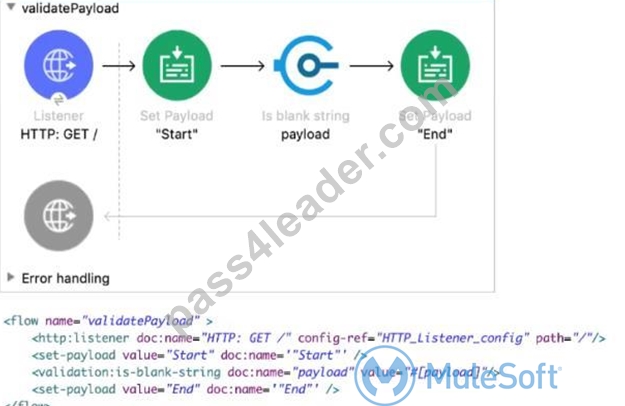
- A. "End"
- B. ""
- C. "Start"
- D. "String is not blank"
Answer: D
NEW QUESTION # 64
Refer to the exhibits. APIKit router is used to generate the flow components for RAML specification.
The Mule application must be available to REST clients using the two URL's
http://localhost:8081/internal and http://localhost:8081/external
How many APIKit Router components are generated to handle requests to every endpoint defined in RAML specification?
1. Library.raml
2. /books
3. get:
4. post:
5. /order:
6. get
7. patch
8. /members
9. get:
- A. 0
- B. 1
- C. 2
- D. 3
Answer: D
Explanation:
Correct answer is 5 as APIkit for REST generates a backend flow for each resource-action pairing in a RAML file.
MuleSOft Doc Ref : https://docs.mulesoft.com/mule-runtime/4.2/build-application-from-api
NEW QUESTION # 65
Refer to the exhibits.
Larger image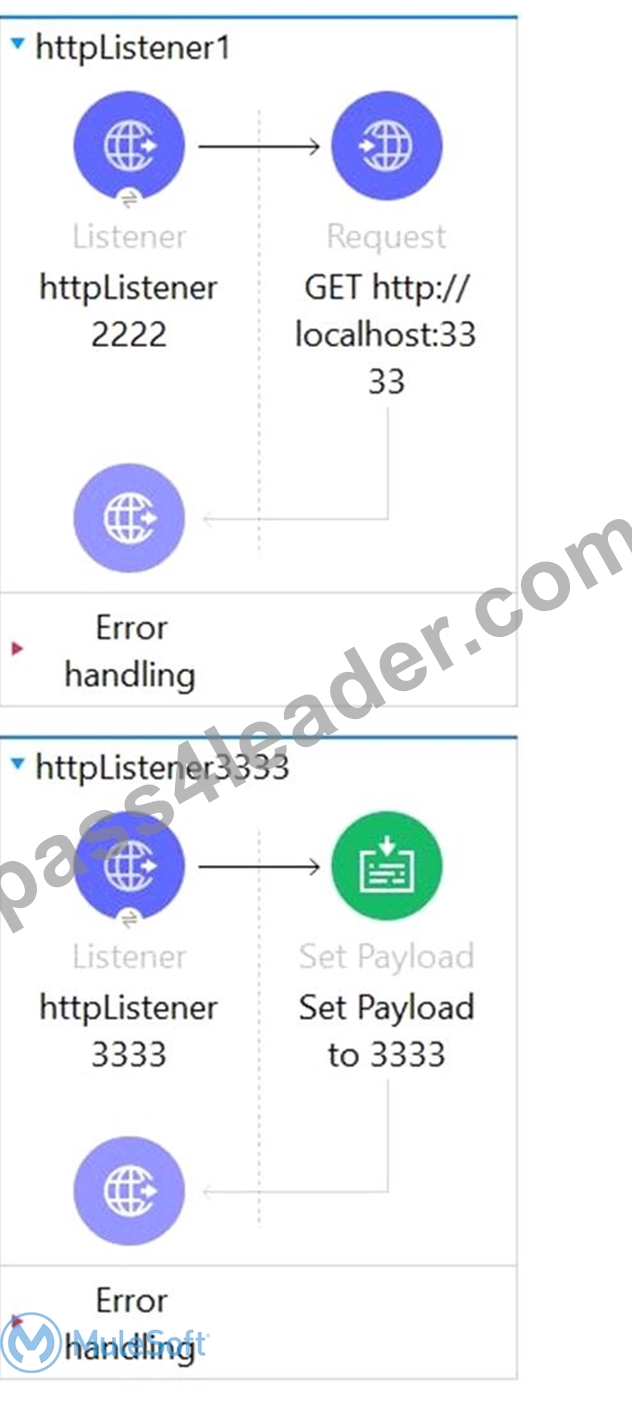
Larger image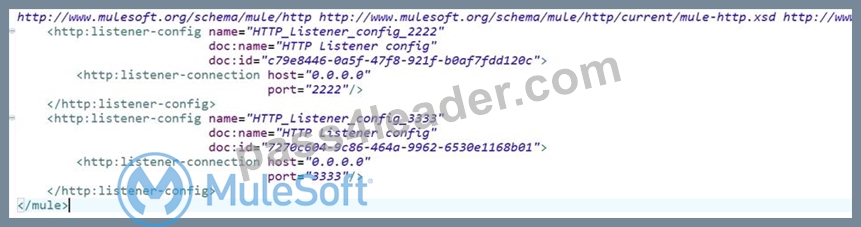
Larger image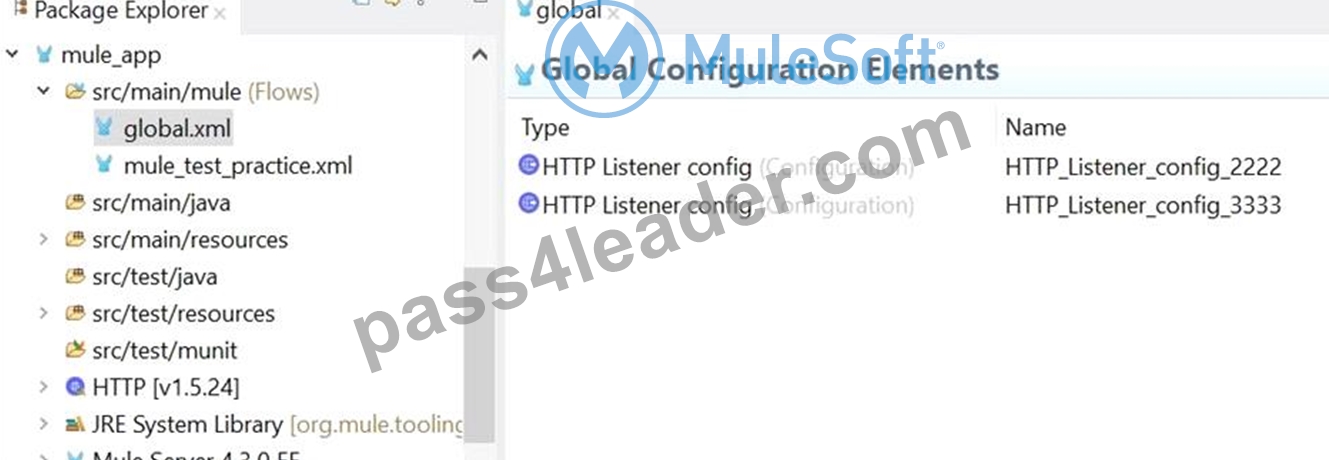
The Mule application configures and uses two HTTP Listener global configuration elements.
Mule application is run in Anypoint Studio.
If the mule application starts correctly, what URI and port numbers can receive web client requests? If the mule applications fails to start , what is the reason for the failure?
- A. The mule application start successfully
Web client requests can only be received at URI on port 2222 but not on port 3333 - B. The mule application fails to start
There is URL path conflict because both HTTP Listeners are configured with same path - C. The mule application start successfully
Web client requests can be received at URI on port 2222 and on port 3333. - D. The mule application fails to start because of the port binding conflict as HTTP request also use same port i.e. 3333
Answer: C
Explanation:
In this case both the flows can start without any error and requests can be received on both ports. Flow names httpListener1 can call other flow using HTTP request without any issues.
NEW QUESTION # 66
An API has been created in Design Center. What is the next step to make the API discoverable?
- A. Publish the API from inside flow designer
- B. Deploy the API to a Maven repository
- C. Publish the API to Anypoint Exchange
- D. Enable autodiscovery in API Manager
Answer: C
Explanation:
Correct answer is Publish the API to Anypoint Exchange
Anypoint Exchange makes this possible by making it discoverable in below ways
1) In private exchange for internal developers
2) In a public portal for external developers/clients
Here is diagram created by me to help you understand sequence: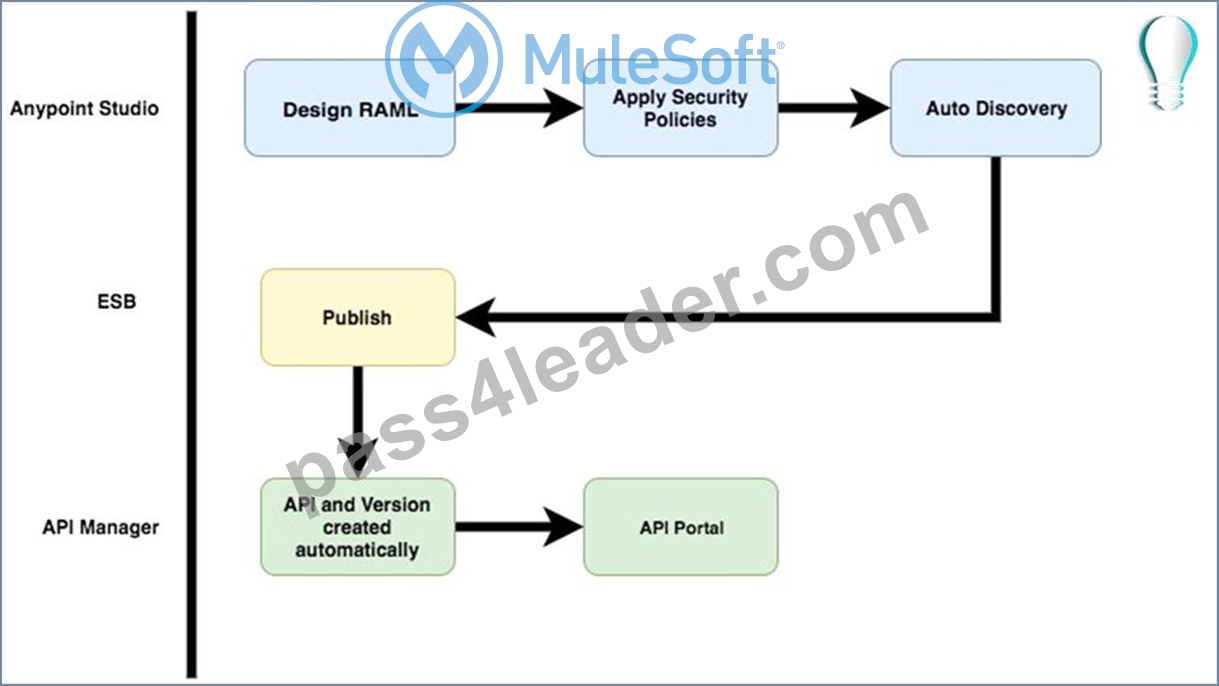
NEW QUESTION # 67
Refer to the exhibits.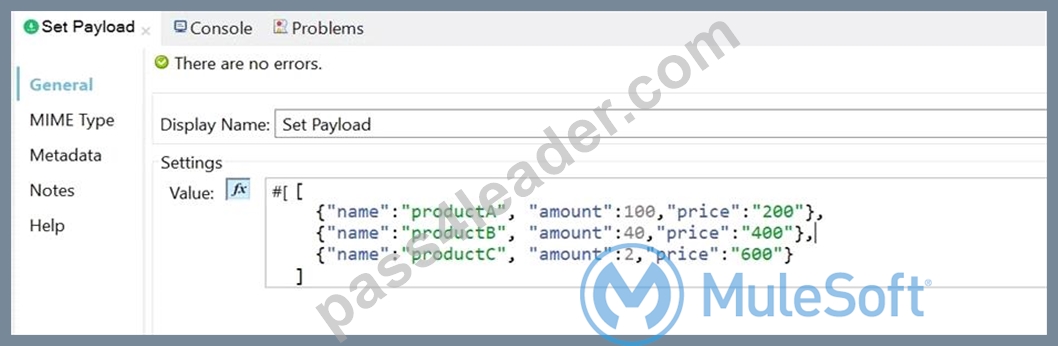
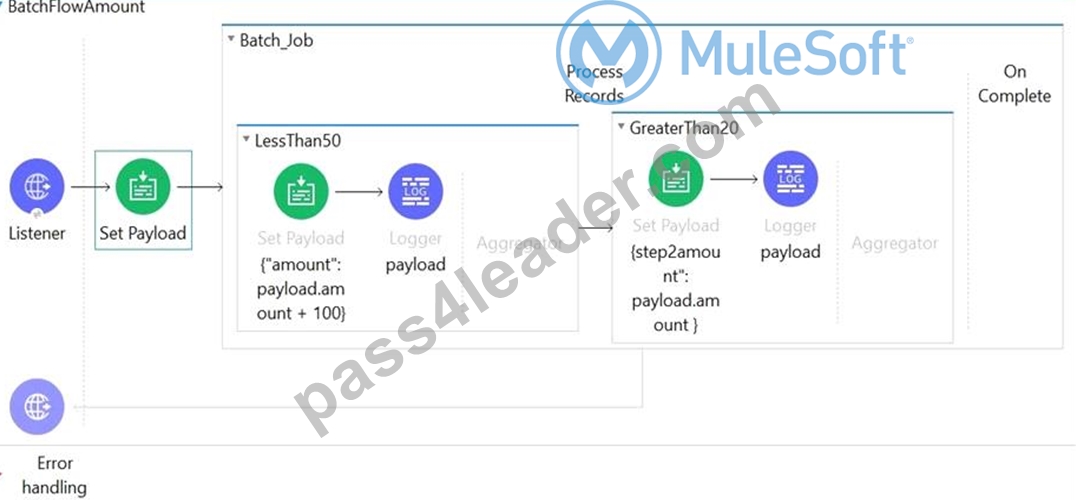
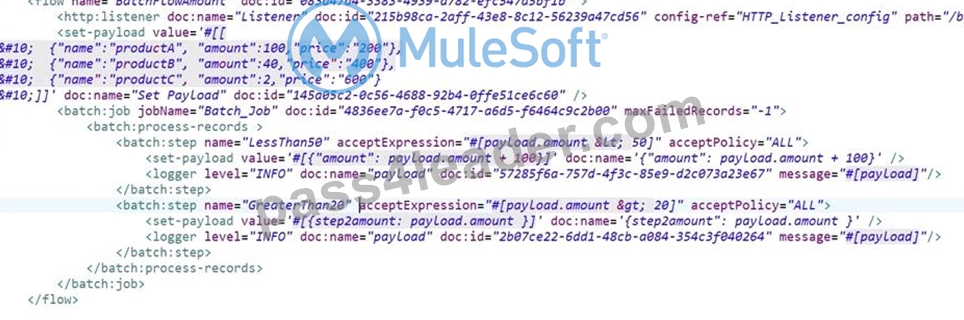
The Batch Job scope contains two Batch Steps scopes with different accept expression.
The input payload is passed to the Batch Job scope.
After the entire payload is processed by the batch job scope , what messages have been logged by the Logger component?
- A. 1. {amount=140}
2. {amount=102}
3. {step2amount=100}
4. {step2amount=140} - B. 1. {amount=140}
2. {amount=102}
3. {step2amount=100}
4. {step2amount=140} - C. 1. {amount=140}
2. {amount=102}
3. {step2amount=100} - D. 1. {amount=140}
2. {amount=102}
3. {step2amount=100}
4. {step2amount=40}
Answer: B
Explanation:
5. {step2amount=102}
Explanation:
Lets understand this solution step by step.
1) Batch Step (Less than 50)
Accept expression for this batch step is less than 50. Hence elements which will go in this batch step are amount value 40 and 2. Hence output of logger in first batch step is
{amount=140}
{amount=102}
2) Batch Step (Greater than 20)
Accept condition for this batch step is greater than 20. Note that input amount values for this batch step are 100 , 140 and 102 (last two values have been updated in batch step less than 50) As all values satisfy this condition out put of second logger is
{step2amount=100}
{step2amount=140}
{step2amount=102}
Hence correct answer to this question is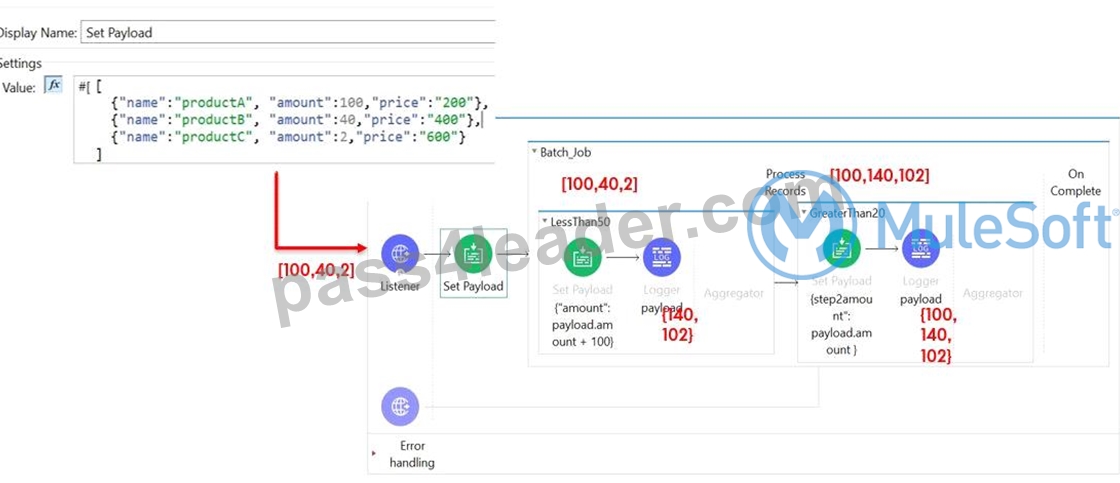
{amount=140}
{amount=102}
{step2amount=100}
{step2amount=140}
{step2amount=102}
NEW QUESTION # 68
Where are values of query parameters stored in the Mule event by the HTTP Listener?
- A. Payload
- B. Attributes
- C. Inbound Properties
- D. Variables
Answer: B
Explanation:
Correct answer is Attributes.
Query parameters , URI parameters and headers are some of examples which are part of attributes.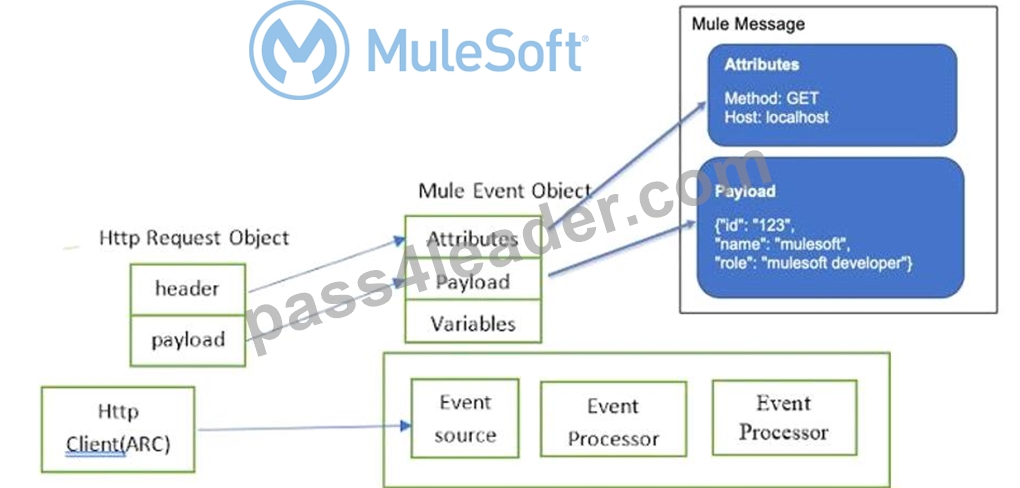
NEW QUESTION # 69
Refer to the exhibit.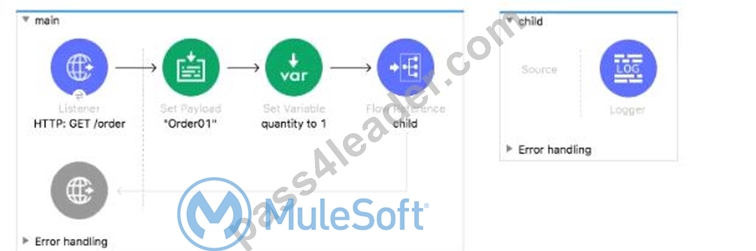
The main flow contains a Flow Reference for the child flow.
What values are accessible in the child flow after a web client submits a request to http://localhost:8Q81/order? color=red?
- A. payload
quantity var color query param - B. payload
color query param - C. payload
- D. payload
quantity var
Answer: A
Explanation:
Correct answer is
payload
quantity var
color query param
NEW QUESTION # 70
Which of the below functionality is provided by zip operator in DataWeave?
- A. All of the above
- B. Minimize the size of long text using encoding.
- C. Merges elements of two lists (arrays) into a single list
- D. Used for sending attachments
Answer: C
Explanation:
Correct answer is Merges elements of two lists (arrays) into a single list MuleSoft Doc Reference : https://docs.mulesoft.com/mule-runtime/4.3/dw-core-functions-zip
NEW QUESTION # 71
What payload is returned by a Database SELECT operation that does not match any rows in the database?
- A. null
- B. false
- C. Exception
- D. Empty Array
Answer: D
NEW QUESTION # 72
Refer to the exhibit.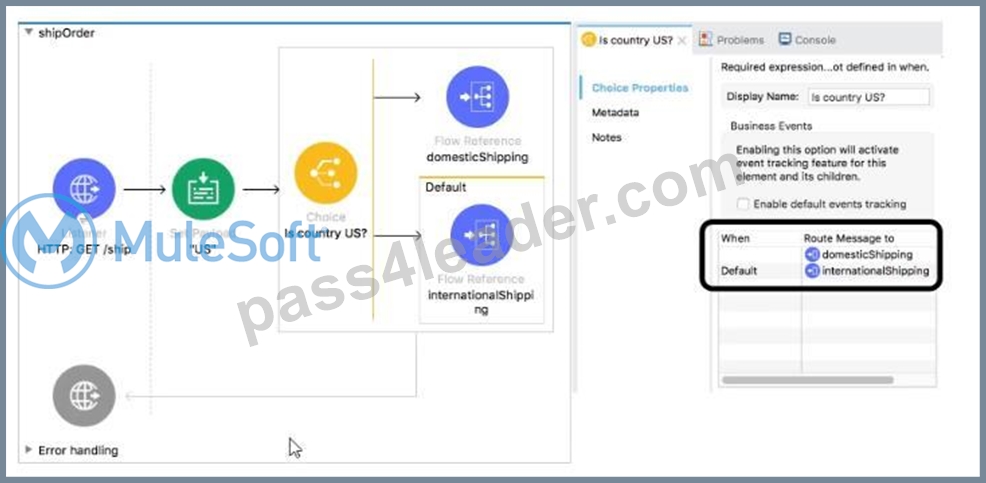
What is a valid expression for the Choice router's when expression to route events to the documenticShipping flow?
- A. #[ if(payload == "US") ]
- B. #[ if(payload = 'US') J
- C. #[ payload == 'US' J
- D. 0#[ payload = 'US' ]
Answer: C
NEW QUESTION # 73
What statement is a part of MuleSoft's description of an application network?
- A. Creates and manages high availability and fault tolerant services and infrastructure
- B. Creates and manages a collection of JMS messaging services and infrastructure
- C. Leverages Central IT to deliver complete point-to-point solutions with master data management
- D. Creates reusable APIs and assets designed to be consumed by other business units
Answer: D
Explanation:
Creates reusable APIs and assets designed to be consumed by other business units
NEW QUESTION # 74
A
web client submits a request to http://localhost:8081/books/0471767840. The value
"0471767840" is captured by a Set Variable transformer to a variable named booklSBN.
What is the DataWeave expression to access booklSBN later in the flow?
- A. attributes.booklSBN
- B. flowVars.booklSBN
- C. vars. booklSBN
- D. booklSBN
Answer: C
NEW QUESTION # 75
A RAML specification is defined to manage customers with a unique identifier for each customer record. What URI does MuleSoft recommend to uniquely access the customer identified with the unique ID 1234?
- A. /customers/custid=1234
- B. /customers?operation=get&custid=1234
- C. /customers/1234
- D. /customers?custid=true&custid=1234
Answer: C
Explanation:
URI parameter (Path Param) is basically used to identify a specific resource or resources . For eg : the URL to get employee details on the basis of employeeID will be GET /employees/{employeeID} where employees is resource and {employeeID} is URI parameter. Hence option 1is the correct answer
NEW QUESTION # 76
Refer to the exhibit.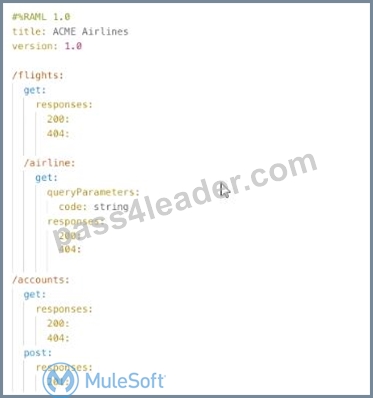
How many private flows does APIKIT generate from the RAML specification?
- A. 0
- B. 1
- C. 2
- D. 3
Answer: B
NEW QUESTION # 77
......
MuleSoft MCD-Level-1 Exam Syllabus Topics:
| Topic | Details |
|---|---|
| Topic 1 |
|
| Topic 2 |
|
| Topic 3 |
|
| Topic 4 |
|
| Topic 5 |
|
| Topic 6 |
|
| Topic 7 |
|
| Topic 8 |
|
| Topic 9 |
|
| Topic 10 |
|
MuleSoft MCD-Level-1 Study Guide Archives : https://www.pass4leader.com/MuleSoft/MCD-Level-1-exam.html