

[Jul-2025] PCCSE Dumps are Available for Instant Access from Pass4Leader
Study resources for the Valid PCCSE Braindumps!
NEW QUESTION # 144
Which step is included when configuring Kubernetes to use Prisma Cloud Compute as an admission controller?
- A. copy the Console address and set the config map for the default namespace.
- B. create a new namespace in Kubernetes called admission-controller.
- C. enable Kubernetes auditing from the Defend > Access > Kubernetes page in the Console.
- D. copy the admission controller configuration from the Console and apply it to Kubernetes.
Answer: D
Explanation:
When configuring Kubernetes to use Prisma Cloud Compute as an admission controller, a crucial step involves D. copy the admission controller configuration from the Console and apply it to Kubernetes. This step is essential for integrating Prisma Cloud Compute's security controls directly into the Kubernetes admission process, enabling real-time security assessments and policy enforcement for new or modified resources within the cluster.
https://docs.paloaltonetworks.com/prisma/prisma-cloud/20-04/prisma-cloud-compute-edition-admin/access_cont step 2
NEW QUESTION # 145
Which two statements are true about the differences between build and run config policies? (Choose two.)
- A. Build policies enable you to check for security misconfigurations in the IaC templates and ensure that these issues do not get into production.
- B. Run and Network policies belong to the configuration policy set.
- C. Build and Audit Events policies belong to the configuration policy set.
- D. Run policies monitor network activities in your environment, and check for potential issues during runtime.
- E. Run policies monitor resources, and check for potential issues after these cloud resources are deployed.
Answer: C,D
NEW QUESTION # 146
Move the steps to the correct order to set up and execute a serverless scan using AWS DevOps.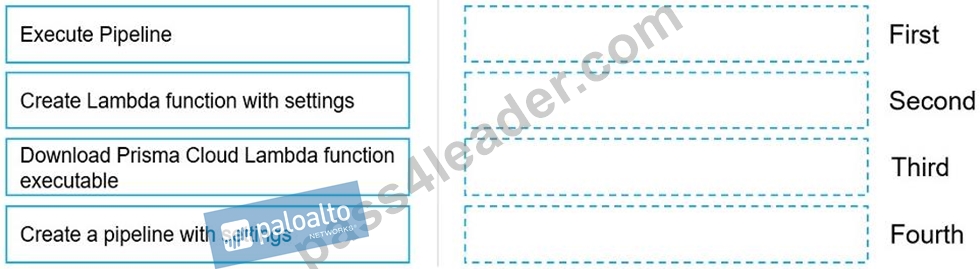
Answer:
Explanation: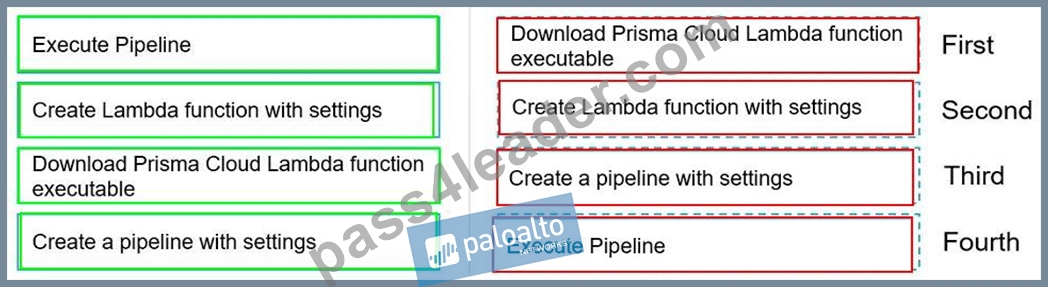
NEW QUESTION # 147
Which role does Prisma Cloud play when configuring SSO?
- A. Service provider
- B. JIT
- C. Identity provider issuer
- D. SAML
Answer: C
NEW QUESTION # 148
An administrator wants to install the Defenders to a Kubernetes cluster. This cluster is running the console on the default service endpoint and will be exporting to YAML.
Console Address: $CONSOLE_ADDRESS Websocket Address: $WEBSOCKET_ADDRESS User: $ADMIN_USER Which command generates the YAML file for Defender install?
- A. <PLATFORM>/twistcli defender export kubernetes \
--address $CONSOLE_ADDRESS \
--user $ADMIN_USER \
--cluster-address $WEBSOCKET_ADDRESS - B. <PLATFORM>/twistcli defender YAML kubernetes \
--address $CONSOLE_ADDRESS \
--user $ADMIN_USER \
--cluster-address $WEBSOCKET_ADDRESS - C. <PLATFORM>/twistcli defender export kubernetes \
--address $WEBSOCKET_ADDRESS \
--user $ADMIN_USER \
--cluster-address $CONSOLE_ADDRESS - D. <PLATFORM>/twistcli defender \
--address $CONSOLE_ADDRESS \
--user $ADMIN_USER \
--cluster-address $CONSOLE_ADDRESS
Answer: A
NEW QUESTION # 149
Which order of steps map a policy to a custom compliance standard?
(Drag the steps into the correct order of occurrence, from the first step to the last.)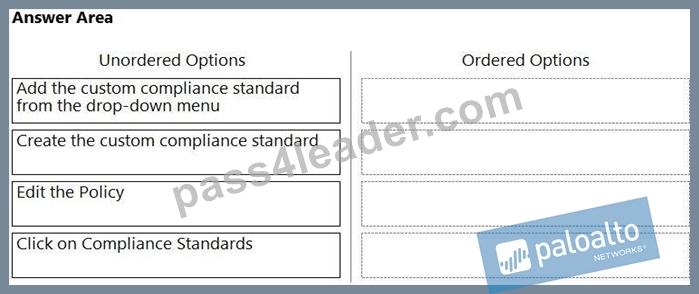
Answer:
Explanation: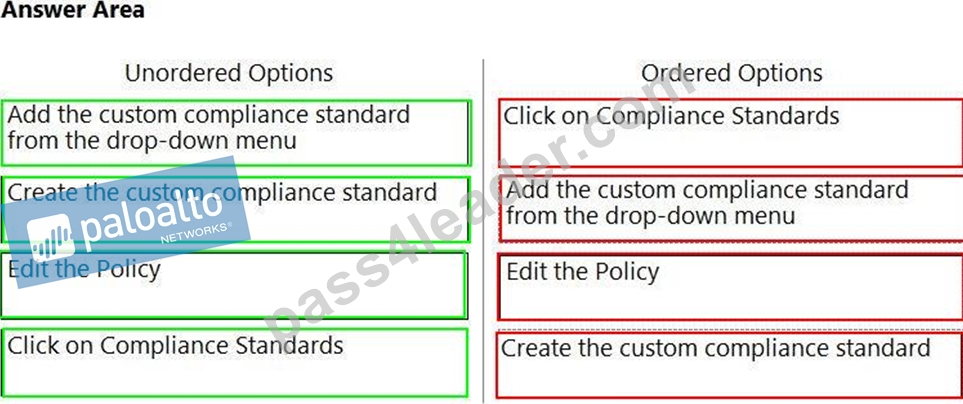
NEW QUESTION # 150
Console is running in a Kubernetes cluster, and Defenders need to be deployed on nodes within this cluster.
How should the Defenders in Kubernetes be deployed using the default Console service name?
- A. From the deployment page in Console, choose "pod name" for Console identifier, generate DaemonSet file, and apply the DaemonSet to twistlock namespace.
- B. From the deployment page, configure the cloud credential in Console and allow cloud discovery to auto-protect the Kubernetes nodes.
- C. From the deployment page in Console, choose "twistlock-console" for Console identifier and run the "curl | bash" script on the master Kubernetes node.
- D. From the deployment page in Console, choose "twistlock-console" for Console identifier, generate DaemonSet file, and apply DaemonSet to the twistlock namespace.
Answer: D
Explanation:
In Kubernetes environments, deploying Defenders to protect nodes involves leveraging DaemonSets, which ensure that every node in the cluster runs a copy of a specific pod. When the Console is running within a Kubernetes cluster, it's essential to correctly reference the Console service to ensure seamless communication between Defenders and the Console. Option A is the most straightforward and Kubernetes-native method for deploying Defenders. By choosing "twistlock-console" as the Console identifier on the deployment page within the Console, users can generate a DaemonSet configuration file tailored for the Twistlock namespace. This approach ensures that the Defenders are correctly configured to communicate with the Console, providing comprehensive security coverage across the Kubernetes nodes. This method aligns with best practices for deploying security agents in Kubernetes and is supported by Prisma Cloud (formerly Twistlock) documentation, which provides step-by-step instructions for deploying Defenders using DaemonSets.
NEW QUESTION # 151
A Prisma Cloud administrator is tasked with pulling a report via API. The Prisma Cloud tenant is located on app2.prismacloud.io.
What is the correct API endpoint?
- A. https://api2.eu.prismacloud.io
- B. httsp://api.prismacloud.cn
- C. https://api2.prismacloud.io
- D. https://api.prismacloud.io
Answer: C
Explanation:
Explanation
https://prisma.pan.dev/api/cloud/api-urls/
NEW QUESTION # 152
In Prisma Cloud for Azure Net Effective Permissions Calculation, the following Azure permission levels are supported by which three permissions? (Choose three).
- A. Subscription
- B. Resource groups
- C. Management Group
- D. Resources
- E. Tenant
Answer: A,C,D
Explanation:
https://docs.prismacloud.io/en/classic/cspm-admin-guide/prisma-cloud-iam-security/context-used-to-calculate-ef
NEW QUESTION # 153
What is the behavior of Defenders when the Console is unreachable during upgrades?
- A. Defenders continue to alert, but not enforce, using the policies and settings most recently cached before upgrading the Console.
- B. Defenders will fail closed until the web-socket can be re-established.
- C. Defenders will fail open until the web-socket can be re-established.
- D. Defenders continue to alert and enforce using the policies and settings most recently cached before upgrading the Console.
Answer: D
Explanation:
When the Console is unreachable during upgrades, Defenders continue to alert and enforce using the policies and settings most recently cached before the upgrade (option D). This behavior ensures that security enforcement remains active and consistent, even when the central management console is temporarily unavailable. The cached policies enable Defenders to maintain the security posture based on the last known configuration, ensuring continuous protection against threats and compliance with established security policies. This approach reflects Prisma Cloud's design principle of ensuring uninterrupted security enforcement, thereby safeguarding the environment against potential vulnerabilities during maintenance periods.
NEW QUESTION # 154
Review this admission control policy:
match[{"msg": msg}] { input.request.operation == "CREATE" input.request.kind.kind == "Pod" input.request.resource.resource == "pods" input.request.object.spec.containers[_].securityContext.privileged msg := "Privileged"
}
Which response to this policy will be achieved when the effect is set to "block"?
- A. The policy will replace Defender with a privileged Defender.
- B. The policy will block the creation of a privileged pod.
- C. The policy will block all pods on a Privileged host.
- D. The policy will alert only the administrator when a privileged pod is created.
Answer: B
Explanation:
The given admission control policy is designed to evaluate pod creation requests in a Kubernetes environment, specifically targeting the creation of privileged pods, which can pose significant security risks.
Option D: The policy will block the creation of a privileged pod is the correct answer when the effect of the policy is set to "block". In this context, the policy's logic checks if a pod being created is set to run in privileged mode (a high-risk configuration that grants the pod extended system privileges). If such a configuration is detected, the policy triggers an action to block the pod's creation, thereby preventing the deployment of privileged pods that could undermine the security posture of the Kubernetes environment.
Reference:
Kubernetes Admission Controllers Documentation: Provides a comprehensive overview of admission controllers in Kubernetes, including how they can be used to enforce policy decisions, such as preventing the creation of privileged pods.
Best Practices for Kubernetes Security: Discusses the importance of admission control policies in maintaining the security and integrity of Kubernetes environments, with specific emphasis on the risks associated with privileged pods.
NEW QUESTION # 155
Which two offerings will scan container images in Jenkins pipelines? (Choose two.)
- A. Jenkins Docker plugin
- B. Twistcli
- C. Prisma Cloud Visual Studio Code plugin with Jenkins integration
- D. Compute Jenkins plugin
- E. Compute Azure DevOps plugin
Answer: B,E
Explanation:
To integrate security scanning within Jenkins pipelines for container images, the most appropriate tools are the Compute Azure DevOps plugin and Twistcli. The Compute Azure DevOps plugin is designed to integrate with CI/CD workflows, allowing automated security scanning of container images as part of the build process in Azure DevOps environments. This plugin can be used in conjunction with Jenkins pipelines through integration points or scripting to trigger scans during the build or deployment stages. Twistcli, on the other hand, is a command-line interface tool provided by Prisma Cloud (formerly Twistlock) that allows for scanning of container images for vulnerabilities and compliance issues. Twistcli can be directly integrated into Jenkins pipelines using shell scripts or pipeline commands to perform security scans on container images before they are deployed. This ensures that only secure and compliant container images are used in production environments, aligning with DevSecOps practices.
NEW QUESTION # 156
The security team wants to target a CNAF policy for specific running Containers. How should the administrator scope the policy to target the Containers?
- A. scope the policy to Image names.
- B. scope the policy to namespaces.
- C. scope the policy to Defender names.
- D. scope the policy to Host names.
Answer: A
Explanation:
To specifically target running containers with a Cloud Native Application Framework (CNAF) policy in Prisma Cloud, the administrator should scope the policy to Image names. By doing so, the policy will apply to containers based on the images they were created from, allowing for precise targeting of security policies to specific containers. This approach is part of Prisma Cloud's capabilities to provide granular security controls for containerized environments, ensuring that policies are effectively applied to the relevant containers.
NEW QUESTION # 157
A customer is reviewing Container audits, and an audit has identified a cryptominer attack. Which three options could have generated this audit? (Choose three.)
- A. High CPU usage over time for the container is detected.
- B. Common cryptominer process name was found.
- C. The mined currency is associated with a user token.
- D. Common cryptominer port usage was found.
- E. The value of the mined currency exceeds $100.
Answer: A,B,C
NEW QUESTION # 158
Which role must be assigned to DevOps users who need access to deploy Container and Host Defenders in Compute?
- A. Build and Deploy Security
- B. System Admin
- C. Developer
- D. Cloud Provisioning Admin
Answer: A
Explanation:
The role that should be assigned to DevOps users who need access to deploy Container and Host Defenders in Compute within Prisma Cloud is typically "Build and Deploy Security." This role is designed to provide the necessary permissions for users involved in the development and deployment phases of the application lifecycle. It allows them to integrate security measures, such as deploying Container and Host Defenders, into their workflows. By having this role, DevOps teams can ensure that security is embedded into the build and deployment processes, helping to maintain the security of containerized and host-based applications from the outset.
NEW QUESTION # 159
A customer is reviewing Container audits, and an audit has identified a cryptominer attack. Which three options could have generated this audit? (Choose three.)
- A. The mined currency is associated with a user token.
- B. Common cryptominer process name was found
- C. High CPU usage over time for the container is detected.
- D. The value of the mined currency exceeds $100.
- E. Common cryptominer port usage was found.
Answer: A,B,E
NEW QUESTION # 160
The administrator wants to review the Console audit logs from within the Console Which page in the Console should the administrator use to review this data, if it can be reviewed at all?
- A. Navigate to Manage > Defenders > View Logs
- B. The audit logs can be viewed only externally to the Console
- C. Navigate to Monitor > Events > Host Log Inspection
- D. Navigate to Manage > View Logs > History
Answer: D
NEW QUESTION # 161
An administrator has a requirement to ingest all Console and Defender logs to Splunk.
Which option will satisfy this requirement in Prisma Cloud Compute?
- A. Enable the CSV export in the Console.
- B. Enable the syslog option in the Console
- C. Enable the API settings for logging.
- D. Enable the Splunk option in the Console.
Answer: D
Explanation:
Prisma Cloud Compute offers native integration capabilities with Splunk, a leading platform for operational intelligence and security information and event management (SIEM). By enabling the Splunk option within the Prisma Cloud Console, administrators can seamlessly forward Console and Defender logs to Splunk. This integration facilitates advanced analytics, real-time monitoring, and comprehensive incident response workflows within Splunk, leveraging the detailed security data provided by Prisma Cloud Compute.
NEW QUESTION # 162
What is the order of steps to create a custom network policy?
(Drag the steps into the correct order of occurrence, from the first step to the last.)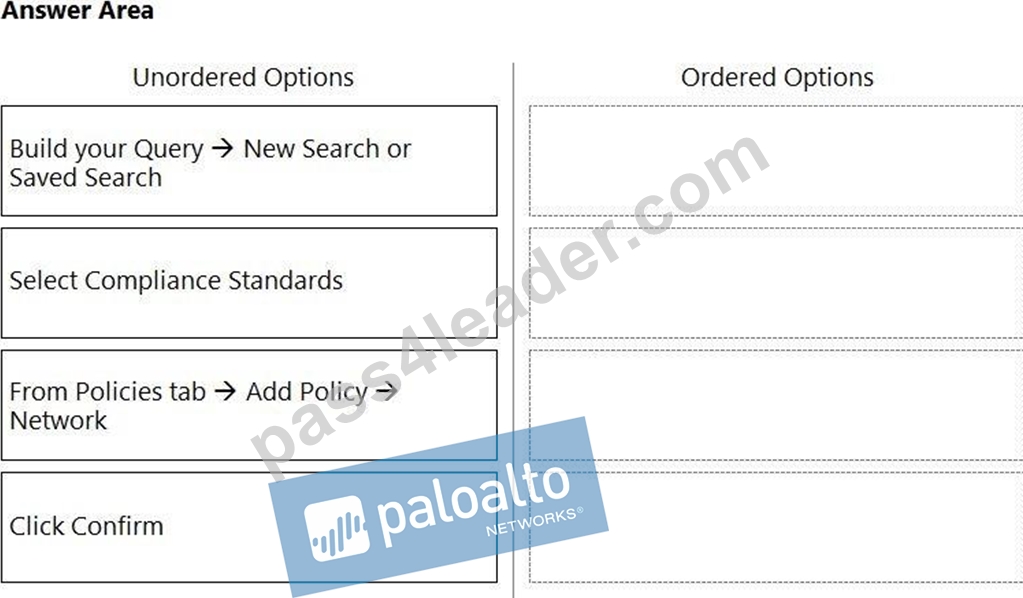
Answer:
Explanation: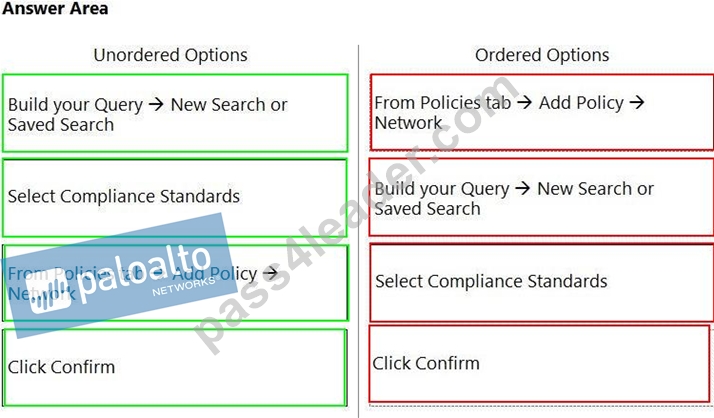
Reference:
https://docs.paloaltonetworks.com/prisma/prisma-cloud/prisma-cloud-admin/prisma-cloud-policies/create-a- policy.html
NEW QUESTION # 163
Which two bot types are part of Web Application and API Security (WAAS) bot protection? (Choose two.)
- A. Customer bots
- B. User-defined bots
- C. Chat bots
- D. Unknown bots
Answer: A,D
NEW QUESTION # 164
An administrator wants to install the Defenders to a Kubernetes cluster. This cluster is running the console on the default service endpoint and will be exporting to YAML.
Console Address: $CONSOLE_ADDRESS Websocket Address: $WEBSOCKET_ADDRESS User:
$ADMIN_USER
Which command generates the YAML file for Defender install?
- A. <PLATFORM>/twistcli defender export kubernetes \
--address $CONSOLE_ADDRESS \
--user $ADMIN_USER \
--cluster-address $WEBSOCKET_ADDRESS - B. <PLATFORM>/twistcli defender YAML kubernetes \
--address $CONSOLE_ADDRESS \
--user $ADMIN_USER \
--cluster-address $WEBSOCKET_ADDRESS - C. <PLATFORM>/twistcli defender export kubernetes \
--address $WEBSOCKET_ADDRESS \
--user $ADMIN_USER \
--cluster-address $CONSOLE_ADDRESS - D. <PLATFORM>/twistcli defender \
--address $CONSOLE_ADDRESS \
--user $ADMIN_USER \
--cluster-address $CONSOLE_ADDRESS
Answer: A
Explanation:
The correct command to generate the YAML file for Defender install in a Kubernetes cluster, considering the console and websocket addresses, as well as the admin user, would typically involve specifying the addresses and user details. The option D seems most aligned with standard practices for such commands, where you export the Defender configuration for Kubernetes, specifying the console and websocket addresses along with the user details.
NEW QUESTION # 165
......
Updated PCCSE Tests Engine pdf - All Free Dumps Guaranteed: https://www.pass4leader.com/Palo-Alto-Networks/PCCSE-exam.html
Latest Cloud Security Engineer PCCSE Actual Free Exam Questions: https://drive.google.com/open?id=1t1jsieoeNaAmFNVvY-ZrLKXTwpMK3J2T