

[2024] Pass HP HPE6-A78 Premium Files Test Engine pdf - Free Dumps Collection
New 2024 Realistic HPE6-A78 Dumps Test Engine Exam Questions in here
NEW QUESTION # 57
An ArubaOS-CX switch enforces 802.1X on a port. No fan-through options or port-access roles are configured on the port The 802 1X supplicant on a connected client has not yet completed authentication Which type of traffic does the authenticator accept from the client?
- A. EAP only
- B. RADIUS only
- C. DHCP, DNS and RADIUS only
- D. DHCP, DNS, and EAP only
Answer: A
Explanation:
For an ArubaOS-CX switch enforcing 802.1X on a port without any fallback options or port-access roles configured, and where the supplicant on the connected client has not completed authentication, the only type of traffic the authenticator accepts from the client is EAP (Extensible Authentication Protocol). EAP is a universal authentication framework used in 802.1X for message exchange during the authentication process.
The switch allows EAP packets because they are necessary for the client and the authentication server to perform the authentication process. This is standard behavior for 802.1X authenticators, which is to permit EAP traffic to pass through even before authentication is successful to facilitate the authentication exchange.
This information is supported by the IEEE 802.1X standard and ArubaOS-CX security configuration guides.
NEW QUESTION # 58
Refer to the exhibit.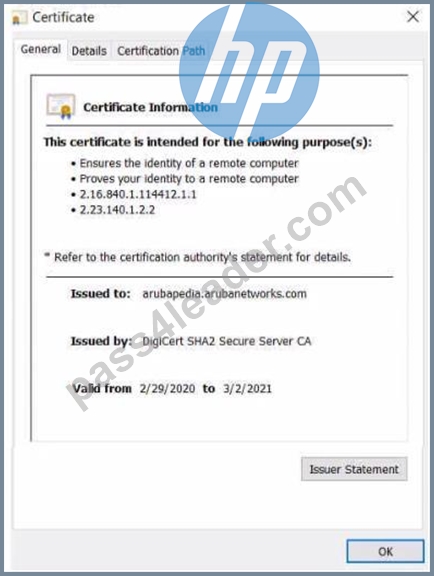
Device A is establishing an HTTPS session with the Arubapedia web sue using Chrome. The Arubapedia web server sends the certificate shown in the exhibit What does the browser do as part of vacating the web server certificate?
- A. It uses the public key in the DigCert root CA certificate to check the certificate signature
- B. It uses the private key in the Arubapedia web site's certificate to check that certificate's signature
- C. It uses the public key in the DigCen SHA2 Secure Server CA certificate to check the certificate's signature.
- D. It uses the private key in the DigiCert SHA2 Secure Server CA to check the certificate's signature.
Answer: C
NEW QUESTION # 59
What is a consideration for using MAC authentication (MAC-Auth) to secure a wired or wireless connection?
- A. MAC-Auth can add a degree of security to an open WLAN by enabling the generation of a PMK to encrypt traffic.
- B. Headless devices, such as Internet of Things (loT) devices, must be configured in advance to support MAC-Auth.
- C. It is very easy for hackers to spoof their MAC addresses and get around MAC authentication.
- D. As a Layer 2 authentication method, MAC-Auth cannot be used to authenticate devices to an external authentication server.
Answer: C
Explanation:
MAC authentication, also known as MAC-Auth, is a method used to authenticate devices based on their Media Access Control (MAC) address. It is often employed in both wired and wireless networks to grant network access based solely on the MAC address of a device. While MAC-Auth is straightforward and doesn't require complex configuration, it has significant security limitations primarily because MAC addresses can be easily spoofed. Attackers can change the MAC address of their device to match an authorized one, thereby gaining unauthorized access to the network. This susceptibility to MAC address spoofing makes MAC-Auth a weaker security mechanism compared to more robust authentication methods like 802.1X, which involves mutual authentication and encryption protocols.
NEW QUESTION # 60
Which is a use case for enabling Control Plane Policing on Aruba switches?
- A. to prevent the switch from accepting routing updates from unauthorized users
- B. to mitigate Denial of Service (Dos) attacks on the switch
- C. to encrypt traffic between tunneled node switches and Mobility Controllers (MCs)
- D. to prevent unauthorized network devices from sending routing updates
Answer: B
Explanation:
Control Plane Policing (CoPP) on Aruba switches is used to mitigate Denial of Service (DoS) attacks on the switch. CoPP allows network administrators to restrict the impact of control plane traffic on the switch's CPU, thereby protecting network stability and integrity. By setting rate limits and specifying allowed traffic types, administrators can prevent malicious or malformed packets from overwhelming the switch's control plane, which could otherwise lead to a DoS condition and potentially disrupt network operations. This use case of CoPP is detailed in Aruba's network management documentation, where best practices and configurations to protect against DoS attacks are discussed.
NEW QUESTION # 61
What is a Key feature of me ArubaOS firewall?
- A. The firewall is stateful which means that n can track client sessions and automatically allow return traffic for permitted sessions
- B. The firewall Includes application layer gateways (ALGs). which it uses to filter Web traffic based on the reputation of the destination web site.
- C. The firewall is designed to fitter traffic primarily based on wireless 802.11 headers, making it ideal for mobility environments
- D. The firewall examines all traffic at Layer 2 through Layer 4 and uses source IP addresses as the primary way to determine how to control traffic.
Answer: B
NEW QUESTION # 62
What distinguishes a Distributed Denial of Service (DDoS) attack from a traditional Denial or service attack (DoS)?
- A. A DDoS attack originates from external devices, while a DoS attack originates from internal devices
- B. A DoS attack targets one server, a DDoS attack targets all the clients that use a server
- C. A DDoS attack targets multiple devices, while a DoS Is designed to Incapacitate only one device
- D. A DDoS attack is launched from multiple devices, while a DoS attack is launched from a single device
Answer: D
Explanation:
The main distinction between a Distributed Denial of Service (DDoS) attack and a traditional Denial of Service (DoS) attack is that a DDoS attack is launched from multiple devices, whereas a DoS attack originates from a single device. This distinction is critical because the distributed nature of a DDoS attack makes it more difficult to mitigate. Multiple attacking sources can generate a higher volume of malicious traffic, overwhelming the target more effectively than a single source, as seen in a DoS attack. DDoS attacks exploit a variety of devices across the internet, often coordinated using botnets, to flood targets with excessive requests, leading to service degradation or complete service denial.
References:
Cybersecurity texts and resources that differentiate between types of denial of service attacks.
Technical documentation and analysis of DDoS tactics, which illustrate how botnets and other distributed systems are employed to execute attacks.
NEW QUESTION # 63
A company has a WLAN that uses Tunnel forwarding mode and WPA3-Enterprise security, supported by an Aruba Mobility Controller (MC) and campus APs (CAPs). You have been asked to capture packets from a wireless client connected to this WLAN and submit the packets to the security team.
What is a guideline for this capture?
- A. You should mirror traffic from the switch port that connects to the AP out on a port connected to a packet analyzer.
- B. You should capture the traffic on the AP, so that the capture is as close to the source as possible.
- C. You should use an Air Monitor (AM) to capture the packets in the air.
- D. You should capture the traffic on the MC dataplane to obtain unencrypted traffic.
Answer: C
Explanation:
The correct approach for capturing packets from a wireless client in a WLAN that uses Tunnel forwarding mode and WPA3-Enterprise, managed by an Aruba Mobility Controller and Campus APs, is to use an Air Monitor (AM). An AM is specifically designed to capture wireless traffic "in the air," which means it listens to the wireless signals transmitted between devices and the access points. This method ensures that the capture includes all the necessary details while maintaining the integrity and security of the data as it is transmitted over the air. Using an Air Monitor helps in analyzing the raw wireless traffic before it gets encrypted or tunneled to the Mobility Controller, providing a clear view of the wireless client's activity and interactions. The information regarding the use of Air Monitors for packet capture in such environments can be found in the Aruba Network's official documentation and configuration guides for WLAN setups and security analysis.
NEW QUESTION # 64 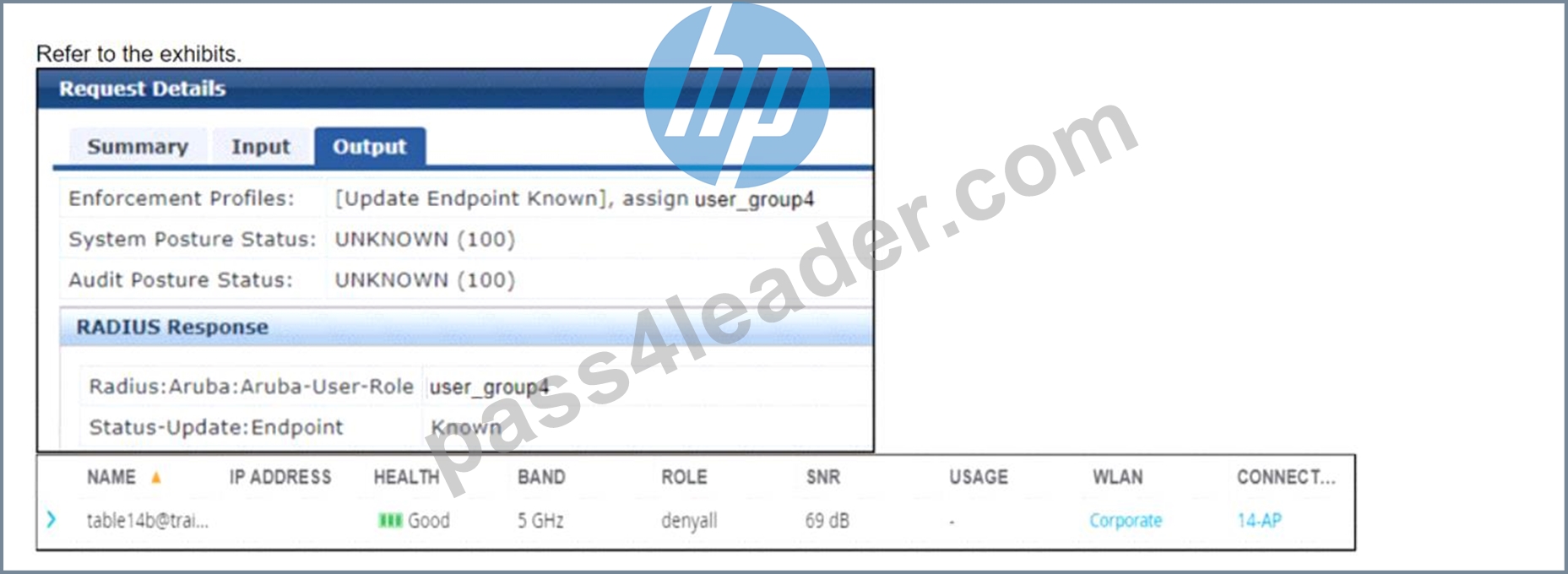
A company has added a new user group. Users in the group try to connect to the WLAN and receive errors that the connection has no Internet access. The users cannot reach any resources. The first exhibit shows the record for one of the users who cannot connect. The second exhibit shows the role to which the ArubaOS device assigned the user's client.
What is a likely problem?
- A. The ArubaOS device does not have the correct RADIUS dictionaries installed on it to under-stand the Aruba-User-Role VSA.
- B. The clients rejected the server authentication on their side because they do not have the root CA for CPPM's RADIUS/EAP certificate.
- C. The role name that CPPM is sending does not match the role name configured on the Aru-baOS device.
- D. The ArubaOS device has a server derivation rule configured on it that has overridden the role sent by CPPM.
Answer: C
Explanation:
The image indicates that there is an issue with the user role assignment, which is key to network access in ArubaOS. If the user role name sent by CPPM doesn't match any of the roles defined in the ArubaOS, then the user will be assigned a default or incorrect role that does not have the necessary permissions, thus leading to the connection errors and lack of Internet access. Ensuring that the role names are consistent between CPPM and ArubaOS can resolve this issue.
NEW QUESTION # 65
Your Aruba Mobility Master-based solution has detected a rogue AP Among other information the ArubaOS Detected Radios page lists this Information for the AP SSID = PubllcWiFI BSSID = a8M27 12 34:56 Match method = Exact match Match type = Eth-GW-wired-Mac-Table The security team asks you to explain why this AP is classified as a rogue. What should you explain?
- A. The AP has been detected as launching a DoS attack against your company's default gateway. This qualities it as a rogue which needs to be contained with wireless association frames immediately
- B. The AP Is connected to your LAN because It is transmitting wireless traffic with your network's default gateway's MAC address as a source MAC Because it does not belong to the company, it is a rogue
- C. The ap has a BSSID mat matches authorized client MAC addresses. This indicates that the AP is spoofing the MAC address to gam unauthorized access to your company's wireless services, so It is a rogue
- D. The AP is spoofing a routers MAC address as its BSSID. This indicates mat, even though WIP cannot determine whether the AP is connected to your LAN. it is a rogue.
Answer: B
Explanation:
The AP is classified as a rogue because it is connected to your LAN and is transmitting wireless traffic with your network's default gateway's MAC address as a source MAC. In this scenario, the 'Match method = Exact match' and 'Match type = Eth-GW-wired-Mac-Table' indicates that the rogue AP has been detected by matching the Ethernet gateway's MAC address, which is on the wired network, implying that the rogue AP is connected to the corporate LAN. Since the AP does not belong to the company, its presence on the network is unauthorized and is thus classified as a rogue AP.
References:
ArubaOS documentation on rogue AP detection and classification.
Wireless security best practices that explain how the presence of unauthorized APs on the LAN constitutes a security threat.
NEW QUESTION # 66
How should admins deal with vulnerabilities that they find in their systems?
- A. They should add the vulnerability to their Common Vulnerabilities and Exposures (CVE).
- B. They should apply fixes, such as patches, to close the vulnerability before a hacker exploits it.
- C. They should notify the security team as soon as possible that the network has already been breached.
- D. They should classify the vulnerability as malware. a DoS attack or a phishing attack.
Answer: B
NEW QUESTION # 67
Your ArubaoS solution has detected a rogue AP with Wireless intrusion Prevention (WIP). Which information about the detected radio can best help you to locate the rogue device?
- A. the confidence level
- B. the detecting devices
- C. the match method
- D. the match type
Answer: C
NEW QUESTION # 68
You have detected a Rogue AP using the Security Dashboard Which two actions should you take in responding to this event? (Select two)
- A. There is no need to locate the AP If the Aruba solution is properly configured to automatically contain it.
- B. This is a serious security event, so you should always contain the AP immediately regardless of your company's specific policies.
- C. For forensic purposes, you should copy out logs with relevant information, such as the time mat the AP was detected and the AP's MAC address.
- D. You should receive permission before containing an AP. as this action could have legal Implications.
- E. There is no need to locale the AP If you manually contain It.
Answer: B,C
NEW QUESTION # 69
What is a benefit or Protected Management Frames (PMF). sometimes called Management Frame Protection (MFP)?
- A. PMF protects clients from DoS attacks based on forged de-authentication frames
- B. PMF helps to protect APs and MCs from unauthorized management access by hackers.
- C. PMF ensures trial traffic between APs and Mobility Controllers (MCs) is encrypted.
- D. PMF prevents hackers from capturing the traffic between APs and Mobility Controllers.
Answer: B
NEW QUESTION # 70
A company has Aruba Mobility Controllers (MCs), Aruba campus APs, and ArubaOS-CX switches. The company plans to use ClearPass Policy Manager (CPPM) to classify endpoints by type. The company is contemplating the use of ClearPass's TCP fingerprinting capabilities.
What is a consideration for using those capabilities?
- A. ClearPass admins will need to provide the credentials of an API admin account to configure on Aruba devices.
- B. ArubaOS-CX switches do not offer the support necessary for CPPM to use TCP fingerprinting on wired endpoints.
- C. TCP fingerprinting of wireless endpoints requires a third-party Mobility Device Management (MDM) solution.
- D. You will need to mirror traffic to one of CPPM's span ports from a device such as a core routing switch.
Answer: D
Explanation:
ClearPass Policy Manager (CPPM) uses various methods to classify endpoints, and one of them is TCP fingerprinting, which involves analyzing TCP/IP packets to identify the type of device or operating system sending them. To utilize TCP fingerprinting capabilities, network traffic needs to be accessible to the CPPM.
This can be done by mirroring traffic to CPPM's span port from a device that can see the traffic, like a core routing switch. This approach allows CPPM to observe the TCP characteristics of devices as they communicate over the network, enabling it to make more accurate decisions for device classification.
NEW QUESTION # 71
Which is a correct description of a stage in the Lockheed Martin kill chain?
- A. In the delivery stage, malware collects valuable data and delivers or exfilltrated it to the hacker.
- B. In the exploitation and installation phases, malware creates a backdoor into the infected system for the hacker.
- C. In the reconnaissance stage, the hacker assesses the impact of the attack and how much information was exfilltrated.
- D. In the weaponization stage, which occurs after malware has been delivered to a system, the malware executes Its function.
Answer: C
NEW QUESTION # 72
What is one benefit of a Trusted Platform Module (TPM) on an Aruba AP?
- A. It allows the AP to run in secure mode, which automatically enables CPsec and disables the console port.
- B. It enables the AP to encrypt and decrypt 802.11 traffic locally, rather than at the MC.
- C. It enables secure boot, which detects if hackers corrupt the OS with malware.
- D. It deploys the AP with enhanced security, which includes disabling the password recovery mechanism.
Answer: C
Explanation:
The TPM (Trusted Platform Module) is a hardware-based security feature that can provide various security functions, one of which includes secure boot. Secure boot is a process where the TPM ensures that the device boots using only software that is trusted by the manufacturer. If the OS has been tampered with or infected with malware, the secure boot process can detect this and prevent the system from loading the compromised OS.
NEW QUESTION # 73 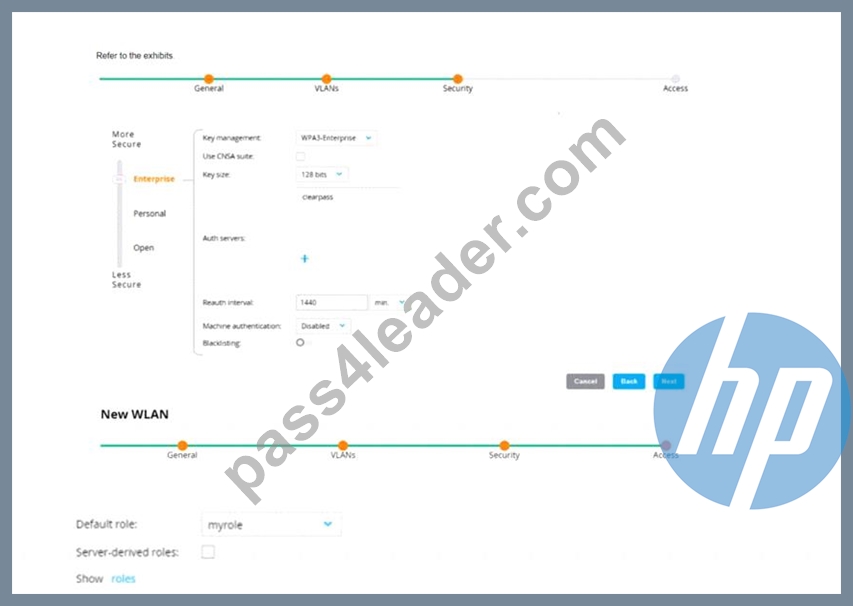
An admin has created a WLAN that uses the settings shown in the exhibits (and has not otherwise adjusted the settings in the AAA profile) A client connects to the WLAN Under which circumstances will a client receive the default role assignment?
- A. The client has attempted 802 1X authentication, but the MC could not contact the authentication server
- B. The client has attempted 802 1X authentication, but failed to maintain a reliable connection, leading to a timeout error
- C. The client has passed 802 1X authentication, and the value in the Aruba-User-Role VSA matches a role on the MC
- D. The client has passed 802 1X authentication and the authentication server did not send an Aruba-User-Role VSA
Answer: D
Explanation:
In the context of an Aruba Mobility Controller (MC) configuration, a client will receive the default role assignment if they have passed 802.1X authentication and the authentication server did not send an Aruba-User-Role Vendor Specific Attribute (VSA). The default role is assigned by the MC when a client successfully authenticates but the authentication server provides no specific role instruction. This behavior ensures that a client is not left without any role assignment, which could potentially lead to a lack of network access or access control. This default role assignment mechanism is part of Aruba's role-based access control, as documented in the ArubaOS user guide and best practices.
NEW QUESTION # 74
Which endpoint classification capabilities do Aruba network infrastructure devices have on their own without ClearPass solutions?
- A. ArubaOS devices (controllers and lAPs) can use DHCP fingerprints to assign roles to clients.
- B. ArubaOS-CX switches can use a combination of active and passive methods to assign roles to clients.
- C. ArubaOS devices can use a combination of DHCP fingerprints, HTTP User-Agent strings, and Nmap to construct endpoint profiles.
- D. ArubaOS-Switches can use DHCP fingerprints to construct detailed endpoint profiles.
Answer: A
Explanation:
Without the integration of Aruba ClearPass or other advanced network access control solutions, ArubaOS devices (controllers and Instant APs) are able to use DHCP fingerprinting to assign roles to clients. This method allows the devices to identify the type of client devices connecting to the network based on the DHCP requests they send. While this is a more basic form of endpoint classification compared to the capabilities provided by ClearPass, it still enables some level of access control based on device type. This functionality and its limitations are described in Aruba's product documentation for ArubaOS devices, highlighting the benefits of integrating a full-featured solution like ClearPass for more granular and powerful endpoint classification capabilities.
NEW QUESTION # 75
......
Updated Official licence for HPE6-A78 Certified by HPE6-A78 Dumps PDF: https://www.pass4leader.com/HP/HPE6-A78-exam.html
Newly Released HPE6-A78 Dumps for Aruba ACNSA Certified: https://drive.google.com/open?id=1IkZK0pdPpROASpV67xZCZcXisqvkuBBO