

Pass Your PCCP Exam Easily With 100% Exam Passing Guarantee [2026]
PCCP Dumps are Available for Instant Access from Pass4Leader
NEW QUESTION # 59
Which of the following is an AWS serverless service?
- A. Kappa
- B. Beta
- C. Lambda
- D. Delta
Answer: C
Explanation:
Examples of serverless environments include Amazon Lambda and Azure Functions. Many PaaS offerings, such as Pivotal Cloud Foundry, also are effectively serverless even if they have not historically been marketed as such. Although serverless may appear to lack the container-specific, cloud native attribute, containers are extensively used in the underlying implementations, even if those implementations are not exposed to end users directly.
NEW QUESTION # 60
Given the graphic, match each stage of the cyber-attack lifecycle to its description.
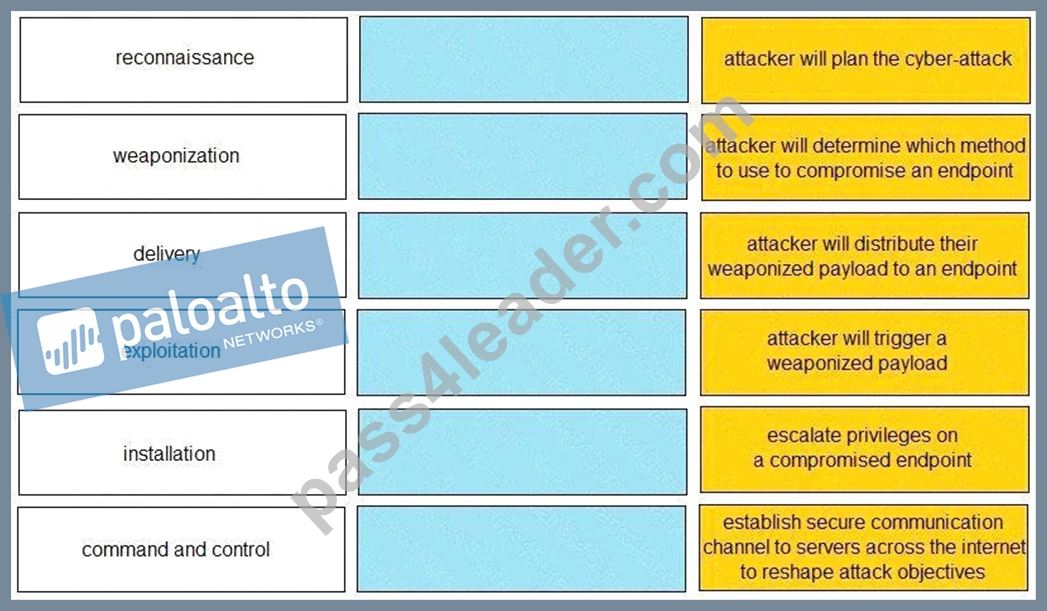
Answer:
Explanation: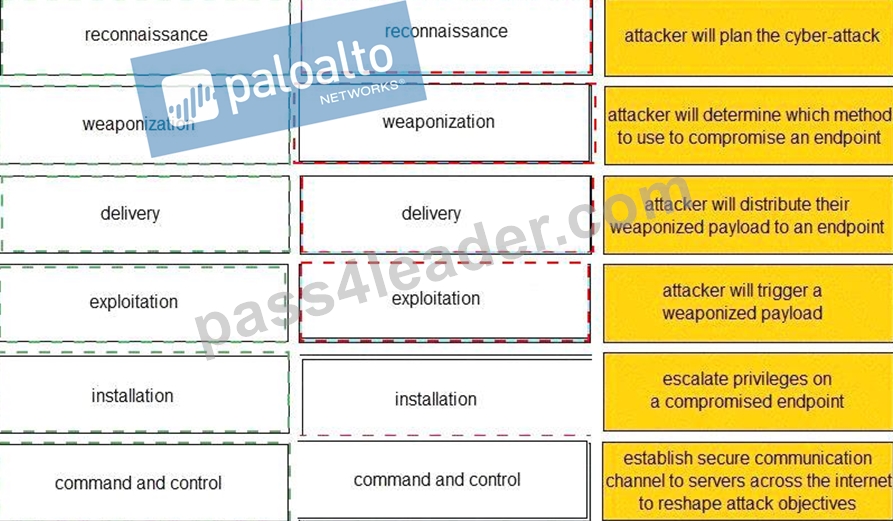
Explanation: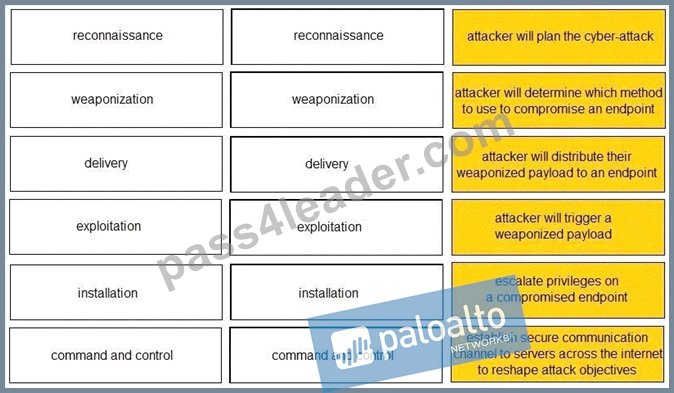
NEW QUESTION # 61
TCP is the protocol of which layer of the OSI model?
- A. Transport
- B. Session
- C. Data Link
- D. Application
Answer: A
Explanation:
TCP stands for Transmission Control Protocol, and it is one of the main protocols used in the internet. TCP provides reliable, ordered, and error-free delivery of data between applications 1. In terms of the OSI model, TCP is a transport-layer protocol. The transport layer is the fourth layer of the OSI model, and it is responsible for establishing end-to-end connections, segmenting data into packets, and ensuring reliable and efficient data transfer 2. The transport layer also provides flow control, congestion control, and error detection and correction mechanisms 2. TCP is not the only transport-layer protocol; another common one is UDP (User Datagram Protocol), which is faster but less reliable than TCP 3. References: 1: TCP/IP TCP, UDP, and IP protocols - IBM 2: Transport Layer | Layer 4 | The OSI-Model 3: TCP/IP Model vs. OSI Model | Similarities and Differences - Fortinet
NEW QUESTION # 62
Which component of the AAA framework verifies user identities so they may access the network?
- A. Authentication
- B. Accounting
- C. Authorization
- D. Allowance
Answer: A
Explanation:
Authentication is the component of the AAA (Authentication, Authorization, and Accounting) framework that verifies user identities (e.g., via passwords, certificates, or biometrics) before granting access to network resources.
NEW QUESTION # 63
Which tool supercharges security operations center (SOC) efficiency with the world's most comprehensive operating platform for enterprise security?
- A. WildFire
- B. Cortex XDR
- C. Prisma SAAS
- D. Cortex XSOAR
Answer: D
Explanation:
Cortex XSOAR enhances Security Operations Center (SOC) efficiency with the world's most comprehensive operating platform for enterprise security. Cortex XSOAR unifies case management, automation, real-time collaboration, and native threat intel management in the industry's first extended security orchestration, automation, and response (SOAR) offering.
NEW QUESTION # 64
Which not-for-profit organization maintains the common vulnerability exposure catalog that is available through their public website?
- A. MITRE
- B. Department of Homeland Security
- C. Cybersecurity Vulnerability Research Center
- D. Office of Cyber Security and Information Assurance
Answer: A
Explanation:
MITRE is a not-for-profit organization that operates research and development centers sponsored by the federal government. MITRE maintains the Common Vulnerabilities and Exposures (CVE) catalog, which is a dictionary of common names for publicly known cybersecurity vulnerabilities. CVE's common identifiers, called CVE Identifiers, make it easier to share data across separate network security databases and tools, and provide a baseline for evaluating the coverage of an organization's security tools12. References:
* Common Vulnerabilities and Exposures (CVE)
* CVE - CVE
NEW QUESTION # 65
Which network device breaks networks into separate broadcast domains?
- A. Router
- B. Hub
- C. Layer 2 switch
- D. Wireless access point
Answer: A
Explanation:
A layer 2 switch will break up collision domains but not broadcast domains. To break up broadcast domains you need a Layer 3 switch with vlan capabilities.
NEW QUESTION # 66
Which two statements are true about servers in a demilitarized zone (DMZ)? (Choose two.)
- A. They can expose servers in the internal network to attacks.
- B. They can be accessed by traffic from the internet.
- C. They are located in the internal network.
- D. They are isolated from the internal network.
Answer: B,D
Explanation:
A demilitarized zone (DMZ) is a portion of an enterprise network that sits behind a firewall but outside of or segmented from the internal network1. The DMZ typically hosts public services, such as web, mail, and domain servers, that can be accessed by traffic from the internet1. However, the DMZ is isolated from the internal network by another firewall or security gateway, which prevents unauthorized access to the private network2. Therefore, statements A and D are true about servers in a DMZ, while statements B and C are false. References:
* What is a Demilitarized Zone (DMZ)? | F5
* Demilitarized Zones (DMZs) - Secure Network Architecture - CompTIA ...
NEW QUESTION # 67
Which two statements apply to SaaS financial botnets? (Choose two.)
- A. They are a defense against spam attacks.
- B. They are larger than spamming or DDoS botnets.
- C. They are sold as kits that allow attackers to license the code.
- D. They are used by attackers to build their own botnets.
Answer: C,D
Explanation:
SaaS financial botnets are often sold as kits, enabling attackers to license and reuse the malicious code easily.
These kits allow attackers to build and operate their own botnets, often targeting financial data or systems.
Financial botnets are typically smaller but more targeted than spamming or DDoS botnets. Botnets are not a defense mechanism, but rather a threat.
NEW QUESTION # 68
Which Palo Alto Networks tools enable a proactive, prevention-based approach to network automation that accelerates security analysis?
- A. WildFire
- B. MineMeld
- C. Cortex XDR
- D. AutoFocus
Answer: C
Explanation:
Cortex XDR is a security analytics platform that converges logs from network, identity, endpoint, application, and other security relevant sources to generate high-fidelity behavioral alerts and facilitate rapid incident analysis, investigation, and response1. Cortex XDR uses machine learning algorithms to automate data analysis and apply modeling in real time, helping organizations to reduce analyst workloads and improve security1. Cortex XDR also integrates with Palo Alto Networks next-generation firewalls and other security tools to streamline and speed network security response2. References: Security Analytics - Palo Alto Networks, Network Security Automation - Palo Alto Networks
NEW QUESTION # 69
Which network analysis tool can be used to record packet captures?
- A. Wireshark
- B. Angry IP Scanner
- C. Netman
- D. Smart IP Scanner
Answer: A
Explanation:
Wireshark is a network analysis tool that can capture packets from various network interfaces and protocols.
It can display the captured packets in a human-readable format, as well as filter, analyze, and export them. Wireshark is widely used for network troubleshooting, security testing, and education purposes12. References: Wireshark Go Deep, How to Use Wireshark to Capture, Filter and Inspect Packets, Palo Alto Networks Certified Cybersecurity Entry-level Technician
NEW QUESTION # 70
Which component of the AAA framework regulates user access and permissions to resources?
- A. Accounting
- B. Authentication
- C. Authorization
- D. Allowance
Answer: C
Explanation:
Authorization is the component of the AAA (Authentication, Authorization, and Accounting) framework that regulates user access and permissions to resources after identity has been verified. It determines what actions or resources a user is allowed to access.
NEW QUESTION # 71
Match each tunneling protocol to its definition.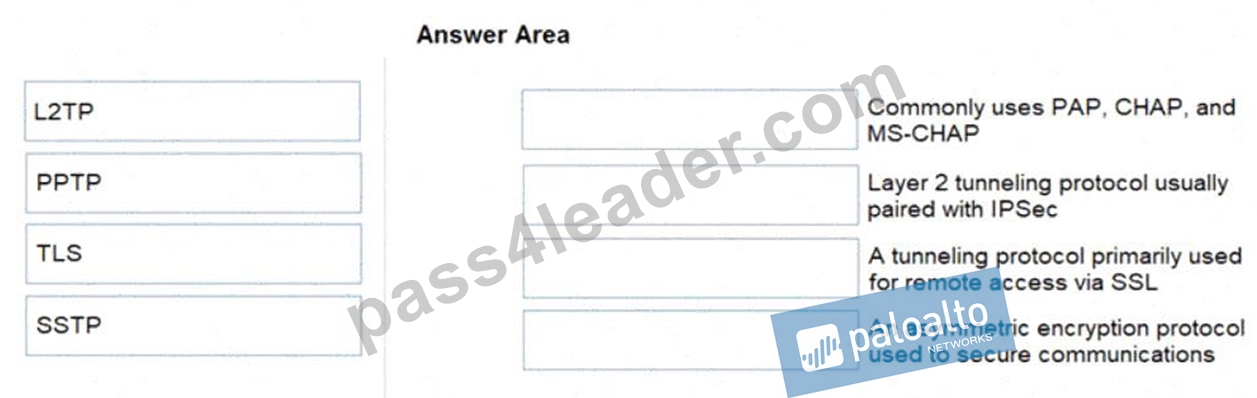
Answer:
Explanation: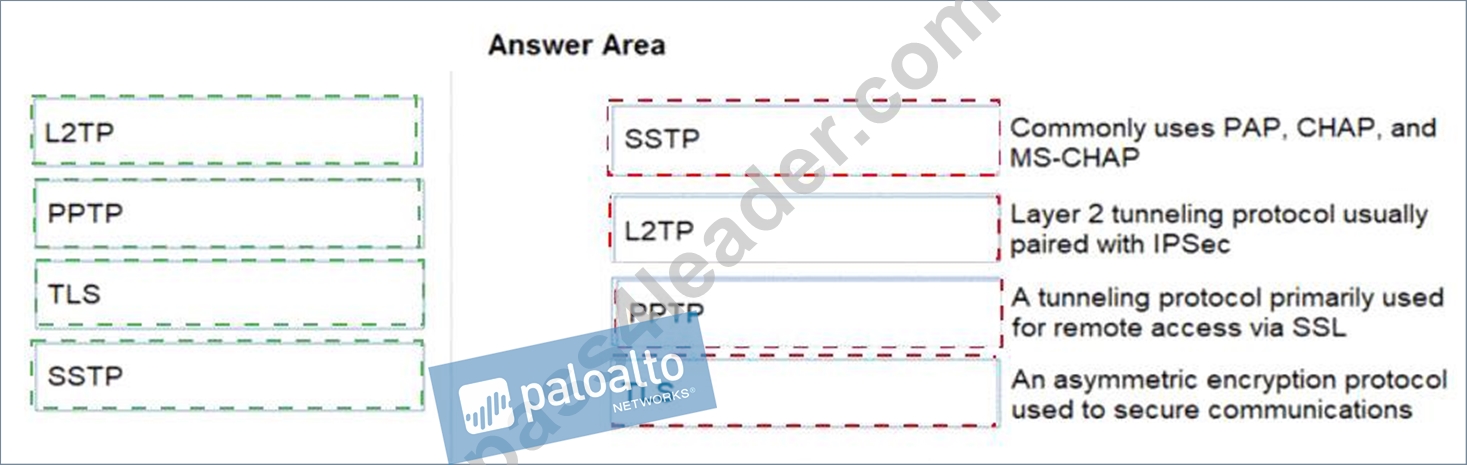
Explanation: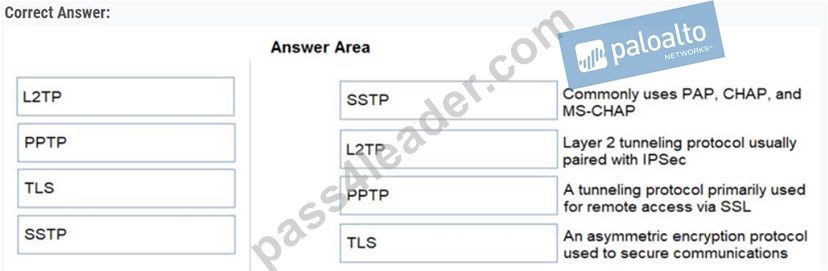
NEW QUESTION # 72
Which type of IDS/IPS uses a baseline of normal network activity to identify unusual patterns or levels of network activity that may be indicative of an intrusion attempt?
- A. Knowledge-based
- B. Database-based
- C. Signature-based
- D. Behavior-based
Answer: D
Explanation:
IDSs and IPSs also can be classified as knowledge-based (or signature-based) or behavior-based (or statistical anomaly-based) systems:
# A knowledge-based system uses a database of known vulnerabilities and attack profiles to identify intrusion attempts. These types of systems have lower false-alarm rates than behavior-based systems but must be continually updated with new attack signatures to be effective.
# A behavior-based system uses a baseline of normal network activity to identify unusual patterns or levels of network activity that may be indicative of an intrusion attempt.
These types of systems are more adaptive than knowledge-based systems and therefore may be more effective in detecting previously unknown vulnerabilities and attacks, but they have a much higher false-positive rate than knowledge-based systems
NEW QUESTION # 73
Which action must Secunty Operations take when dealing with a known attack?
- A. Disclose details of lhe attack in accordance with regulatory standards.
- B. Increase the granularity of the application firewall.
- C. Limit the scope of who knows about the incident.
- D. Document, monitor, and track the incident.
Answer: D
Explanation:
Security Operations (SecOps) is the process of coordinating and aligning security teams and IT teams to improve the security posture of an organization. SecOps involves implementing and maintaining security controls, technologies, policies, and procedures to protect the organization from cyber threats and incidents.
When dealing with a known attack, SecOps must take the following action: document, monitor, and track the incident. This action is important because it helps SecOps to:
*Record the details of the attack, such as the source, target, impact, timeline, and response actions.
*Monitor the status and progress of the incident response and recovery efforts, as well as the ongoing threat activity and indicators of compromise.
*Track the performance and effectiveness of the security controls and technologies, as well as the lessons learned and improvement opportunities. References:
*Palo Alto Networks Certified Cybersecurity Entry-level Technician (PCCET)
*6 Incident Response Steps to Take After a Security Event - Exabeam
*Dealing with Cyber Attacks-Steps You Need to Know | NIST
NEW QUESTION # 74
You have been invited to a public cloud design and architecture session to help deliver secure east west flows and secure Kubernetes workloads.
What deployment options do you have available? (Choose two.)
- A. CN-Series
- B. Panorama
- C. VM-Series
- D. PA-Series
Answer: A,C
Explanation:
To deliver secure east-west flows and secure Kubernetes workloads in a public cloud environment, you have two deployment options available: VM-Series and CN-Series.
* VM-Series is a virtualized form factor of the Palo Alto Networks next-generation firewall that can be deployed in public cloud platforms such as AWS, Azure, Google Cloud, and Oracle Cloud. VM-Series provides comprehensive network security and threat prevention capabilities for protecting your cloud workloads and applications from cyberattacks. VM-Series can also integrate with native cloud services and third-party tools to enable automation, orchestration, and visibility across your cloud environment. VM-Series supports various deployment scenarios, such as securing internet-facing applications, protecting hybrid connectivity, segmenting internal networks, and enabling secure DevOps12.
* CN-Series is a containerized form factor of the Palo Alto Networks next-generation firewall that can be deployed in Kubernetes environments. CN-Series provides granular network security and threat prevention capabilities for protecting your Kubernetes pods and namespaces from cyberattacks. CN- Series can also integrate with Kubernetes network plugins and services to enable dynamic policy enforcement, service discovery, and visibility across your Kubernetes clusters. CN-Series supports various deployment scenarios, such as securing ingress and egress traffic, enforcing microsegmentation, and enabling secure DevSecOps34.
VM-Series in Public Cloud
VM-Series Deployment Guide
CN-Series in Kubernetes
CN-Series Deployment Guide
NEW QUESTION # 75
What is required for a SIEM to operate correctly to ensure a translated flow from the system of interest to the SIEM data lake?
- A. containers and developers
- B. infrastructure and containers
- C. data center and UPS
- D. connectors and interfaces
Answer: D
Explanation:
Connectors and interfaces are the components that enable a SIEM to collect, process, and analyze data from various sources, such as Microsoft 365 services and applications1, cloud platforms, network devices, and security solutions. Connectors are responsible for extracting and transforming data from the source systems, while interfaces are responsible for sending and receiving data to and from the SIEM server. Without connectors and interfaces, a SIEM cannot operate correctly and ensure a translated flow from the system of interest to the SIEM data lake. References:
* SIEM server integration with Microsoft 365 services and applications
* What Is SIEM Integration? 2024 Comprehensive Guide - SelectHub
* SIEM Connector - docs.metallic.io
* SIEM Connector
NEW QUESTION # 76
Which NGFW feature is used to provide continuous identification, categorization, and control of known and previously unknown SaaS applications?
- A. User-ID
- B. App-ID
- C. Content-ID
- D. Device-ID
Answer: B
Explanation:
App-ID™ technology leverages the power of the broad global community to provide continuous identification, categorization, and granular risk-based control of known and previously unknown SaaS applications, ensuring new applications are discovered automatically as they become popular.
NEW QUESTION # 77
Which organizational function is responsible for security automation and eventual vetting of the solution to help ensure consistency through machine-driven responses to security issues?
- A. SecDevOps
- B. SecOps
- C. DevOps
- D. NetOps
Answer: B
Explanation:
SecOps is the organizational function that is responsible for security automation and eventual vetting of the solution to help ensure consistency through machine-driven responses to security issues. SecOps is a collaboration between security and operations teams that aims to align their goals, processes, and tools to improve security posture and efficiency. SecOps can leverage automation to simplify and accelerate security tasks, such as threat detection, incident response, vulnerability management, compliance enforcement, and more. Security automation can also reduce human errors, enhance scalability, and free up resources for more strategic initiatives. References:
* SecOps from Palo Alto Networks
* What is security automation? from Red Hat
* What is Security Automation? from Check Point Software
NEW QUESTION # 78
Which security component should you configure to block viruses not seen and blocked by the perimeter firewall?
- A. endpoint disk encryption
- B. endpoint antivirus software
- C. strong endpoint passwords
- D. endpoint NIC ACLs
Answer: B
Explanation:
Endpoint antivirus software is a type of software designed to help detect, prevent, and eliminate malware on devices, such as laptops, desktops, smartphones, and tablets. Endpoint antivirus software can block viruses that are not seen and blocked by the perimeter firewall, which is a network security device that monitors and controls incoming and outgoing network traffic based on predefined security rules. Perimeter firewall can block some known viruses, but it may not be able to detect and stop new or unknown viruses that use advanced techniques to evade detection. Endpoint antivirus software can provide an additional layer of protection by scanning the files and processes on the devices and using various methods, such as signatures, heuristics, behavior analysis, and cloud-based analysis, to identify and remove malicious code123. References:
* What Is Endpoint Antivirus? Key Features & Solutions Explained - Trellix
* Microsoft Defender for Endpoint | Microsoft Security
* Download ESET Endpoint Antivirus | ESET
NEW QUESTION # 79
With regard to cloud-native security in layers, what is the correct order of the four C's from the top (surface) layer to the bottom (base) layer?
- A. container, code, cloud, cluster
- B. code, container, cloud, cluster
- C. code, container, cluster, cloud
- D. container, code, cluster, cloud
Answer: C
Explanation:
Cloud-native security is the integration of security strategies into applications and systems designed to be deployed and to run in cloud environments. It involves a layered approach that considers security at every level of the cloud-native application architecture. The four C's of cloud-native security are123:
* Code: This layer refers to the application code and its dependencies. Security at this layer involves ensuring the code is free of vulnerabilities, using secure coding practices, and implementing encryption, authentication, and authorization mechanisms.
* Container: This layer refers to the lightweight, isolated units that encapsulate the application and its dependencies. Security at this layer involves scanning and verifying the container images, enforcing policies and rules for container deployment and runtime, and isolating and protecting the containers from unauthorized access.
* Cluster: This layer refers to the group of nodes that host the containers and provide orchestration and management capabilities. Security at this layer involves securing the communication between the nodes and the containers, monitoring and auditing the cluster activity, and applying security patches and updates to the cluster components.
* Cloud: This layer refers to the underlying infrastructure and services that support the cloud-native applications. Security at this layer involves configuring and hardening the cloud resources, implementing identity and access management, and complying with the cloud provider's security standards and best practices.
The correct order of the four C's from the top (surface) layer to the bottom (base) layer is code, container, cluster, cloud, as each layer depends on the security of the next outermost layer. References: What Is Cloud- Native Security? - Palo Alto Networks, What is Cloud-Native Security? An Introduction | Splunk, The 4C's of Cloud Native Kubernetes security - Medium
NEW QUESTION # 80
What role do containers play in cloud migration and application management strategies?
- A. They enable companies to use cloud-native tools and methodologies.
- B. They are used for data storage in cloud environments.
- C. They serve as a template manager for software applications and services.
- D. They are used to orchestrate virtual machines (VMs) in cloud environments.
Answer: A
Explanation:
Containers encapsulate applications and their dependencies into lightweight, portable units that can run consistently across multiple environments. This abstraction supports cloud-native development by enabling microservices architectures, rapid deployment, and scaling within orchestration platforms like Kubernetes. Containers accelerate cloud migration by decoupling applications from infrastructure, facilitating automation, and continuous integration/continuous deployment (CI/CD) workflows. Palo Alto Networks addresses container security by integrating runtime protection, vulnerability scanning, and compliance enforcement within its Prisma Cloud platform, ensuring safe adoption of cloud-native tools and methodologies.
NEW QUESTION # 81
......
Palo Alto Networks PCCP Exam Syllabus Topics:
| Topic | Details |
|---|---|
| Topic 1 |
|
| Topic 2 |
|
| Topic 3 |
|
| Topic 4 |
|
| Topic 5 |
|
Study resources for the Valid PCCP Braindumps: https://www.pass4leader.com/Palo-Alto-Networks/PCCP-exam.html
Latest Certified Cybersecurity Associate PCCP Actual Free Exam Questions: https://drive.google.com/open?id=1f3-Zy9PTvbxstZpYOnJXHxvxNSIKTKvB