

Accurate & Verified 2026 New ISO-IEC-27001-Lead-Auditor Answers As Experienced in the Actual Test!
ISO-IEC-27001-Lead-Auditor Certification Sample Questions certification Exam
PECB ISO-IEC-27001-Lead-Auditor exam is a certification that is designed for individuals who want to become ISO/IEC 27001 lead auditors. PECB Certified ISO/IEC 27001 Lead Auditor exam certification is offered by the Professional Evaluation and Certification Board (PECB), which is a leading provider of training and certification services for professionals in various fields. The ISO/IEC 27001 lead auditor certification is considered to be one of the most prestigious certifications in the field of information security management.
PECB ISO-IEC-27001-Lead-Auditor certification exam is a globally recognized credential that validates the expertise and knowledge of an individual in leading, planning, executing, and reporting on information security management system (ISMS) audits in accordance with ISO/IEC 27001 standards. PECB Certified ISO/IEC 27001 Lead Auditor exam certification exam is offered by the Professional Evaluation and Certification Board (PECB) and is intended for professionals who want to become competent and proficient in conducting ISMS audits.
NEW QUESTION # 240
Question
Factors such as costs related to nonconformities or penalties in case of failure to comply with legal and contractual obligations are evaluated during the definition of which of the following?
- A. Reasonable assurance
- B. Audit risks
- C. Materiality
Answer: C
Explanation:
The correct answer is Materiality, because materiality involves evaluating the significance and potential impact of issues identified during an audit, including financial, legal, contractual, and reputational consequences. In auditing, materiality helps determine which matters are important enough to influence audit conclusions or stakeholder decisions.
When defining materiality, auditors consider factors such as the cost of nonconformities, potential regulatory penalties, contractual breaches, and the broader business impact of noncompliance. For an ISO/IEC 27001 audit, this may include assessing whether failures in information security controls could lead to fines under data protection laws, loss of customer trust, or breach of service-level agreements. These considerations help auditors decide where to focus audit effort and how to prioritize findings.
Option B is incorrect because audit risk relates to the risk that auditors may reach incorrect conclusions due to inherent, control, or detection risks. While costs and penalties may influence risk assessment, they are not evaluated specifically when defining audit risk. Option C is incorrect because reasonable assurance refers to the level of confidence an audit can provide, not the evaluation of financial or legal impacts.
ISO 19011 supports the use of materiality concepts to ensure audits focus on issues that matter most to the organization and interested parties. Therefore, evaluating costs and penalties is directly linked to defining materiality.
NEW QUESTION # 241
You are performing an ISMS audit at a residential nursing home that provides healthcare services. The next step in your audit plan is to verify the information security incident management process. The IT Security Manager presents the information security incident management procedure and explains that the process is based on ISO/IEC 27035-1:2016.
You review the document and notice a statement "any information security weakness, event, and incident should be reported to the Point of Contact (PoC) within 1 hour after identification". When interviewing staff, you found that there were differences in the understanding of the meaning of "weakness, event, and incident".
You sample incident report records from the event tracking system for the last 6 months with summarized results in the following table.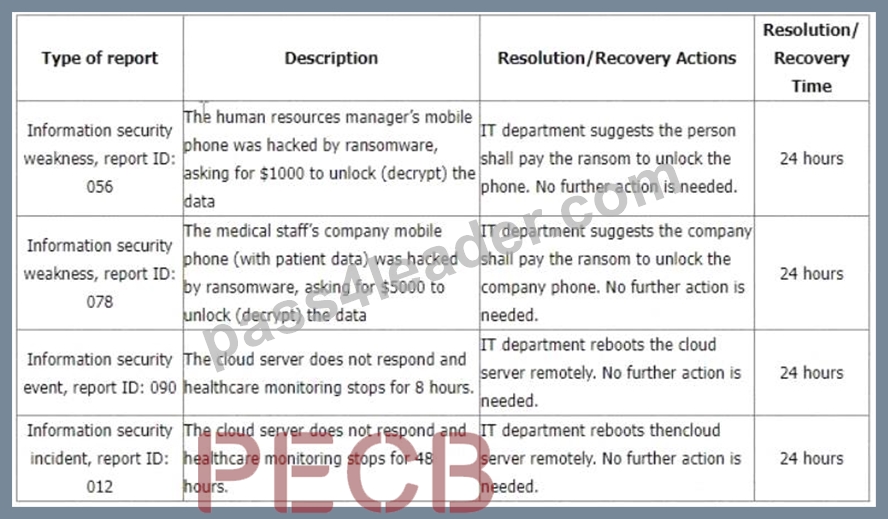
You would like to further investigate other areas to collect more audit evidence. Select two options that will not be in your audit trail.
- A. Collect more evidence on how and when the Human Resources manager pays the ransom fee to unlock personal mobile data, i.e., credit card, and bank transfer. (Relevant to control A.5.26)
- B. Collect more evidence on how the organisation determined the incident recovery time. (Relevant to control A.5.27)
- C. Collect more evidence on how and when the company pays the ransom fee to unlock the company's mobile phone and data, i.e., credit card, and bank transfer. (Relevant to control A.5.26)
- D. Collect more evidence on how the organization determined no further action was needed after the incident. (Relevant to control A.5.26)
- E. Collect more evidence on what the service requirements of healthcare monitoring are. (Relevant to clause 4.2)
- F. Collect more evidence on the incident recovery procedures. (Relevant to control A.5.26)
- G. Collect more evidence by interviewing more staff about their understanding of the reporting process.
(Relevant to control A.6.8)
Answer: C,E
Explanation:
According to ISO/IEC 27001:2022, which specifies the requirements for establishing, implementing, maintaining and continually improving an information security management system (ISMS), clause 4.2 requires an organization to determine the needs and expectations of interested parties that are relevant to its ISMS1. This includes identifying the legal, regulatory, contractual and other requirements that apply to its information security activities1. Therefore, collecting more evidence on what the service requirements of healthcare monitoring are may not be relevant to verifying the information security incident management process, as it is not directly related to the audit objective or criteria. This option will not be in the audit trail.
NEW QUESTION # 242
Select the words that best complete the sentence:
Answer:
Explanation:
Explanation:
A third-party audit is an independent assessment of an organisation's management system by an external auditor, who is not affiliated with the organisation or its customers. The auditor verifies that the management system meets the requirements of a specific standard, such as ISO 27001, and evaluates its effectiveness and performance. The auditor also identifies any strengths, weaknesses, opportunities, or risks of the management system, and provides recommendations for improvement. The purpose of a third-party audit is to provide an objective and impartial evaluation of the organisation's management system, and to inform a certification decision by a certification body. A certification body is an organisation that grants a certificate of conformity to the organisation, after reviewing the audit report and evidence, and confirming that the management system meets the certification criteria. A certification decision is the outcome of the certification process, which can be positive (granting, maintaining, renewing, or expanding the scope of certification) or negative (suspending, withdrawing, or reducing the scope of certification). References:
* PECB Candidate Handbook ISO 27001 Lead Auditor, pages 19-25
* ISO 19011:2018 - Guidelines for auditing management systems
* The ISO 27001 audit process | ISMS.online
NEW QUESTION # 243
Select two options that describe an advantage of using a checklist.
- A. Reducing audit duration
- B. Ensuring the audit plan is implemented
- C. Using the same checklist for every audit without review
- D. Ensuring relevant audit trails are followed
- E. Restricting interviews to nominated parties
- F. Not varying from the checklist when necessary
Answer: B,D
Explanation:
A checklist is a tool that helps auditors to collect and verify information relevant to the audit objectives and scope. It can provide the following advantages:
* Ensuring relevant audit trails are followed: A checklist can help auditors to identify and trace the sources of evidence that support the conformity or nonconformity of the audited criteria. It can also help auditors to avoid missing or overlooking any important aspects of the audit.
* Ensuring the audit plan is implemented: A checklist can help auditors to follow and fulfil the audit plan, which describes the arrangements and details of the audit, such as the objectives, scope, criteria, schedule, roles, and responsibilities. It can also help auditors to manage their time and resources effectively and efficiently.
The other options are not advantages of using a checklist, but rather:
* Using the same checklist for every audit without review: This is a disadvantage of using a checklist, as it can lead to a rigid and ineffective audit approach. A checklist should be tailored and adapted to each specific audit, taking into account the context, risks, and changes of the auditee and the audit criteria. A checklist should also be reviewed and updated periodically to ensure its validity and relevance.
* Restricting interviews to nominated parties: This is a disadvantage of using a checklist, as it can limit the scope and depth of the audit. A checklist should not prevent auditors from interviewing other relevant parties or sources of information that may provide valuable evidence or insights for the audit.
A checklist should be used as a guide, not as a constraint.
* Reducing audit duration: This is not necessarily an advantage of using a checklist, as it depends on various factors, such as the complexity, size, and maturity of the auditee's ISMS, the availability and quality of evidence, the competence and experience of the auditors, and the level of cooperation and communication between the auditors and the auditee. A checklist may help reduce audit duration by improving efficiency and organization, but it may also increase audit duration by requiring more evidence or verification.
* Not varying from the checklist when necessary: This is a disadvantage of using a checklist, as it can result in a superficial or incomplete audit. A checklist should not prevent auditors from exploring or investigating any issues or concerns that arise during the audit, even if they are not included in the checklist. A checklist should be used as a support, not as a substitute.
References:
* ISO/IEC 27001:2022 Lead Auditor (Information Security Management Systems) objectives and content from Quality.org and PECB
* ISO 19011:2018 Guidelines for auditing management systems [Section 6.2.2]
NEW QUESTION # 244
After completing Stage 1 and in preparation for a Stage 2 initial certification audit, the auditee informs the audit team leader that they wish to extend the audit scope to include two additional sites that have recently been acquired by the organisation.
Considering this information, what action would you expect the audit team leader to take?
- A. Arrange to complete a remote Stage 1 audit of the two sites using a video conferencing platform
- B. Increase the length of the Stage 2 audit to include the extra sites
- C. Inform the auditee that the request can be accepted but a full Stage 1 audit must be repeated
- D. Obtain information about the additional sites to inform the certification body
Answer: D
Explanation:
According to ISO/IEC 17021-1, which specifies the requirements for bodies providing audit and certification of management systems, a certification body should establish criteria for determining audit time and audit team composition based on factors such as the scope of certification, size and complexity of the organization, risks associated with its activities, etc2. Therefore, if an auditee requests to extend the audit scope to include two additional sites after completing Stage 1 of an initial certification audit, the audit team leader should obtain information about the additional sites to inform the certification body, so that they can review and approve the change in scope and adjust the audit time and audit team accordingly2. The other options are not appropriate actions for the audit team leader to take in this situation. For example, increasing the length of the Stage 2 audit to include the extra sites without informing the certification body may violate their procedures and policies; arranging to complete a remote Stage 1 audit of the two sites using a video conferencing platform may not be feasible or effective depending on the nature and location of the sites; and informing the auditee that the request can be accepted but a full Stage 1 audit must be repeated may not be necessary or reasonable if there are no significant changes in the auditee's ISMS since Stage 12. Reference: ISO/IEC 17021-1:2015 - Conformity assessment - Requirements for bodies providing audit and certification of management systems - Part 1: Requirements
NEW QUESTION # 245
Scenario 7
Lawsy is a leading law firm with offices in Bangkok, Thailand. It has over 50 attorneys offering sophisticated legal services to clients in business and commercial law, intellectual property, banking, and financial services.
They believe they have a comfortable position in the market thanks to their commitment to implementing information security best practices and remaining up to date with technological developments.
Lawsy has rigorously implemented, evaluated, and conducted internal audits for the information security management system (ISMS) for two years. Now, they have applied for ISO/IEC 27001 certification at ISMA, a well-known and trusted certification body.
During the stage 1 audit, the audit team reviewed all the ISMS documents created during the implementation phase. They also reviewed and evaluated the records from management reviews and internal audits. Lawsy submitted records of evidence that corrective actions on nonconformities were performed when necessary, so the audit team interviewed the internal auditor. The interview validated the adequacy and frequency of the internal audits by providing insight into the internal audit plan and procedures.
The audit team continued verifying strategic documents, including the information security policy and risk evaluation criteria. During the information security policy review, the team noticed inconsistencies between the documented information describing the governance framework and the procedures. Following the completion of stage 1, the audit team leader prepared the audit plan, which addressed the audit objectives, scope, criteria, and procedures.
During the stage 2 audit, the audit team interviewed the information security manager, who drafted the information security policy. He justified the issue identified in stage 1 by stating that Lawsy conducts mandatory information security training and awareness sessions every three months.
Later, the audit team found that Lawsy did not have procedures for using laptops outside the workplace, even though employees were allowed to take laptops outside the workplace. The company only provided general information about the use of laptops and relied on employees' common knowledge to protect the confidentiality and integrity of information stored on the laptops.
Following the interview, the audit team examined 15 employee training records (out of 50) and concluded that Lawsy meets the requirements of ISO/IEC 27001 related to training and awareness. To support this conclusion, the auditor photocopied and archived the examined employee training records after completing the audit.
Question
Lawsy lacks a procedure for using laptops outside the workplace and relies on employees' common knowledge to protect the confidentiality of information stored on the laptops. What does this present?
- A. A nonconformity
- B. A conformity
- C. An anomaly
Answer: A
Explanation:
This situation represents a nonconformity, making option B the correct answer. ISO/IEC 27001:2022 requires organizations to implement controls to manage information security risks and to support them with appropriate documented information where necessary. Allowing employees to use laptops outside the workplace without defined procedures represents a failure to implement adequate controls for protecting information assets.
From a control perspective, ISO/IEC 27002:2022 includes technological and organizational controls related to endpoint device security, protection of information assets, and secure use of equipment. Relying on employees' "common knowledge" instead of defined procedures does not meet the requirement for systematic, repeatable, and auditable control implementation. Controls must be formally defined, communicated, and consistently applied.
Option A is incorrect because an anomaly is typically a one-off deviation or unusual occurrence that does not indicate a systemic failure. In this case, the absence of procedures is systemic and affects all employees who use laptops externally. Option C is incorrect because conformity would require documented, implemented, and effective controls aligned with identified risks, which is not the case here.
Even though Lawsy meets training and awareness requirements, training cannot substitute for missing operational controls and procedures. Auditors must assess both awareness and the existence of formal controls. Therefore, the lack of procedures for laptop use outside the workplace constitutes a nonconformity with ISO/IEC 27001 requirements.
NEW QUESTION # 246
Which two of the following statements are true?
* The benefits of implementing an ISMS primarily result from a reduction in information security risks
- A. The purpose of an ISMS is to demonstrate compliance with regulatory requirements
- B. The purpose of an ISMS is to apply a risk management process for preserving information security
- C. The benefit of certifying an ISMS is to obtain contracts from governmental institutions
Answer: A,C
Explanation:
The benefits of implementing an ISMS are not limited to a reduction in information security risks, but also include improved business performance, customer satisfaction, legal compliance, and stakeholder confidence.
The benefit of certifying an ISMS is not only to obtain contracts from governmental institutions, but also to demonstrate the organisation's commitment to information security to other potential customers, partners, and regulators. The purpose of an ISMS is to apply a risk management process for preserving information security, which means identifying, analysing, evaluating, treating, monitoring, and reviewing the information security risks that the organisation faces. The purpose of an ISMS is not to demonstrate compliance with regulatory requirements, but rather to ensure that the organisation meets its own information security objectives and obligations.
References:
ISO/IEC 27001:2022 Lead Auditor (Information Security Management Systems) objectives and content from Quality.org and PECB ISO/IEC 27001:2013 Information technology - Security techniques - Information security management systems - Requirements [Section 0.1] and [Section 1]
NEW QUESTION # 247
The following are purposes of Information Security, except:
- A. Ensure Business Continuity
- B. Minimize Business Risk
- C. Maximize Return on Investment
- D. Increase Business Assets
Answer: D
Explanation:
The following are purposes of information security, except increasing business assets. Increasing business assets is not a purpose of information security, as it is not directly related to protecting information and systems from threats and risks. Information security may contribute to increasing business assets by enhancing customer trust, reputation, compliance, and efficiency, but it is not its primary goal. Ensuring business continuity is a purpose of information security, as it aims to prevent or minimize disruptions or losses caused by incidents affecting information and systems. Minimizing business risk is a purpose of information security, as it aims to identify and reduce threats and vulnerabilities that may compromise information and systems.
Maximizing return on investment is a purpose of information security, as it aims to optimize the costs and benefits of implementing and maintaining information security controls and measures. References: : CQI & IRCA ISO 27001:2022 Lead Auditor Course Handbook, page 23. : [ISO/IEC 27001 Brochures | PECB], page 4.
NEW QUESTION # 248
You are the audit team leader conducting a third-party audit of an online insurance organisation. During Stage 1, you found that the organisation took a very cautious risk approach and included all the information security controls in ISO/IEC 27001:2022 Appendix A in their Statement of Applicability.
During the Stage 2 audit, your audit team found that there was no evidence of the implementation of the three controls (5.3 Segregation of duties, 6.1 Screening, 7.12 Cabling security) shown in the extract from the Statement of Applicability. No risk treatment plan was found.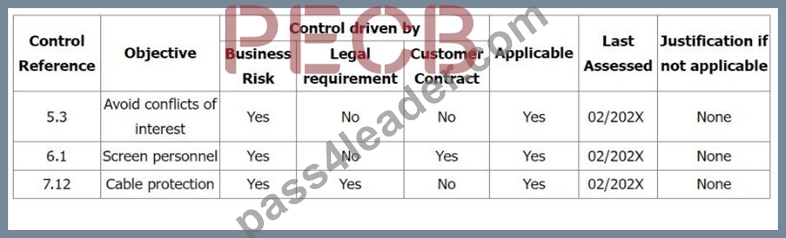
Select three options for the actions you would expect the auditee to take in response to a nonconformity against clause 6.1.3.e of ISO/IEC 27001:2022.
- A. Remove the three controls from the Statement of Applicability.
- B. Allocate responsibility for producing evidence to prove to auditors that the controls are implemented.
- C. Compile plans for the periodic assessment of the risks associated with the controls.
- D. Revise the relevant content in the Statement of Applicability to justify their exclusion.
- E. Implement the appropriate risk treatment for each of the applicable controls.
- F. Revisit the risk assessment process relating to the three controls.
- G. Incorporate written procedures for the controls into the organisation's Security Manual.
- H. Undertake a survey of customers to find out if the controls are needed by them.
Answer: D,E,F
Explanation:
According to the PECB Candidate Handbook for ISO/IEC 27001 Lead Auditor, the auditee should take the following actions in response to a nonconformity against clause 6.1.3.e of ISO/IEC 27001:20221:
Implement the appropriate risk treatment for each of the applicable controls, as this is the main requirement of clause 6.1.3.e and the objective of the risk treatment process2.
Revise the relevant content in the Statement of Applicability to justify their exclusion, as this is the expected output of the risk treatment process and the evidence of the risk-based decisions3.
Revisit the risk assessment process relating to the three controls, as this is the input for the risk treatment process and the source of identifying the risks and the controls4.
The other options are not correct because:
Allocating responsibility for producing evidence to prove to auditors that the controls are implemented is not a valid action, as the audit team already found that there was no evidence of the implementation of the three controls.
Compiling plans for the periodic assessment of the risks associated with the controls is not a valid action, as this is part of the risk monitoring and review process, not the risk treatment process5.
Incorporating written procedures for the controls into the organisation's Security Manual is not a valid action, as this is part of the documentation and operation of the ISMS, not the risk treatment process.
Removing the three controls from the Statement of Applicability is not a valid action, as this is not a sufficient justification for their exclusion and does not reflect the risk treatment process.
Undertaking a survey of customers to find out if the controls are needed by them is not a valid action, as this is not a relevant criterion for the risk assessment and treatment process, which should be based on the organisation's own context and objectives.
NEW QUESTION # 249
Scenario 9: Techmanic is a Belgian company founded in 1995 and currently operating in Brussels. It provides IT consultancy, software design, and hardware/software services, including deployment and maintenance. The company serves sectors like public services, finance, telecom, energy, healthcare, and education. As a customer-centered company, it prioritizes strong client relationships and leading security practices.
Techmanic has been ISO/IEC 27001 certified for a year and regards this certification with pride. During the certification audit, the auditor found some inconsistencies in its ISMS implementation. Since the observed situations did not affect the capability of its ISMS to achieve the intended results, Techmanic was certified after auditors followed up on the root cause analysis and corrective actions remotely During that year, the company added hosting to its list of services and requested to expand its certification scope to include that area The auditor in charge approved the request and notified Techmanic that the extension audit would be conducted during the surveillance audit Techmanic underwent a surveillance audit to verify its iSMS's continued effectiveness and compliance with ISO/IEC 27001. The surveillance audit aimed to ensure that Techmanic's security practices, including the recent addition of hosting services, aligned seamlessly with the rigorous requirements of the certification The auditor strategically utilized the findings from previous surveillance audit reports in the recertification activity with the purpose of replacing the need for additional recertification audits, specifically in the IT consultancy sector. Recognizing the value of continual improvement and learning from past assessments.
Techmanic implemented a practice of reviewing previous surveillance audit reports. This proactive approach not only facilitated identifying and resolving potential nonconformities but also aimed to streamline the recertification process in the IT consultancy sector.
During the surveillance audit, several nonconformities were found. The ISMS continued to fulfill the ISO/IEC
27001*s requirements, but Techmanic failed to resolve the nonconformities related to the hosting services, as reported by its internal auditor. In addition, the internal audit report had several inconsistencies, which questioned the independence of the internal auditor during the audit of hosting services. Based on this, the extension certification was not granted. As a result. Techmanic requested a transfer to another certification body. In the meantime, the company released a statement to its clients stating that the ISO/IEC 27001 certification covers the IT services, as well as the hosting services.
Based on the scenario above, answer the following question:
Question:
What action should be taken regarding Techmanic's certification?
- A. Transfer the certification because they were not granted the extension certification
- B. Suspend the certification because they used the certification out of its scope
- C. Withdraw the certification because they failed to resolve nonconformities related to hosting services
Answer: B
Explanation:
Comprehensive and Detailed In-Depth Explanation:
* A. Correct Answer:
* Techmanic misrepresented its certification scope, which is a violation of ISO certification rules.
* Suspension allows time for corrective action before withdrawal is considered.
* B. Incorrect:
* Certification withdrawal is only necessary if corrective actions fail after suspension.
* C. Incorrect:
* Transfer does not resolve misrepresentation issues.
Relevant Standard Reference:
* ISO/IEC 17021-1:2015 Clause 9.6.5 (Certification Suspension and Misrepresentation Issues)
NEW QUESTION # 250
Which two of the following phrases would apply to 'check' in the Plan-Do-Check-Act cycle for a business process?
- A. Managing changes
- B. Making improvements
- C. Resetting objectives
- D. Auditing processes
- E. Updating the Information Security Policy
- F. Verifying training
Answer: D,F
Explanation:
Explanation
The two phrases that would apply to 'check' in the Plan-Do-Check-Act cycle for a business process are:
C: Verifying training
F: Auditing processes
C: This phrase applies to 'check' in the PDCA cycle because it involves measuring and evaluating the effectiveness of the training activities that were implemented in the 'do' phase. Training is an important aspect of information security awareness, education, and competence, which are required by clause 7.2 of ISO 27001:20221. Verifying training can help the organisation to assess whether the staff have acquired the necessary knowledge, skills, and behaviour to perform their roles and responsibilities in relation to information security. Verifying training can also help the organisation to identify any gaps or weaknesses in the training program and to plan for improvement actions.
F: This phrase applies to 'check' in the PDCA cycle because it involves examining and reviewing the performance and conformity of the processes that were implemented in the 'do' phase. Auditing is a systematic, independent, and documented process for obtaining objective evidence and evaluating it to determine the extent to which the audit criteria are fulfilled2. Auditing processes can help the organisation to verify whether the information security objectives and requirements are met, whether the information security controls are effective and efficient, and whether the information security risks are adequately managed. Auditing processes can also help the organisation to identify any nonconformities or opportunities for improvement and to plan for corrective or preventive actions.
References:
1: ISO/IEC 27001:2022 - Information technology - Security techniques - Information security management systems - Requirements, clause 7.2 2: ISO 19011:2018 - Guidelines for auditing management systems, clause 3.2
NEW QUESTION # 251
A fire breaks out in a branch office of a health insurance company. The personnel are transferred to neighboring branches to continue their work.
Where in the incident cycle is moving to a stand-by arrangements found?
- A. between incident and damage
- B. between recovery and threat
- C. between threat and incident
- D. between damage and recovery
Answer: A
NEW QUESTION # 252
As the Information Security Management System audit team leader, you are conducting a second-party audit of an international logistics company on behalf of an online retailer.
During the audit, one of your team members reports a nonconformity relating to control 5.18 (Access rights) of Appendix A of ISO/IEC 27001:2022.
She found evidence that removing the server access protocols of 20 people who left in the last 3 months took up to 1 week whereas the policy required removing access within 24 hours of their departure.
When the auditee was asked why there was a delay in removing access they replied, 'no one was available in the IT department during that period as a result of COVID-19.
As soon as an IT officer became available the rights were removed.
You note that she intends to raise a minor non-conformity against Access rights control (5.18). How should you respond to this?
- A. Disagree with the raising of the minor nonconformity as appropriate action was taken at the earliest opportunity. Instead raise an opportunity for improvement.
- B. Disagree with the raising of a minor conformity as appropriate action was taken at the earliest opportunity Take no further action.
- C. Require additional audit evidence to be obtained before determining whether a non-conformity is appropriate.
- D. Disagree with the raising of the minor nonconformity, there is sufficient evidence to justify an escalation to a major non-conformity.
- E. Agree with the raising of a minor non-conformity but against control 5.15, not 5.18.
- F. Agree with the raising of the minor non-conformity against 5.18.
Answer: E
NEW QUESTION # 253
Scenario 8: Tessa. Malik, and Michael are an audit team of independent and qualified experts in the field of security, compliance, and business planning and strategies. They are assigned to conduct a certification audit in Clastus, a large web design company. They have previously shown excellent work ethics, including impartiality and objectiveness, while conducting audits. This time, Clastus is positive that they will be one step ahead if they get certified against ISO/IEC 27001.
Tessa, the audit team leader, has expertise in auditing and a very successful background in IT-related issues, compliance, and governance. Malik has an organizational planning and risk management background. His expertise relies on the level of synthesis and analysis of an organization's security controls and its risk tolerance in accurately characterizing the risk level within an organization On the other hand, Michael is an expert in the practical security of controls assessment by following rigorous standardized programs.
After performing the required auditing activities, Tessa initiated an audit team meeting They analyzed one of Michael s findings to decide on the issue objectively and accurately. The issue Michael had encountered was a minor nonconformity in the organization's daily operations, which he believed was caused by one of the organization's IT technicians As such, Tessa met with the top management and told them who was responsible for the nonconformity after they inquired about the names of the persons responsible To facilitate clarity and understanding, Tessa conducted the closing meeting on the last day of the audit.
During this meeting, she presented the identified nonconformities to the Clastus management. However, Tessa received advice to avoid providing unnecessary evidence in the audit report for the Clastus certification audit, ensuring that the report remains concise and focused on the critical findings.
Based on the evidence examined, the audit team drafted the audit conclusions and decided that two areas of the organization must be audited before the certification can be granted. These decisions were later presented to the auditee, who did not accept the findings and proposed to provide additional information. Despite the auditee's comments, the auditors, having already decided on the certification recommendation, did not accept the additional information. The auditee's top management insisted that the audit conclusions did not represent reality, but the audit team remained firm in their decision.
Based on the scenario above, answer the following question:
Question:
What must Tessa do regarding the presentation of nonconformities during the closing meeting?
- A. Consistently align discussions with the relevant standard clauses
- B. Only present major nonconformities
- C. Provide detailed analysis of each nonconformity, including potential impacts on the organization
Answer: C
Explanation:
Comprehensive and Detailed In-Depth Explanation:
* A. Correct Answer:
* ISO 19011:2018 mandates that auditors present all nonconformities with sufficient detail and context to ensure proper understanding and corrective action planning.
* Failure to explain nonconformities fully could lead to ineffective remediation.
* B. Incorrect:
* Minor nonconformities must also be presented to ensure full transparency.
* C. Incorrect:
* Aligning with standard clauses is necessary, but detailed analysis is more critical.
Relevant Standard Reference:
* ISO 19011:2018 Clause 6.6.2 (Presentation of Audit Findings in Closing Meetings)
NEW QUESTION # 254
You ask the IT Manager why the organisation still uses the mobile app while personal data encryption and pseudonymisation tests failed. Also, whether the Service Manager is authorised to approve the test.
The IT Manager explains the test results should be approved by him according to the software security management procedure. The reason why the encryption and pseudonymisation functions failed is that these functions heavily slowed down the system and service performance. An extra 150% of resources are needed to cover this. The Service Manager agreed that access control is good enough and acceptable. That's why the Service Manager signed the approval.
You are preparing the audit findings. Select the correct option.
- A. There is a nonconformity (NC). The Service Manager does not comply with the software security management procedure. (Relevant to clause 8.1, control A.8.30)
- B. There is NO nonconformity (NC). The Service Manager makes a good decision to continue the service.
(Relevant to clause 8.1, control A.8.30) - C. There is a nonconformity (NC). The organisation and developer do not perform acceptance tests.
(Relevant to clause 8.1, control A.8.29) - D. There is a nonconformity (NC). The organisation and developer perform security tests that fail.
(Relevant to clause 8.1, control A.8.29)
Answer: A
Explanation:
Explanation
According to ISO 27001:2022 Annex A Control 8.30, the organisation shall ensure that externally provided processes, products or services that are relevant to the information security management system are controlled. This includes developing and entering into licensing agreements that cover code ownership and intellectual property rights, and implementing appropriate contractual requirements related to secure design and coding in accordance with Annex A 8.25 and 8.2912 In this case, the organisation and the developer have performed security tests that failed, which indicates that the secure design and coding requirements of Annex A 8.29 were not met. The IT Manager explains that the encryption and pseudonymisation functions failed because they slowed down the system and service performance, and that an extra 150% of resources are needed to cover this. However, this does not justify the acceptance of the test results by the Service Manager, who is not authorised to approve the test according to the software security management procedure. The Service Manager should have consulted with the IT Manager, who is the owner of the process, and followed the procedure for handling nonconformities and corrective actions. The Service Manager's decision to continue the service based on access control alone exposes the organisation to the risk of compromising the confidentiality, integrity, and availability of personal data processed by the mobile app. Therefore, there is a nonconformity (NC) with clause 8.1, control A.8.30.
References:
1: ISO/IEC 27001:2022 Lead Auditor (Information Security Management Systems) Course by CQI and IRCA Certified Training 1 2: ISO/IEC 27001 Lead Auditor Training Course by PECB 2
NEW QUESTION # 255
In acceptable use of Information Assets, which is the best practice?
- A. Accessing phone or network transmissions, including wireless or wifi transmissions
- B. Playing any computer games during office hours
- C. Interfering with or denying service to any user other than the employee's host
- D. Access to information and communication systems are provided for business purpose only
Answer: D
Explanation:
Explanation
The best practice in acceptable use of information assets is A: access to information and communication systems are provided for business purpose only. This means that the organization grants access to its information and communication systems only to authorized users who need to use them for legitimate and approved business activities. The organization does not allow or tolerate any unauthorized, inappropriate or personal use of its information and communication systems, as this could compromise information security, violate policies or laws, or cause damage or harm to the organization or its stakeholders. The other options are not best practices in acceptable use of information assets, as they could violate information security policies and procedures, as well as ethical or legal standards. Interfering with or denying service to any user other than the employee's host (B) is a malicious act that could disrupt the availability or performance of the information systems or services of another user or organization. Playing any computer games during office hours is a personal and unprofessional use of the information and communication systems that could distract the employee from their work duties, waste resources and bandwidth, or expose the systems to malware or other risks. Accessing phone or network transmissions, including wireless or wifi transmissions (D) is a potential breach of confidentiality or privacy that could intercept, monitor or modify the information transmitted by another user or organization without their consent or authorization. ISO/IEC 27001:2022 requires the organization to implement rules for acceptable use of assets (see clause A.8.1.3). References: CQI & IRCA Certified ISO/IEC 27001:2022 Lead Auditor Training Course, ISO/IEC 27001:2022 Information technology
- Security techniques - Information security management systems - Requirements, What is Acceptable Use?
NEW QUESTION # 256
A member of staff denies sending a particular message.
Which reliability aspect of information is in danger here?
- A. correctness
- B. availability
- C. integrity
- D. confidentiality
Answer: C
NEW QUESTION # 257
You are an experienced ISMS audit team leader, assisting an auditor in training to write their first audit report.
You want to check the auditor in training's understanding of terminology relating to the contents of an audit report and chose to do this by presenting the following examples.
For each example, you ask the auditor in training what the correct term is that describes the activity Match the activity to the description.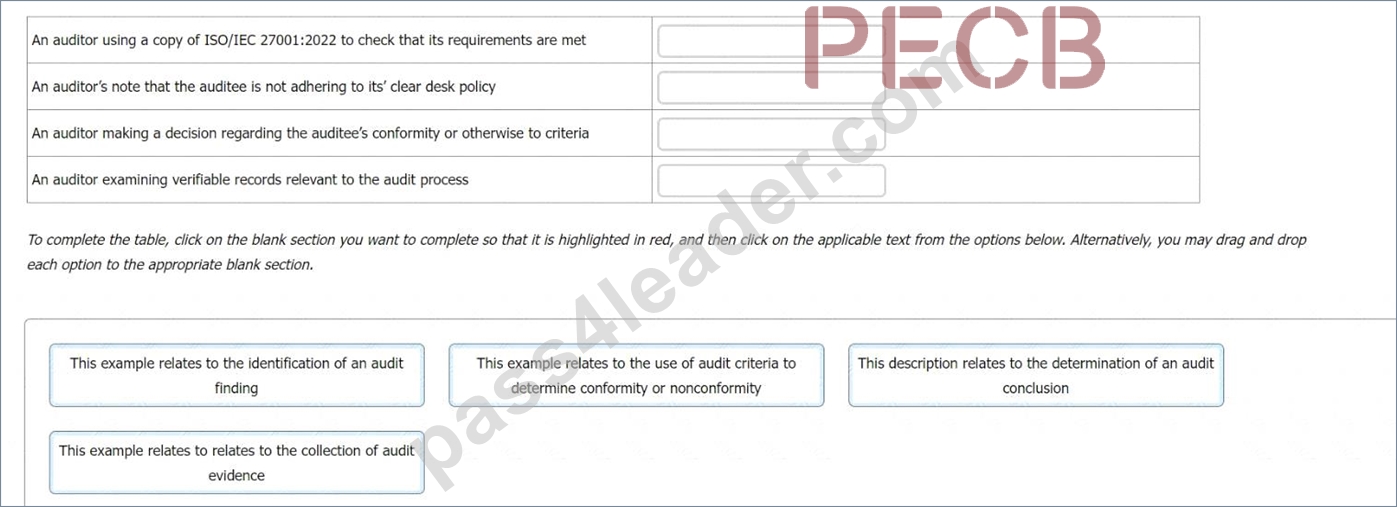
Answer:
Explanation: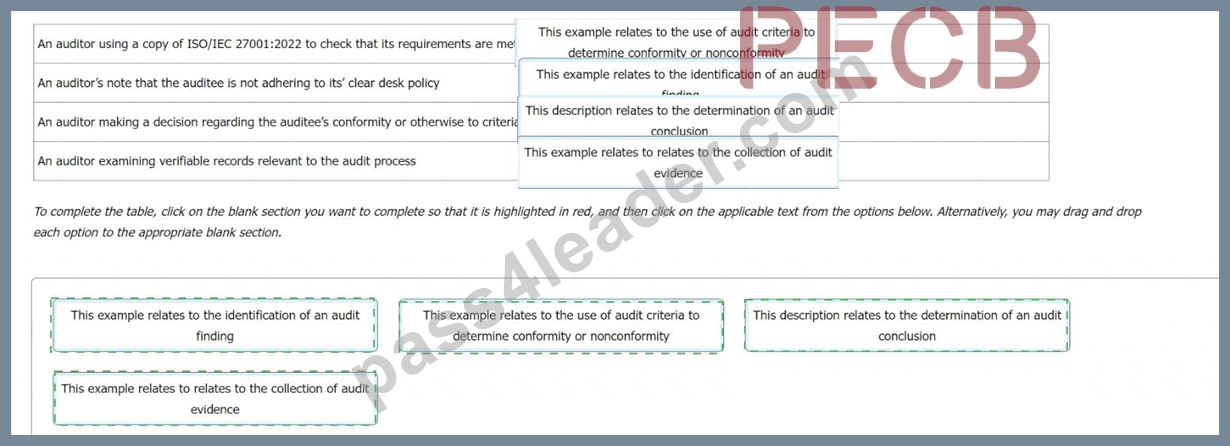
Explanation:
1. An auditor using a copy of ISO/IEC 27001:2022 to check that its requirements are met:
Termed: Reviewing audit criteria.
Justification: The auditor is comparing the auditee's information security management system (ISMS) against the established criteria outlined in the ISO/IEC 27001:2022 standard. This activity falls under the use of audit criteria to determine conformity or nonconformity.
2. An auditor's note that the auditee is not adhering to its clear desk policy:
Termed: Identifying an audit finding.
Justification: The auditor has observed a deviation from the auditee's established policy on clear desks. This observation is documented as a potential nonconformity, which requires further investigation and evaluation.
3. An auditor making a decision regarding the auditee's conformity or otherwise to criteria:
Termed: Determining an audit conclusion.
Justification: Based on the collected audit evidence and evaluation against the established criteria, the auditor forms an opinion about the overall compliance of the auditee's ISMS. This opinion is the audit conclusion and is a key element of the audit report.
4. An auditor examining verifiable records relevant to the audit process:
Termed: Collecting audit evidence.
Justification: The auditor is gathering objective and verifiable information to support their findings and conclusions. This information comes from various sources, including documents, records, interviews, and observations.
NEW QUESTION # 258
Scenario 6
Sinvestment is an insurance provider that offers a wide range of coverage options, including home, commercial, and life insurance. Originally established in North California, the company has expanded its operations to other locations, including Europe and Africa. In addition to its growth, Sinvestment is committed to complying with laws and regulations applicable to its industry and preventing any information security incident. They have implemented an information security management system (ISMS) based on ISO
/IEC 27001 and have applied for certification.
A team of auditors was assigned by the certification body to conduct the audit. After signing a confidentiality agreement with Sinvestment, they started the audit activities. For the activities of the stage 1 audit, it was decided that they would be performed on site, except the review of documented information, which took place remotely, as requested by Sinvestment.
The audit team started the stage 1 audit by reviewing the documentation required, including the declaration of the ISMS scope, information security policies, and internal audit reports. The evaluation of the documented information was based on the content and procedure for managing the documented information.
In addition, the auditors found out that the documentation related to information security training and awareness programs was incomplete and lacked essential details. When asked, Sinvestment's top management stated that the company has provided information security training sessions to all employees.
The stage 2 audit was conducted three weeks after the stage 1 audit. The audit team observed that the marketing department (not included in the audit scope) had no procedures to control employees' access rights.
Since controlling employees' access rights is one of the ISO/IEC 27001 requirements and was included in the company's information security policy, the issue was included in the audit report.
Question
Was Sinvestment's request for reviewing documented information remotely acceptable?
- A. No, as the combination of different locations can negatively impact the audit efficiency.
- B. No, as it can lead to a breach of confidentiality.
- C. Yes, documented information can be reviewed remotely.
Answer: C
Explanation:
Sinvestment's request to review documented information remotely during the stage 1 audit is acceptable and aligns with established auditing practices, making option A the correct answer. ISO/IEC 17021-1 and ISO
19011:2018 both permit flexibility in how audit activities are conducted, including the use of remote techniques, provided confidentiality, integrity, and effectiveness of the audit are maintained.
Stage 1 audits are primarily focused on reviewing documented information, understanding the organization's context, confirming the ISMS scope, and assessing readiness for stage 2. Reviewing documents remotely is a widely accepted practice, especially when supported by appropriate confidentiality agreements, as was the case in this scenario. The auditors had already signed confidentiality agreements, mitigating the risk of information disclosure.
Option B is incorrect because remote document review does not inherently lead to a breach of confidentiality.
Risks must be managed, not assumed. Secure document-sharing platforms and confidentiality agreements are sufficient safeguards when properly implemented. Option C is incorrect because the use of different locations or remote methods does not automatically reduce audit efficiency; in many cases, it enhances efficiency by reducing travel time and allowing better preparation.
Therefore, allowing remote review of documented information during stage 1 is fully consistent with ISO auditing standards and recognized certification body practices.
NEW QUESTION # 259
You are the audit team leader conducting a third-party audit of an online insurance company. During Stage 1, you found that the organization took a very cautious risk approach and included all the information security controls in ISO/IEC 27001:2022 Appendix A in their Statement of Applicability.
During the Stage 2 audit, your audit team found that there was no evidence of a risk treatment plan for the implementation of the three controls (5.3 Segregation of duties, 6.1 Screening, 7.12 Cabling security). You raise a nonconformity against clause 6.1.3.e of ISO 27001:2022.
At the closing meeting, the Technical Director issues an extract from an amended Statement of Applicability (as shown) and asks for the nonconformity to be withdrawn.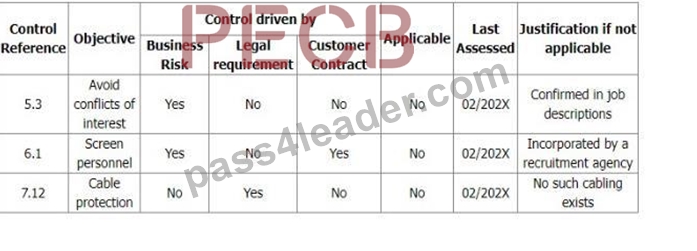
Select three options of the correct responses of an audit team leader to the request of the Technical Director.
- A. Advise the Technical Director that the nonconformity must stand since the evidence obtained for it was clear.
- B. Advise management that the information provided will be reviewed when the auditors have more time.
- C. Ask the auditor who raised the issue for their opinion on how you should respond to the request.
- D. State that a follow up audit will be necessary to review the evidence for the updated Statement of Applicability.
- E. Advise the Technical Director that his request will be included in the audit report.
- F. Advise the Technical Director that once a nonconformity is raised it cannot be withdrawn.
- G. Inform the Technical Director that the nonconformity will be changed to an Opportunity for Improvement.
- H. Review the documentation produced and withdraw the nonconformity.
Answer: A,D,E
Explanation:
The three options of the correct responses of an audit team leader to the request of the Technical Director are:
B). Advise the Technical Director that his request will be included in the audit report.
D). Advise the Technical Director that the nonconformity must stand since the evidence obtained for it was clear.
H). State that a follow up audit will be necessary to review the evidence for the updated Statement of Applicability.
B). This response is correct because the audit team leader should document the request of the Technical Director and include it in the audit report, along with the audit findings and conclusions12. This will ensure transparency and traceability of the audit process and the audit results.
D). This response is correct because the audit team leader should not withdraw the nonconformity based on the amended Statement of Applicability alone. The nonconformity was raised against clause 6.1.3.e of ISO 27001:2022, which requires the organisation to produce and maintain a risk treatment plan that defines how the information security risks are treated, including the controls selected and their implementation status34. The Statement of Applicability is only one part of the risk treatment plan, and it does not provide sufficient evidence that the controls have been implemented effectively. The audit team leader should base the nonconformity on the objective evidence obtained during the audit, not on the subjective claims of the auditee12.
H). This response is correct because the audit team leader should state that a follow up audit will be necessary to review the evidence for the updated Statement of Applicability. A follow up audit is an audit that is conducted after a previous audit to verify the implementation and effectiveness of the corrective actions and/or opportunities for improvement that were agreed upon as a result of the previous audit56. The follow up audit should seek to ensure that the nonconformity has been effectively addressed and that the ISMS is compliant and effective. The follow up audit should also consider any new or changed risks or requirements that may affect the ISMS56.
References:
1: PECB Candidate Handbook - ISO 27001 Lead Auditor, page 25 2: ISO 19011:2018 - Guidelines for auditing management systems, clause 6.7 3: ISO/IEC 27001:2022 - Information technology - Security techniques - Information security management systems - Requirements, clause 6.1.3.e 4: ISO/IEC 27005:2022 - Information technology - Security techniques - Information security risk management, clause 8.3.2 5: PECB Candidate Handbook - ISO 27001 Lead Auditor, page 25 6: ISO 19011:2018 - Guidelines for auditing management systems, clause 6.7
NEW QUESTION # 260
You are an experienced audit team leader guiding an auditor in training.
Your team is currently conducting a third-party surveillance audit of an organisation that stores data on behalf of external clients. The auditor in training has been tasked with reviewing the PHYSICAL controls listed in the Statement of Applicability (SoA) and implemented at the site.
Select four controls from the following that would you expect the auditor in training to review.
- A. Access to and from the loading bay
- B. The organisation's arrangements for maintaining equipment
- C. The conducting of verification checks on personnel
- D. The development and maintenance of an information asset inventory
- E. How power and data cables enter the building
- F. The organisation's business continuity arrangements
- G. The operation of the site CCTV and door control systems
- H. Information security awareness, education, and training
Answer: A,B,E,G
Explanation:
The four controls from the list that are related to PHYSICAL aspects of the ISMS are:
* Access to and from the loading bay
* How power and data cables enter the building
* The operation of the site CCTV and door control systems
* The organisation's arrangements for maintaining equipment
These controls are derived from the ISO 27001 Annex A, which provides a comprehensive list of information security controls that can be applied to an ISMS1. The other controls in the list are more related to ORGANIZATIONAL, LEGAL, or HUMAN aspects of the ISMS, which are also important, but not the focus of this question.
According to the ISMS Auditing Guideline2, the auditor in training should review the PHYSICAL controls by:
* Checking the SoA to identify the applicable controls and their implementation status
* Interviewing the relevant staff and management to verify their understanding and involvement in the controls
* Observing the physical and environmental conditions to confirm the existence and effectiveness of the controls
* Examining the relevant documents and records to validate the compliance and performance of the controls I hope this helps you prepare for the exam.
NEW QUESTION # 261
You are the audit team leader conducting a third-party audit of an online insurance company. During Stage 1, you found that the organization took a very cautious risk approach and included all the information security controls in ISO/IEC 27001:2022 Appendix A in their Statement of Applicability.
During the Stage 2 audit, your audit team found that there was no evidence of a risk treatment plan for the implementation of the three controls (5.3 Segregation of duties, 6.1 Screening, 7.12 Cabling security). You raise a nonconformity against clause 6.1.3.e of ISO 27001:2022.
At the closing meeting, the Technical Director issues an extract from an amended Statement of Applicability (as shown) and asks for the nonconformity to be withdrawn.
Select three options of the correct responses of an audit team leader to the request of the Technical Director.
- A. Advise the Technical Director that the nonconformity must stand since the evidence obtained for it was clear.
- B. Advise management that the information provided will be reviewed when the auditors have more time.
- C. Ask the auditor who raised the issue for their opinion on how you should respond to the request.
- D. State that a follow up audit will be necessary to review the evidence for the updated Statement of Applicability.
- E. Advise the Technical Director that his request will be included in the audit report.
- F. Advise the Technical Director that once a nonconformity is raised it cannot be withdrawn.
- G. Inform the Technical Director that the nonconformity will be changed to an Opportunity for Improvement.
- H. Review the documentation produced and withdraw the nonconformity.
Answer: A,D,E
Explanation:
The three options of the correct responses of an audit team leader to the request of the Technical Director are:
* B. Advise the Technical Director that his request will be included in the audit report.
* D. Advise the Technical Director that the nonconformity must stand since the evidence obtained for it was clear.
* H. State that a follow up audit will be necessary to review the evidence for the updated Statement of Applicability.
* B. This response is correct because the audit team leader should document the request of the Technical Director and include it in the audit report, along with the audit findings and conclusions12. This will ensure transparency and traceability of the audit process and the audit results.
* D. This response is correct because the audit team leader should not withdraw the nonconformity based on the amended Statement of Applicability alone. The nonconformity was raised against clause 6.1.3.e of ISO 27001:2022, which requires the organisation to produce and maintain a risk treatment plan that defines how the information security risks are treated, including the controls selected and their implementation status34. The Statement of Applicability is only one part of the risk treatment plan, and it does not provide sufficient evidence that the controls have been implemented effectively. The audit team leader should base the nonconformity on the objective evidence obtained during the audit, not on the subjective claims of the auditee12.
* H. This response is correct because the audit team leader should state that a follow up audit will be necessary to review the evidence for the updated Statement of Applicability. A follow up audit is an audit that is conducted after a previous audit to verify the implementation and effectiveness of the corrective actions and/or opportunities for improvement that were agreed upon as a result of the previous audit56. The follow up audit should seek to ensure that the nonconformity has been effectively addressed and that the ISMS is compliant and effective. The follow up audit should also consider any new or changed risks or requirements that may affect the ISMS56.
References:
1: PECB Candidate Handbook - ISO 27001 Lead Auditor, page 25 2: ISO 19011:2018 - Guidelines for auditing management systems, clause 6.7 3: ISO/IEC 27001:2022 - Information technology - Security techniques - Information security management systems - Requirements, clause 6.1.3.e 4: ISO/IEC 27005:
2022 - Information technology - Security techniques - Information security risk management, clause 8.3.2
5: PECB Candidate Handbook - ISO 27001 Lead Auditor, page 25 6: ISO 19011:2018 - Guidelines for auditing management systems, clause 6.7
NEW QUESTION # 262
......
Certification Topics of ISO-IEC-27001-Lead-Auditor Exam PDF Recently Updated Questions: https://www.pass4leader.com/PECB/ISO-IEC-27001-Lead-Auditor-exam.html
ISO-IEC-27001-Lead-Auditor Exam Prep Guide: Prep guide for the ISO-IEC-27001-Lead-Auditor Exam: https://drive.google.com/open?id=1HxNAP_bgMKOW2ZZtmv-phJ9atniA5KLc