

Online Questions - Valid Practice To your PPAN01 Exam (Updated 54 Questions)
Practice To PPAN01 - Remarkable Practice On your Certified Threat Protection Analyst Exam Exam
NEW QUESTION # 30
As a security analyst, you need to update the TAP URL Defense Custom Blocklist. Which three entries are valid formats for the blocklist? (Select three.)
- A. example.com
- B. .xxx
- C. *.acme.org
- D. example
- E. ftp://ftp.example.com
- F. http://www.example.com
Answer: B
Explanation:
In
Proofpoint TAP URL Defense, the Custom Blocklist is intended to match domains/patterns, not full URLs with schemes or non-domain tokens. Valid entries are typically domain-based patterns (e.g., exact domains or wildcard subdomains) and, in some cases, top-level domain patterns. The entry .xxx is a valid pattern format used to match a TLD, enabling broad blocking of that TLD class when appropriate for policy. By contrast, entries including schemes such as http:// or ftp:// are not the expected format for the URL Defense custom domain list and can generate warnings or fail validation. A single-label token like example is not a valid DNS domain in this context. Operationally, defenders use the URL Defense Custom Blocklist to rapidly mitigate active campaigns by blocking known malicious domains or risky domain classes without waiting for reputation propagation. Best practice in IR is to block as narrowly as possible (exact domain or controlled wildcard) to reduce business disruption, document the reason and incident reference, and periodically review entries to remove stale blocks or replace broad patterns with more precise IOCs.
NEW QUESTION # 31
Refer to the exhibit.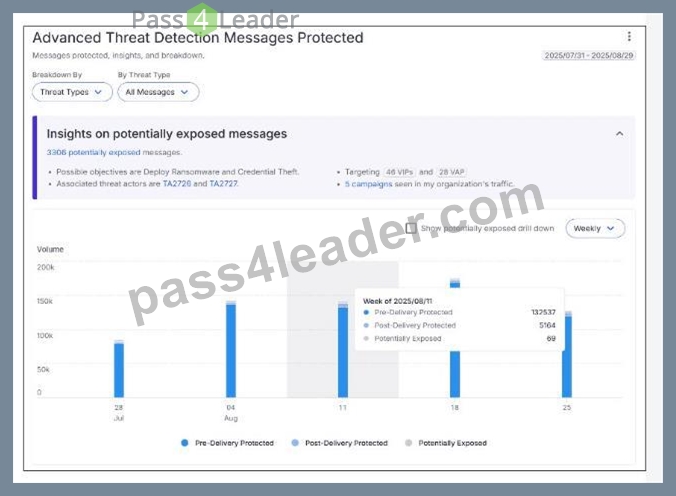
Based on the metrics for the highlighted week, how many malicious messages were blocked by TAP at the email gateway?
- A. 0
- B. 1
- C. 132,537
- D. 5,164
Answer: C
Explanation:
In TAP reporting and weekly dashboard metrics, "blocked at the email gateway" represents messages prevented from reaching user mailboxes by the Proofpoint email security layer (pre-delivery containment).
The highlighted week's gateway-blocked malicious count in the exhibit corresponds to 132,537 (C), which reflects the volume of threats stopped before user exposure-an important operational metric for prevention effectiveness. In Proofpoint-focused IR, analysts use this metric to distinguish between (1) threats fully contained pre-delivery (lower immediate response burden) and (2) threats delivered or interacted with (higher incident risk requiring containment and user remediation). High gateway-blocked numbers can still indicate an active campaign targeting the organization and may justify proactive measures: tightening policy thresholds, reviewing top senders/domains, and validating that URL/attachment defenses are functioning as expected. It also supports post-incident reporting by showing "prevented impact" and helping stakeholders understand defense value. For detection and analysis, the key is correlating this figure with At Risk/Impacted trends; a high blocked count with low impacted is a healthy posture, while any spike in impacted warrants immediate investigation.
NEW QUESTION # 32
You would like to view the total number of uncleared threats or false positives that have been interacted with by users over the past 2 weeks. How can this be accomplished on the TAP Dashboard?
- A. On the Threats page, select Last 14 days and click on the "Highlighted" column header.
- B. On the Threats page, select Last 14 days and click on the "Intended" column header.
- C. On the Threats page, select Last 14 days and click on the "Impacted" column header.
- D. On the Threats page, select Last 14 days and click on the "At Risk" column header.
Answer: C
Explanation:
"Interacted with by users" maps to Proofpoint's Impacted concept-users who clicked, engaged, or otherwise interacted with the threat (depending on threat type and telemetry). To view the total count of uncleared threats or false positives with interaction in the last two weeks, you use the Threats page with a Last 14 days time filter and then sort or focus via the Impacted column (C). Intended measures attempted targeting; At Risk reflects delivery/exposure without necessarily any interaction; Highlighted flags special categories (notable techniques, false positive indicators, notable items) but is not the direct measure of user interaction. In Proofpoint-focused IR, "Impacted last 14 days" is a core operational view because it narrows work to threats with the highest likelihood of real compromise outcomes (credential submission, malware execution, BEC replies). Analysts then pivot into impacted-user drilldowns to confirm whether the threat is still uncleared, whether post-delivery quarantine has succeeded, and whether user remediation is required. This is also a key SOC metric for prioritization and for demonstrating risk reduction when controls and training reduce impacted counts over time.
NEW QUESTION # 33
What is the primary function of the People Page in the Threat Protection Workbench and TAP Dashboard?
- A. To configure email filtering rules for specific users.
- B. To help identify and prioritize users affected by threats.
- C. To track user engagement with phishing simulations.
- D. To manage user permissions and access controls.
Answer: B
Explanation:
The People Page is a user-centric investigation view designed to help analysts quickly identify who is being targeted and who is most at risk/impacted by threats (D). Instead of starting from a single message, responders can pivot from user risk signals-Attack Index, exposure metrics, click behavior, VIP status, and repeated campaign targeting-to build a prioritized queue for investigation. In Proofpoint IR operations, this supports rapid triage during active phishing/BEC waves: analysts identify the highest-risk users first (those with permitted clicks or delivered accessible threats), then perform immediate follow-up actions such as credential resets, session/token revocation, mailbox rule review, and targeted comms. The People Page is not an access control manager and it is not the place to configure granular filtering rules per user (that's policy/admin territory). It's also distinct from security awareness simulation dashboards, though it can inform who should receive training based on risky behavior. As part of detection and analysis, the People Page helps convert large-scale threat telemetry into actionable, person-focused response steps, minimizing dwell time and reducing the chance that the most exposed users are missed.
NEW QUESTION # 34
An analyst is reviewing the Notable Senders section in Proofpoint Supplier Threat Protection.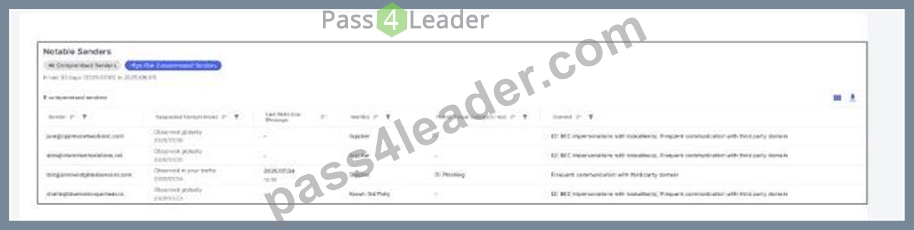
Based on the data shown in the exhibit, which vendor's email activity should be investigated first?
Answer: C
Explanation:
Supplier Threat Protection prioritization focuses on vendor identities whose messaging patterns indicate elevated risk-such as unusual sending behavior, higher malicious/suspicious message counts, abnormal spike patterns, or stronger impersonation/compromise indicators relative to other suppliers. Based on the exhibit's Notable Senders metrics, [email protected] (C) shows the highest-risk activity and should be investigated first. In Proofpoint IR workflow, supplier-related threats are high impact because they exploit trust relationships and can bypass user suspicion (invoice/payment workflows, shared documents, ongoing threads). The investigation typically validates whether this is: (1) a compromised supplier mailbox, (2) supplier-domain impersonation (lookalike domain), or (3) a legitimate supplier system misconfigured and sending risky content. Analysts pivot into message samples, authentication alignment (SPF/DKIM/DMARC), sending infrastructure changes, and recipient targeting patterns (finance/AP, executives). If malicious, containment includes blocking the supplier sender/domain (or precise subdomains), pulling delivered copies via TRAP, alerting impacted users, and initiating vendor contact to remediate the supplier's account security.
NEW QUESTION # 35
Which two factors make Business Email Compromise (BEC) attacks difficult to detect? (Select two.)
- A. They use malicious URLs.
- B. They use social engineering.
- C. They use impersonation.
- D. They use malware.
- E. They use spam.
Answer: B,C
Explanation:
BEC is difficult to detect primarily because it often lacks "traditional malware signals" and instead relies on human deception. Social engineering (C) is core: attackers craft believable narratives (invoice urgency, legal requests, gift card scams, payroll changes) tailored to organizational context. Impersonation (D) is the second pillar: display-name spoofing, lookalike domains, compromised vendor accounts, and executive/finance role impersonation. These tactics can produce messages that are text-only, low-volume, and free of obviously malicious attachments/URLs, making signature-based or URL reputation controls less effective. Proofpoint- specific defenses therefore emphasize identity and relationship signals (impostor detection, supplier risk, unusual sending patterns), authentication (SPF/DKIM/DMARC alignment), and behavioral context (who typically emails whom, anomalies in reply chains, newly observed domains). In IR, analysts triage BEC by validating headers, checking domain age and similarity, confirming invoice/payment workflows out-of-band, and scoping for mailbox compromise (rules/forwarding, suspicious OAuth grants). Because BEC "looks normal" at the technical layer, effective detection requires combining Proofpoint telemetry with process controls and fast escalation to business stakeholders.
NEW QUESTION # 36
Which two threat protection capabilities are available as part of Proofpoint's Targeted Attack Protection (TAP)? (Select two.)
- A. Pulls malicious emails from user inbox after delivery
- B. Cloud-based solution that remediates threats post-delivery
- C. Training solution that drives user behavioral change
- D. Provides protection against URL-based email threats
- E. Protects users against threats in email attachments
Answer: D,E
Explanation:
TAP is Proofpoint's detection and analysis layer for advanced email threats, with core capabilities focused on URL-based threats and attachment-based threats. URL Defense (C) rewrites links and performs time-of-click analysis to block newly malicious destinations and provide click telemetry for investigations. Attachment Defense (E) analyzes file payloads (including sandbox/detonation and static reputation approaches depending on configuration) to detect malware and suspicious content that may evade traditional gateway signatures.
These two capabilities are central to TAP's role in detection and analysis: they generate verdicts, campaign clustering, and exposure metrics (Intended/At Risk/Impacted) used by SOC teams to prioritize response. Post- delivery remediation ("pull from inbox" or "remediate post-delivery") is not TAP's primary function; that is typically handled by TRAP/Cloud Threat Response capabilities (A/D). User training is handled by Proofpoint Security Awareness/ZenGuide solutions (B), which complement TAP by reducing click rates and improving reporting, but are not TAP threat protection capabilities. TAP's value in IR is turning email threat content (URLs/attachments) into actionable, scoped, measurable incidents.
NEW QUESTION # 37
Under what circumstances will TAP generate an email notification alert?
- A. A malicious attachment was blocked from delivery.
- B. A malicious impostor message has been delivered.
- C. A message has been delivered to numerous recipients.
- D. A click has been blocked to a malicious site.
Answer: B
Explanation:
TAP notification alerting is most valuable when there is meaningful risk to users-especially when a threat has been delivered and may require immediate investigation and response. A delivered malicious impostor message (B) is a high-priority condition because it can indicate BEC/executive impersonation or supplier impersonation, which often lacks malware indicators and can lead directly to financial fraud or credential theft. Proofpoint workflows emphasize alerting on delivered threats because "blocked at the gateway" events are already contained, while delivered impostor threats demand rapid action: validate recipient exposure, check user interaction (reply/forward/click), execute post-delivery remediation (TRAP pull/quarantine), and coordinate business verification steps (finance call-back procedures). While blocked clicks can be telemetry, the alert scenario in TAP training contexts typically highlights delivered impostor threats as the condition warranting immediate attention since the attacker reached the user. TAP's design aligns with IR triage:
prioritize what is active, delivered, and likely to cause harm if not rapidly contained.
NEW QUESTION # 38
What type of threat does the Cloud Security Report help identify in connected environments?
- A. Malicious Insider
- B. Account Takeover
- C. Ransomware
- D. Business Email Compromise
Answer: B
Explanation:
The Cloud Security Report is designed to highlight risks and suspicious activity across connected cloud environments, with a strong focus on indicators consistent with account takeover (ATO) (B). In Proofpoint cloud-connected contexts (e.g., cloud email and SaaS integrations), ATO manifests through patterns such as unusual sign-in behavior, suspicious mailbox activity, anomalous sending, unexpected forwarding rules, OAuth application consents, and risky access from new locations/devices. For IR, this is critical because modern phishing frequently targets credentials and sessions rather than delivering executable malware, and compromised cloud identities enable fast lateral movement through internal phishing, invoice fraud, and data access. Proofpoint reporting helps analysts identify which users and accounts show the strongest compromise signals so they can prioritize containment: force password reset, revoke refresh tokens/sessions, remove malicious inbox rules and forwarding, disable suspicious OAuth grants, and validate MFA posture. While ransomware, insider risk, and BEC can be related outcomes, the Cloud Security Report's connected- environment emphasis is on identity compromise signals and cloud account misuse-core ATO detection and investigation drivers.
NEW QUESTION # 39
What is a defining characteristic of Advanced Persistent Threat (APT) actors?
- A. They operate independently without government affiliation.
- B. They are state-sponsored and target strategic assets.
- C. They focus on short-term financial scams.
- D. They primarily use social engineering to gain access.
Answer: B
Explanation:
APT actors are characterized by strategic intent, persistence, and resourcing-commonly associated with state sponsorship or alignment-targeting sensitive assets such as government, defense, critical infrastructure, research IP, and executive communications. In Proofpoint-centered investigations, APT-style campaigns often show tailored lures (highly contextual pretexting), careful targeting (VIPs, finance, legal, IT), and "low-and- slow" operational patterns that reduce obvious malware signals. They may use credential phishing, session hijacking, or BEC-style social engineering as initial access, then pivot to living-off-the-land techniques and stealthy persistence in cloud mailboxes (inbox rules, forwarding, OAuth grants). Proofpoint telemetry (campaign clustering, threat actor mapping where available, impersonation indicators, supplier compromise signals) supports detection and scoping, but the defining attribute remains the attacker's strategic targeting and persistence rather than any single technique. This distinction matters operationally: APT suspicion raises escalation thresholds, broadens scoping (adjacent mailboxes, suppliers, cloud audit logs), increases evidence preservation rigor, and typically triggers executive/legal coordination earlier in the response lifecycle.
NEW QUESTION # 40
Why do some domains generate a warning when they are added to the custom blocklist in TAP?
- A. Because they are less popular and low-risk domains that do not pose a threat.
- B. Because they are already blocked by other security measures, such as IPS and firewall.
- C. Because they are already blocked and restricted by default in the network system.
- D. Because entire domains of popular and prominent services on the web should not be blocked.
Answer: D
Explanation:
TAP URL Defense custom blocklists can accept domain-based entries, but Proofpoint warns when you attempt to block domains that are widely used by legitimate services (D). Blocking an entire "popular
/prominent" domain (or a broad wildcard that matches it) can cause major business disruption: break SaaS access, block legitimate customer/vendor communications, and generate a flood of user tickets-ultimately harming containment efforts by forcing emergency rollback. In Proofpoint-focused IR, the safest containment approach is precision: block the specific malicious domain, subdomain, or path pattern when supported, and avoid blanket blocks that collide with common web platforms (cloud storage, URL shorteners, collaboration tools). The warning is a guardrail to prevent overly broad mitigations that create operational outages while providing limited security benefit (attackers can shift infrastructure quickly). When a threat leverages a legitimate platform, IR teams typically prefer tighter controls: block the exact malicious host, apply time-of- click blocking, use isolation/safe browsing controls, and hunt/pull the related emails rather than blocking the entire service domain.
NEW QUESTION # 41
Refer to the exhibit.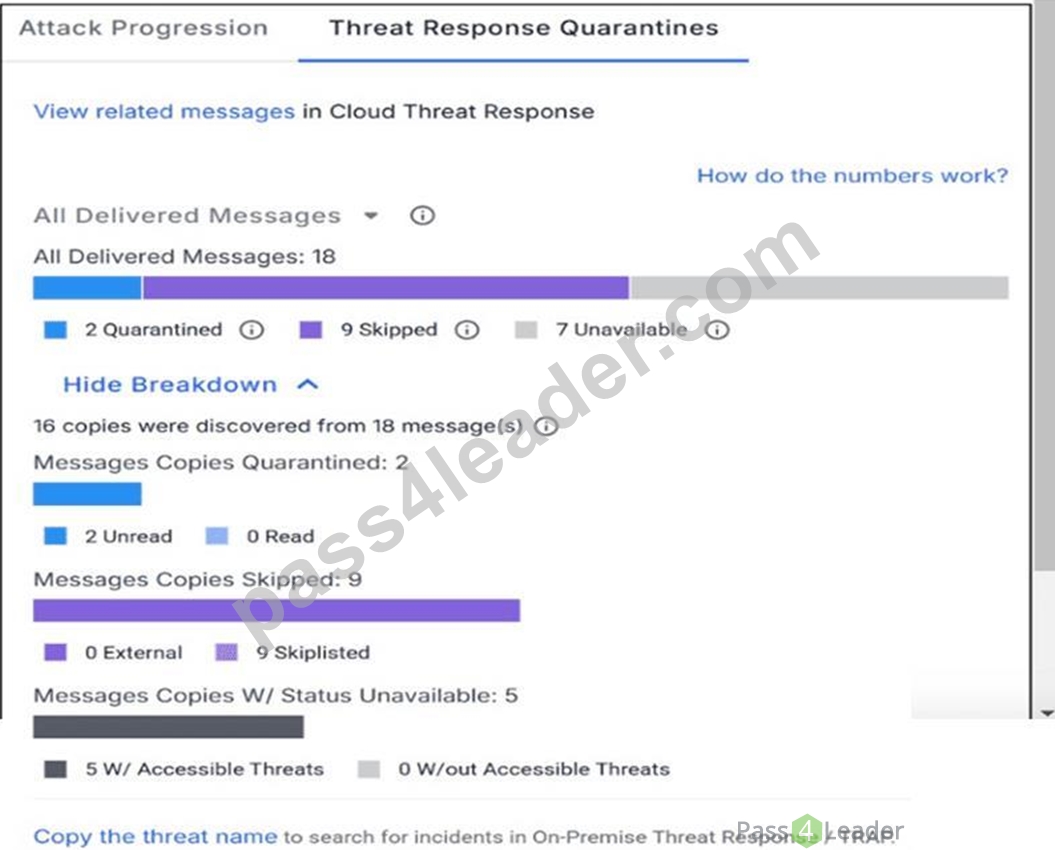
How many messages were sent to a mailbox configured to bypass quarantine for monitoring purposes?
- A. 0
- B. 1
- C. 2
- D. 3
Answer: A
Explanation:
A "bypass quarantine for monitoring" mailbox is typically a controlled testing/observation mailbox used by security teams to validate detection efficacy and to safely observe threat traffic patterns without impacting end-user productivity. In Proofpoint email security operations, these mailboxes are configured so that messages that would normally be quarantined are instead delivered to a designated mailbox for review, allowing analysts to (1) validate classifier accuracy, (2) capture full artifacts for analysis (.eml, headers, URLs
/attachments), and (3) measure how controls behave over time (policy hits, spam/phish/malware scoring).
Based on the exhibit, the correct count of messages routed to that bypass/quarantine-monitoring mailbox is 9 (option C). Operationally, this metric is useful for confirming whether the monitoring workflow is receiving enough samples to be meaningful and whether policy changes unexpectedly increase or reduce quarantined traffic. In IR scenarios, it can also be used to safely test blocklist effectiveness and confirm retroactive remediation actions without exposing production users.
NEW QUESTION # 42
Which two items should be included in an incident report to be discussed during a post-incident debrief?
(Select two.)
- A. Product manuals
- B. Speculation about adversary attribution
- C. Software inventory
- D. Incident timeline
- E. Devices and systems involved
Answer: D,E
Explanation:
Post-incident debriefs require evidence-backed documentation that enables learning and control improvements. The two most essential items are the incident timeline (D) and the devices/systems involved (E). The timeline reconstructs key events (first delivery, first click, first alert, containment actions, TRAP pulls, credential resets, policy changes) and supports measurable IR metrics (MTTD, MTTR). The "devices and systems involved" section defines scope and blast radius: which mailboxes were targeted, which users were impacted, what email systems were involved (gateway, cloud mail, endpoints), and which Proofpoint components contributed (TAP verdicts, URL Defense click logs, Smart Search traces, TRAP remediation).
This information is the foundation for root cause analysis and for validating that remediation fully covered the environment (no missed recipients, no unremediated copies, no lingering compromised accounts). Software inventories and product manuals are generally not debrief deliverables, and adversary attribution speculation is discouraged unless it is evidence-based and necessary for risk decisions. Proofpoint IR best practice is factual, actionable reporting that directly drives preventive control changes.
NEW QUESTION # 43
What happens when a user clicks a rewritten URL that TAP URL Defense has determined to be malicious?
- A. The system delivers a separate email alert to the user.
- B. The user is redirected to the organization's homepage.
- C. The link opens normally and the site remains accessible.
- D. The user is shown a warning page and the site is blocked.
Answer: D
Explanation:
Proofpoint TAP URL Defense rewrites URLs to route clicks through Proofpoint's time-of-click analysis service. If the destination is determined malicious at click time, the user is presented with a block/warning page and access is denied (A). This is a core containment mechanism because URL reputation can change after delivery: a link that looked benign during initial scanning may become weaponized later (compromised site, delayed redirect, newly hosted phishing kit). The warning page both prevents compromise and provides user feedback that a threat was intercepted. For IR responders, this behavior is also valuable telemetry: TAP records click events, verdicts, and whether clicks were blocked or permitted, which drives scoping and prioritization (Impacted users vs At Risk). In recovery, blocked clicks reduce the likelihood that credential resets or endpoint remediation are needed, but analysts still validate whether any earlier clicks occurred before condemnation, whether users accessed the URL outside protected paths (copy/paste, mobile clients), and whether campaign-wide remediation (blocklisting domains, pulling emails) is necessary to prevent repeat attempts.
NEW QUESTION # 44
Which Proofpoint product quarantines malicious email after delivery?
- A. CASB
- B. CLEAR
- C. TRAP
- D. TAP
Answer: C
Explanation:
TRAP (Threat Response Auto-Pull) is the Proofpoint capability designed for post-delivery remediation-it can locate and quarantine/pull messages from user mailboxes after they have already been delivered. This is critical in real-world IR because many threats are discovered after initial delivery (e.g., URL reputation flips, delayed detonation results, user-reported phish via "Report Suspicious," or new campaign intelligence). TAP provides detection, verdicting, and campaign intelligence, but TRAP is the mechanism that operationalizes containment inside mailboxes by removing the message from inboxes and other folders to reduce further exposure. In incident handling, TRAP actions are commonly paired with scoping queries (who received it), retroactive search for similar messages, and compensating controls (URL Defense blocks, domain blocks, authentication enforcement). Using TRAP effectively reduces "time at risk" and limits additional clicks or credential submissions after the incident is identified. It also supports auditability by recording which mailboxes were remediated and whether any items were "unavailable," which becomes a follow-up scoping requirement.
NEW QUESTION # 45
Which of the following is an item that should be included in an incident report as part of the post-incident debrief?
- A. Adversary tactics and techniques
- B. Network diagrams
- C. Incident response plan
- D. Proofpoint threat landscape reporting
Answer: A
Explanation:
A high-quality incident report captures what the adversary did in a way that enables prevention and detection improvements. Including adversary tactics and techniques (C) is essential because it translates raw artifacts (emails, URLs, headers, click events) into actionable security engineering outcomes: which initial access method was used (credential phishing vs BEC), which impersonation technique (display name, lookalike domain, supplier compromise), what persistence was attempted (mailbox rules/forwarding, OAuth consent), and what objectives were pursued (invoice fraud, data theft, lateral phishing). In Proofpoint-centered IR, mapping tactics and techniques supports targeted control tuning: URL Defense policy, attachment sandboxing, impostor rules, DMARC enforcement, and TRAP automation; it also improves analyst playbooks (what pivots to run next time, what indicators to hunt). The incident response plan (B) is a reference document, not an incident-specific report item. Network diagrams (A) may be helpful in some incidents but are not always relevant for email-led events. Threat landscape reporting (D) is contextual intel, but the report must focus on what occurred in this incident and what to change to reduce recurrence, which is best captured via tactics/techniques.
NEW QUESTION # 46
What action does Proofpoint Collab Protection take when a malicious URL is detected?
- A. Encrypts the browser session.
- B. Automatically deletes the URL from the system.
- C. Sends an alert to the user's manager.
- D. Redirects the browser to a block page.
Answer: D
Explanation:
Proofpoint Collab Protection extends threat controls into collaboration channels (e.g., links shared in chat
/collaboration platforms). When a malicious URL is detected, the immediate containment objective is to prevent a user from reaching the destination. The standard enforcement action is to redirect the user to a block page (D), analogous to URL Defense time-of-click blocking in email. This prevents credential harvesting and drive-by compromise while providing clear user feedback that the link was identified as unsafe. From an IR containment perspective, a block-page redirect also creates consistent telemetry: analysts can correlate attempted access events, identify which users attempted to follow the link, and scope the spread of the malicious content across channels (who posted it, who received it, who clicked). Unlike "deleting the URL from the system," which is not realistic in distributed collaboration content, the block-page model is an enforceable control that works at access time. In recovery, responders still validate whether any users accessed the URL outside protected paths and then apply additional mitigations (IOC blocking, user notification, and account checks if the link was credential-phishing).
NEW QUESTION # 47
An analyst is reviewing the Threat Response Quarantines card for a message in TAP Dashboard, as shown in the exhibit.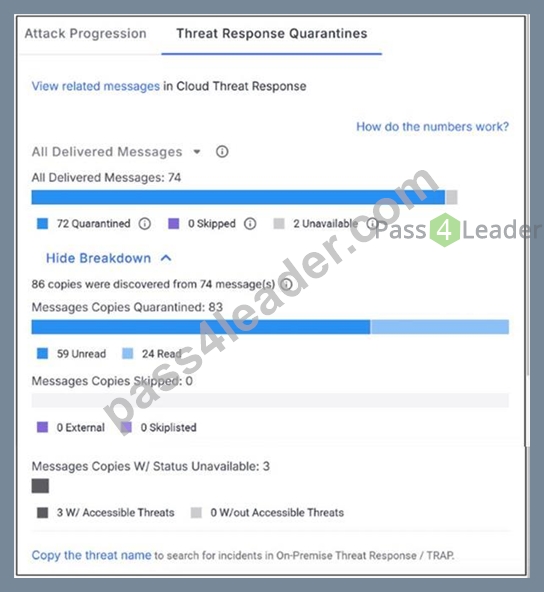
Why might a message be flagged with status "unavailable"?
- A. The message was delayed in delivery because of large attachment size.
- B. The message was marked as read by the user before it could be quarantined.
- C. The message was deleted from the mailbox before it could be quarantined.
- D. The message was automatically moved into a user-created folder for archiving.
Answer: C
Explanation:
In Proofpoint Threat Response / post-delivery remediation workflows, a quarantine action depends on the message still existing in the target mailbox (Inbox or other folders where the connector searches). A status of
"unavailable" commonly indicates the system could not locate the message to apply the action-most often because it was deleted or otherwise removed before quarantine occurred (A). This can happen if the user manually deletes it, an automated mailbox rule moves it to Deleted Items and empties it, retention policies purge it, or another remediation tool removes it first. From an IR containment perspective, "unavailable" is important because it changes the response plan: if the message cannot be pulled, you must pivot to containment through other controls (blocklist URLs/domains, disable sender delivery, enforce URL Defense blocking, reset credentials if interaction occurred) and expand scoping (search for duplicates in other mailboxes). Best practice is to correlate "unavailable" with click telemetry (Impacted users), authentication results, and mailbox audit logs to confirm whether exposure occurred and whether compensating actions are required to prevent recurrence.
NEW QUESTION # 48
Exhibit: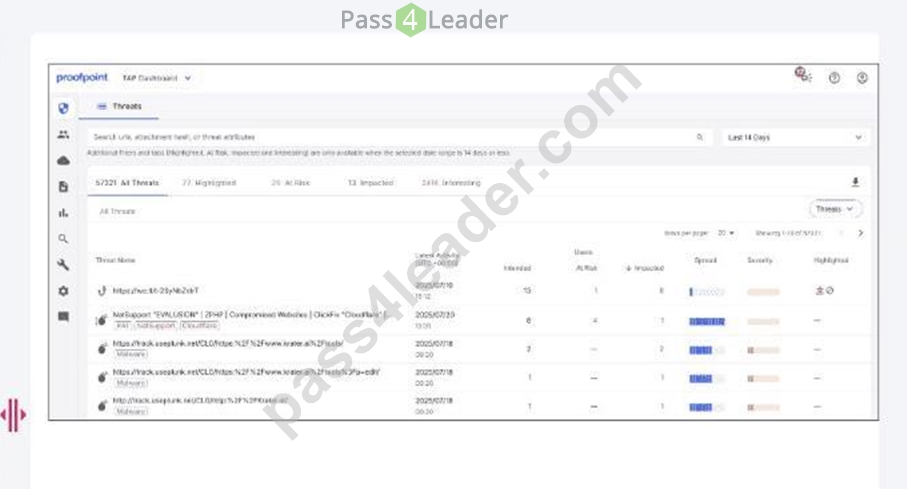
Which column indicates the number of users targeted by a malicious campaign or threat?
- A. Impacted
- B. Highlighted
- C. Intended
- D. At Risk
Answer: C
Explanation:
In TAP threat and campaign views, the columns typically reflect a funnel of exposure and interaction.
"Intended" (B) represents the number of targeted recipients-i.e., how many users the attacker attempted to reach (often including messages that were blocked or not ultimately delivered). "At Risk" usually reflects users who actually received the message (delivered) and were therefore exposed, while "Impacted" reflects users who interacted with the threat (clicks, credential entry, or other measurable engagement depending on the threat type and telemetry). "Highlighted" is a classification/flagging mechanism (not a population count of targets). For IR detection and analysis, "Intended" is crucial for estimating the campaign's scope and potential blast radius at the earliest stage-before you know how many were delivered or clicked. Analysts use Intended to decide whether to escalate, whether to run broad retroactive searches, and whether to apply preventative blocks (domains/URLs) quickly. Then they pivot to At Risk and Impacted to prioritize immediate containment actions for exposed and interacting users.
NEW QUESTION # 49
Where can a user access "Smart Search"? (Select two.)
- A. Protection Server GUI and Email Protection (Cloud) Admin
- B. TAP Dashboard and TRAP Admin Console
- C. Protection Server GUI and Nexus Cloud Risk Explorer
- D. Nexus Cloud Risk Explorer and TAP Dashboard
Answer: A
Explanation:
Smart Search is a message-tracing and investigation capability used to locate and analyze email messages processed by Proofpoint email security components. Practically, responders use it to pivot on sender, recipient, subject, message ID, IPs, URLs, and dispositions to rapidly scope incidents (who received what, what action was taken, whether it was quarantined/rejected/delivered) and to support response actions (block, release, or escalate). In Proofpoint deployments, Smart Search is accessible in the Protection Server administrative interface (on-prem PPS) and in the Email Protection cloud administrative experience (Proofpoint Email Protection / PoD admin), aligning to where message processing and policy decisions are recorded. TAP Dashboard is primarily threat-focused telemetry (URLs, attachments, campaigns, user exposure), while TRAP/Threat Response consoles are centered on post-delivery remediation and orchestration. For IR, knowing the correct consoles matters because message trace data is authoritative for chain-of-events reconstruction: it provides time stamps, policy hits, verdicts, and routing outcomes needed for incident timelines and validation of false positives/negatives. Correct access points ensure analysts can quickly confirm whether the gateway acted as expected and whether any delivered mail requires retroactive remediation.
NEW QUESTION # 50
Refer to Exhibit:
X-Proofpoint-Banner-Trigger: inbound
MIM-version: 1.0
Content-Type: multipart/mixed; boundary="boundary-1698346305"
X-CLX-Shades: MLX
X-Proofpoint-Virus-Version: vendor=baseguard
engine=ICAP:2.0.272,Aquarius:18.0.987,Hydra:6.0.619,FMLib:17.11.176.26 definitions=2023-10-26_22,
2023-10-26_01,2023-05-22_02
X-Proofpoint-Spam-Details: rule=spam policy=default score=89 bulkscore=0 phishscore=0 mlxlogscore=-91 suspectscore=0 malwarescore=0 adultscore=0 spamscore=89 classifier=spam adjust=0 reason=mlx scancount=l engine=8.12.0-2310240000 definitions=main-2310260209 In the process of reviewing a false positive, you see the following email header. What was the reason the message was quarantined by the Proofpoint Protection Server?
- A. The recipient's personal block list forced quarantine of the message.
- B. A content policy rule (DLP/compliance) forced quarantine of the message.
- C. A custom spam rule caused the message to be quarantined.
- D. An anti-virus rule forced the message to be quarantined.
Answer: C
Explanation:
The header contains X-Proofpoint-Spam-Details: rule=spam policy=default ... spamscore=89 ... reason=mlx, which is the Proofpoint spam engine verdict (MLX classifier) and indicates quarantine was driven by the spam policy evaluation, not by anti-virus or a user block list. In Proofpoint PPS/PoD, quarantine decisions frequently include an "X-Proofpoint-*Details" header that records the policy, rule family, and scoring components used to reach the final disposition. Here, the high spamscore=89 is decisive, and there is also an MLX log score entry supporting the ML-based spam classification. Antivirus-related quarantines typically show explicit malware/virus condemnation outcomes (e.g., malware score, "virus" rule, or attachment verdicts), while personal block list actions would be reflected as user-specific allow/block triggers, not the spam classifier rule. For IR triage, this header is the fastest way to validate why a message was quarantined and whether a false positive should be addressed by tuning spam thresholds, allow lists, or MLX-related settings rather than malware policies.
NEW QUESTION # 51
As an information protection security analyst, what should you do to ensure that escalation documentation is up to date?
- A. Wait for official notification of personnel changes from Human Resources to update the escalation documentation.
- B. Only review escalation documentation when there are major incidents and all needed personnel are available for review.
- C. Make sure the escalation documentation is based on department-level contacts and allows you to ignore personnel or role changes.
- D. Initiate updates to escalation documentation when there are personnel or role changes that affect communications paths.
Answer: D
Explanation:
Escalation paths are operational safety rails: they ensure the right stakeholders can be reached quickly under time pressure (e.g., suspected account takeover, executive impersonation, data loss). The correct practice is to update escalation documentation whenever people or roles change in ways that affect communication paths (D). In Proofpoint-centric IR, the "who do we contact" question is time-critical because containment actions may require identity admins (account disable/reset/token revocation), email admins (transport rules, allow
/block changes, TRAP pulls), legal/privacy (breach assessment), and business owners (wire-transfer verification). Waiting for HR (A) introduces delay and gaps; relying only on department-level contacts while
"ignoring" role changes (B) is risky because specific authorities are needed (e.g., the person who can approve emergency mailbox search or enforce MFA). Reviewing only during major incidents (C) fails because the first time you discover stale contacts is the worst time. Best practice is a living escalation matrix tied to on- call rotations, role-based distribution lists, and tested quarterly via tabletop drills, ensuring Proofpoint remediation and comms steps can be executed without bottlenecks.
NEW QUESTION # 52
......
True PPAN01 Exam Extraordinary Practice For the Exam: https://www.pass4leader.com/Proofpoint/PPAN01-exam.html
Get 100% Passing Success With True PPAN01 Exam: https://drive.google.com/open?id=1ugIM1T0eda9z6zJecoaorDWwnhV-U0g6